
Dubai Property Market March 2026: What the Goldman Sachs Data Actually Means
Dubai property market 2026: institutional data, price trends & what Goldman Sachs research reveals and what it means for your portfolio.


There's a message doing the rounds on everywhere right now.
I have seen it forwarded in group chats, repeated in living rooms, and treated as fact in online forums by people who've never closed a deal here. And every time I read it, I have the same thought: whoever wrote that has never looked at an actual transaction. I have spent 15 years in real estate, First in New Delhi, now in Dubai and I have sat across from enough investors to know what panic sounds like. I have also learned that panic and data rarely agree. Over the last two weeks, nearly every client conversation I have had has circled back to three questions: Have the markets dropped by 30%? Should we wait for distress deals? And if not - where do we go from here? So let me answer all three.
The market has corrected. That part is true. But 30% is not a correction, that's a collapse, and that is not what the data shows. What we're actually seeing is a retracement of 6% to 8% on well-located, fundamentally sound products. That's not a crash. That's a market exhaling after a multi-year run.
Here's where the 6-8% comes from. Take Arabian Ranches 3 as a live case study. Certain clusters within that community recorded their first sale in 2022 at AED 770 per sq. ft. A 4-bedroom villa on a 4,197 sq. ft. plot went for AED 3.25 million at launch.
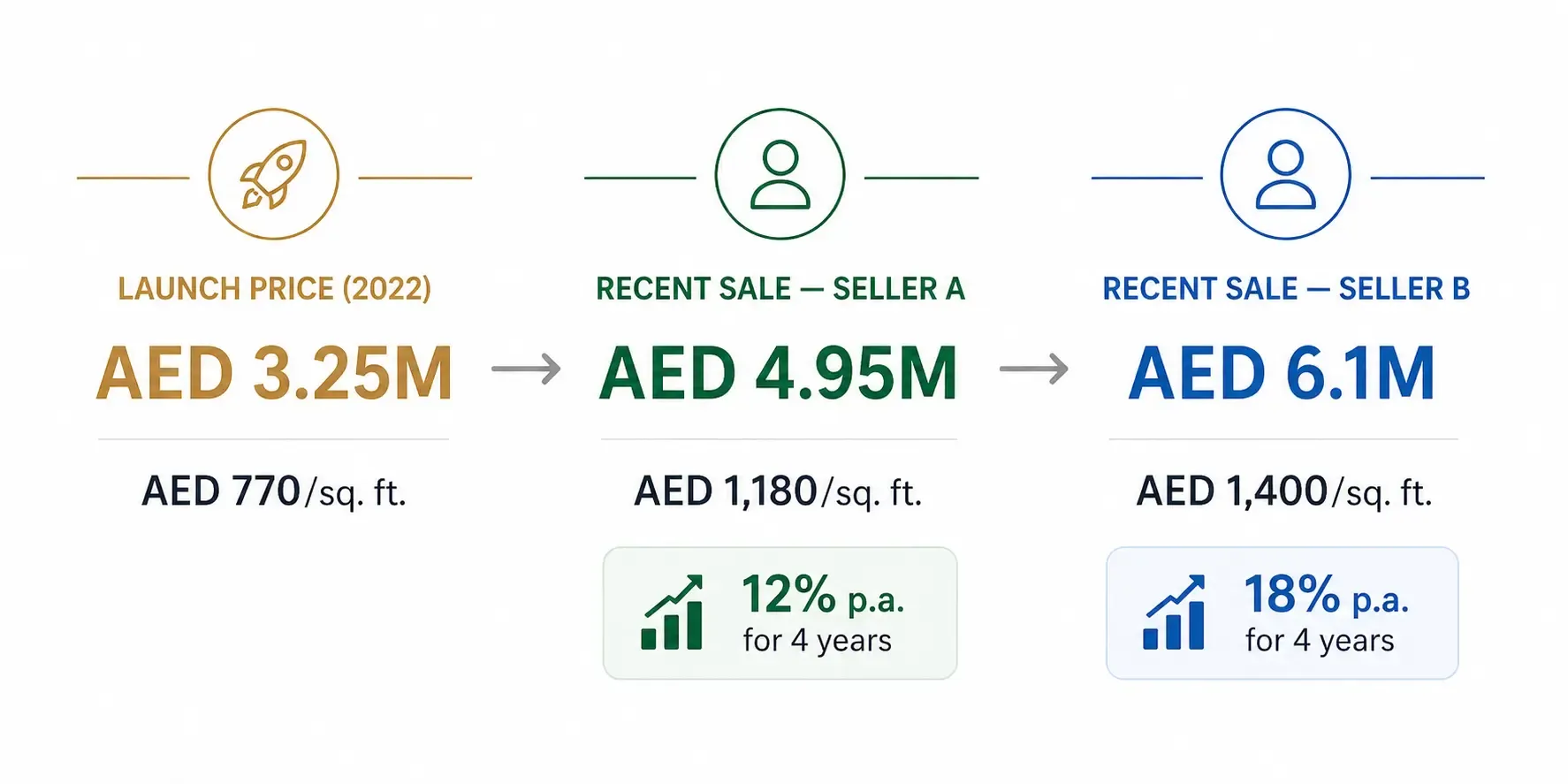
The seller who transacted at AED 4.95 million didn't sell at a loss. They priced in current geopolitical uncertainty and accepted a 12% growth rate rather than hold out for 18%. The buyer agreed. The deal closed.
Before location, let me make the case for the product category itself, because this is where most investors get it wrong. There are approximately 4,299 residential developments across Dubai right now, counting both completed and upcoming inventory. Villas and townhouses account for around 800 of those roughly 18% of total residential supply. Now cross-reference that with transaction data from January 2025 through April 2026: about 246,956 residential units changed hands. Of those, 43,425 were villas and townhouses. Again, 18%. So far, that looks like supply and demand in balance. But here's where it gets interesting.
Villas and townhouses generated AED 217.3 billion of the AED 541.5 billion total residential sales value recorded last year.
18% of the product base is generating 41% of the money. That structural imbalance has held for years and shows no sign of closing. Building more villa communities takes land, planning approval, and construction time. Apartment supply scales faster which is exactly why the apartment segment carries more downside risk during corrections. When the market sneezes, oversupplied segments catch a cold. Undersupplied ones reach for a tissue and get back to work.
Location and developer quality. There's no formula beyond that. A 4,200 sq.ft. villa plot near Downtown, Meydan, Dubai Creek Harbour, Dubai Marina, or Dubai Hills developed by a builder with a verified track record and brand recognition costs between AED 2,400 and AED 2,800 per sq.ft. That puts the total in the AED 10-11 million range. Arabian Ranches offers comparable plot sizes, built by Emaar, one of the UAE's most credibly pedigreed developers at roughly half that price. The gap exists because Arabian Ranches sits outside the perceived prime corridor. But the fundamentals connectivity, community infrastructure, lifestyle design and Emaar's delivery history are intact.
That price gap is the opportunity. It won't stay this wide indefinitely.
If you buy today at AED 5.5 million pricing in current conditions at a 12% annual growth rate the projection is straightforward.
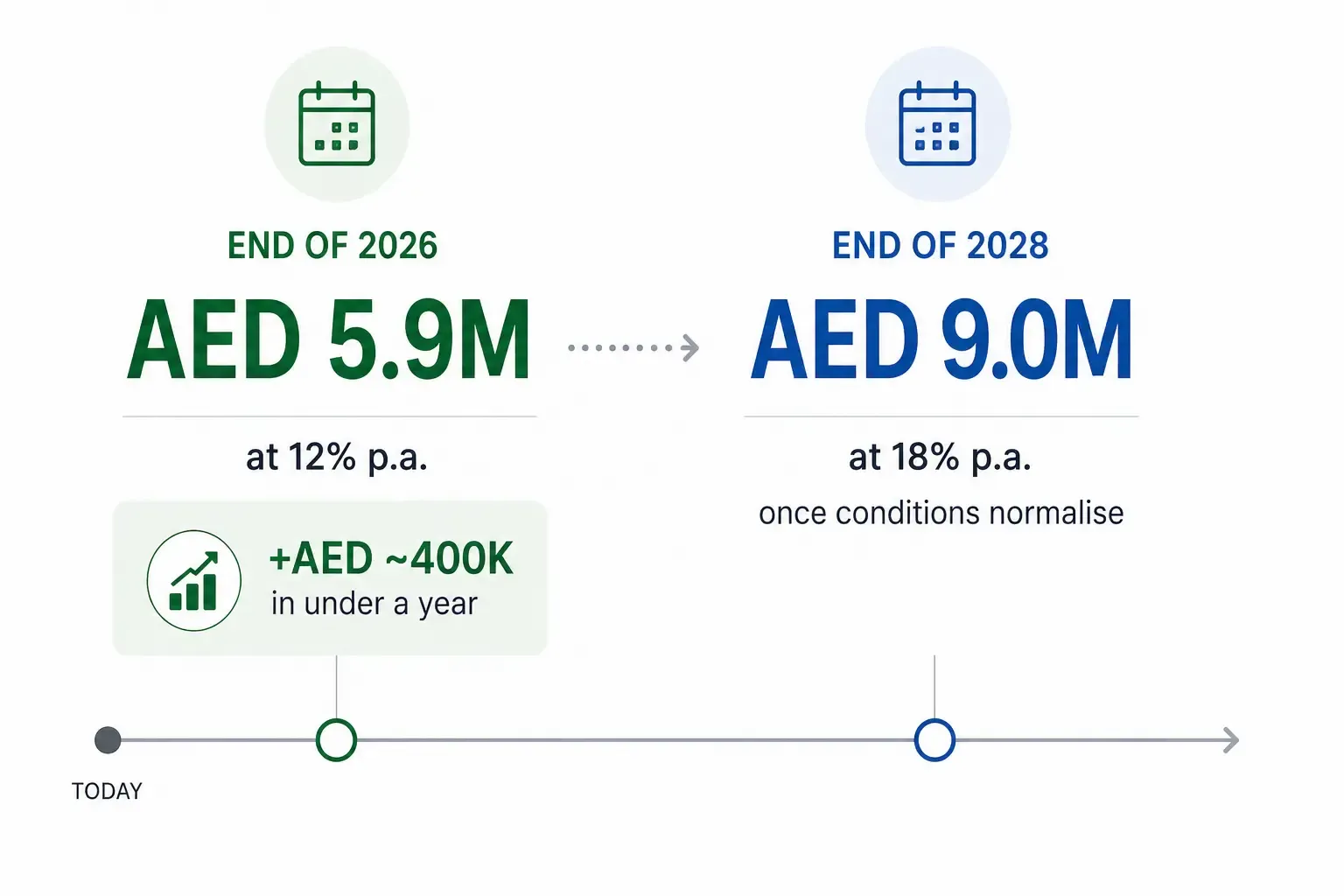
If you're waiting for a 30% crash, think carefully about what would need to be true for that to happen. Developer solvency failures, mass employment loss, a reversal of Dubai's regulatory improvements, and a flight of capital that every current data point contradicts. You'd also need to time the exact bottom and nobody, including me, has ever consistently done that.
The market has already removed short-term speculators. What's left is a cleaner, more fundamentals-driven environment. That's actually a better market to invest in, not a worse one.
The correction happened. Six to eight percent on strong products. More on weaker ones. The headline number 30% isn't real. Villas and townhouses still represent 18% of supply and 41% of revenue. That structural story hasn't changed. Arabian Ranches offers Emaar quality at half the price of prime Dubai. That gap is compression waiting to happen. And the investors who will look back on this period with satisfaction are the ones who understood that entry points don't announce themselves. They're only obvious in hindsight.
Want to review your portfolio position or identify entry points in the current market? Reach out directly. The conversation doesn't cost anything.
Rushil Verma (Senior Real Estate Advisor, Xperience Realty, Dubai) 15 years in residential real estate across New Delhi and Dubai. Specialises in HNI and UHNI portfolio strategy for high-value residential acquisitions across Palm Jumeirah, Downtown, DIFC, Dubai Hills and MBR City.
Dubai property market 2026: institutional data, price trends & what Goldman Sachs research reveals and what it means for your portfolio.

Dubai property in 2026 is driven by institutional data, disciplined supply, investor demand, tax advantages and stable yields. Invest with data, not noise
Dubai's real estate market hit AED 917B in 2025 transactions. Discover why family offices and HNW investors are making Dubai a structural portfolio allocation.