
Dubai Property in 2026: Institutional Data vs Market Narratives

Table of Contents
An investor briefing from inside the market.
You are being told the Dubai property market is in distress. Take a moment and ask yourself a simple question. Who is telling you that?
Because it is not the developer I sat across from in a closed-door briefing this week, in a room with no cameras, one of the largest in the country. It is not the institutional research desks at Knight Frank, CBRE, JLL, or Savills. It is not the Dubai Land Department transaction record. It is not the Henley Private Wealth Migration Dashboard. And it is certainly not the UHNI clients in my book, who are buying calmly while a parallel narrative on social media tells everyone else to panic.
The picture inside the market and the picture being broadcast outside it are not the same picture. This briefing is the inside one, with sources, for investors who allocate capital based on data rather than headlines.
3 Key Insights From a Closed-Door Dubai Developer Briefing
I sat in a closed-door briefing this week with one of Dubai's largest developers. Three observations from that room are worth your attention before any decision you make this quarter.
Why Dubai’s Top Developers Are Refusing Property Discounts in 2026
The market leader is refusing all discounts on primary inventory. Not because they cannot. Because they will not. Discounts on primary product destroy the secondary market and erase the unrealised gains of every existing owner in their communities. The reason your Dubai asset is still holding its valuation in 2026 is precisely because the largest developer is holding the line.
Private developers offering ten percent off, headline reductions, surprise payment-plan sweeteners, or quiet markdowns are not being generous. They are revealing the condition of their balance sheet. Read the action, not the marketing.
Dubai’s Real Estate Supply Strategy Explained
Five to six finished projects are sitting unlaunched, deliberately. The plan is eight to ten controlled launches across the rest of 2026, paced to demand recovery rather than supply pressure. JLL's Dubai Real Estate Market Overview has noted measured launch volumes by Tier 1 developers consistent with this approach.
This matters because the difference between a market in distress and a market in discipline is what they do with finished inventory. A market in distress dumps it to raise liquidity. Dubai did that in 2020. A disciplined market leader withholds it to protect price. That is what is happening in 2026. The first is a stress event. The second is a managed market. They look nothing alike when you read the actions.
How Dubai’s Leading Developers Are Funding Construction Without Liquidity Pressure
In 2020, the same developer was selling existing finished assets to raise emergency liquidity. In 2026, construction across every flagship community is being funded from balance sheet. Cranes are moving on schedule. Handovers are tracking. If you are buying off-plan properties from a Tier 1 developer right now, the delivery risk is materially lower than it was five years ago, and materially lower than the delivery risk attached to private developers who depend on launch revenue to fund construction.
5 Institutional Data Points Every Dubai Property Investor Should Know
Insider observations matter. Institutional data matters more. Here is the comparative picture, with citations, because no opinion replaces a source.
- As per Knight Frank's Dubai Residential Review and CBRE's UAE Real Estate Market Outlook, prime Dubai apartment yields remain in the range of 5.0 to 5.5 percent net of expenses.
- Per Savills and Knight Frank London, prime central London yields sit at 2.5 to 3.5 percent gross.
- The UAE applies a four percent transfer fee through the Dubai Land Department and zero personal income tax on rental income, in line with UAE Ministry of Finance policy.
- The United Kingdom taxes rental income at marginal rates of up to 45 percent under HMRC bands, with capital gains exposure on disposal and inheritance tax on transfer.
- Singapore applies Additional Buyer's Stamp Duty of up to 60 percent on foreign residential buyers, per the Inland Revenue Authority of Singapore.
The yield gap between Dubai and these gateway cities is not a cyclical rebalancing. It is a structural feature of the UAE tax and regulatory framework. It does not close when a Western city has a strong year. It is permanent unless the underlying tax policy of those jurisdictions changes, which is not happening.
Dubai Land Department Data Reveals Where Buyer Demand Is Coming From
Dubai Land Department transaction data confirms Indian nationals as the largest single foreign buyer cohort, at 40 to 45 percent of foreign residential transactions, followed by Pakistani, Chinese, and United Kingdom nationals.
The Henley Private Wealth Migration Dashboard places the UAE as the world's top destination for millionaire relocation, a position the country has held for three consecutive years through the most recent 2025 report.
This is a market quietly absorbing global private wealth, not retreating from it. The online algorithm is telling you to panic. The institutional data is telling you the opposite.
Dubai Property vs Stocks, Gold, and Bonds in 2026
Cash sitting in your bank account is losing real purchasing power against inflation every month it sits there. Equities remain volatile. Gold and silver are oscillating. Bonds at current yields, after tax, barely beat inflation in most jurisdictions.
Dubai prime real estate, at 5.5 percent net yield, zero income tax, and four percent total transfer cost, in a Aa2 sovereign environment, continues to do exactly what a wealth preservation asset is designed to do for HNI and UHNI capital.
The clients I am closing this quarter are not impulsive. They are calm, informed, and they understand the holding period. They are not asking whether to buy. They are asking what to buy and how to structure it.
Dubai Real Estate 2026: The Institutional Verdict
You can wait for clarity. You can wait for the algorithm to switch from bearish to bullish. You can wait for an influencer with no skin in the game to declare the bottom. None of those things are signals. They are noise.Or you can read what the institutional data is already showing you. The yield gap is structural. The supply is disciplined. The buyers with the most capital have already decided.
If you are sitting on cash and waiting for permission, this is the closest thing to permission that the data is going to give you. If you would like a confidential portfolio review under current market conditions, or access to the off-market opportunities I am placing capital into for HNI clients right now, message me directly.
Archana Bhan is Associate Director and Portfolio Manager at Xperience Realty, Dubai. RERA Certified. Eleven years of UAE real estate experience, working exclusively with HNI and UHNI clients on off-plan and ready acquisitions, portfolio construction, and long-term wealth preservation strategies.
Read More

Bvlgari, One Za'abeel, Dorchester - Why Dubai Is Becoming the Global Capital of Branded Living

JP Morgan's $20 Billion Gulf Bet: What It Means for Dubai Property Investors
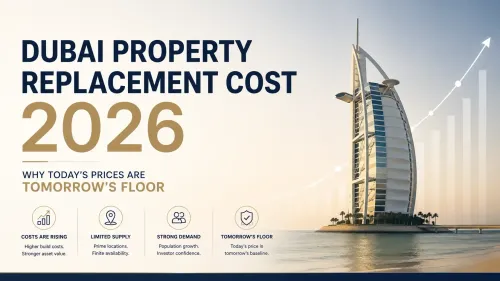
Dubai Property Replacement Cost 2026: Why Today's Prices Are Tomorrow's Floor