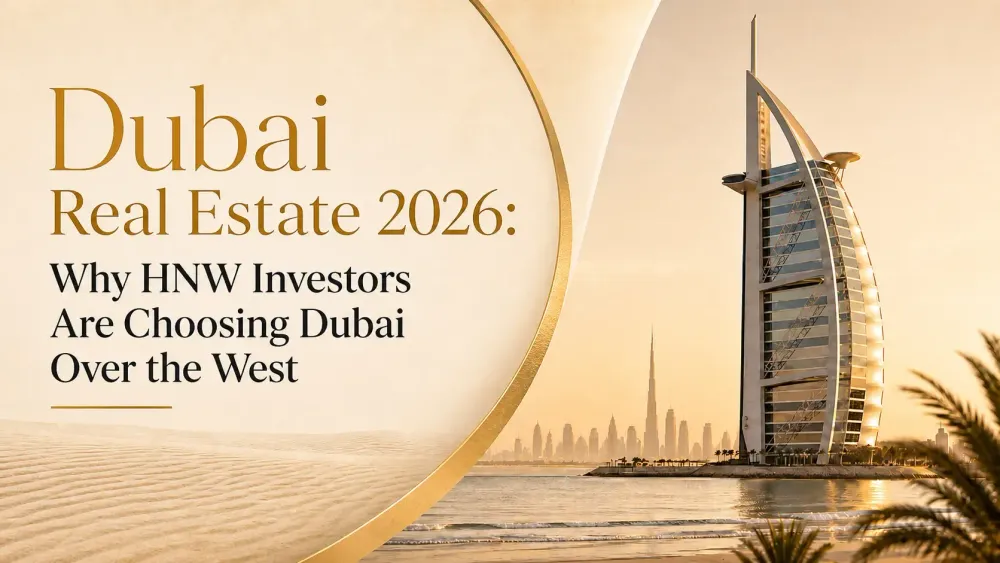
Dubai Real Estate 2026: Why HNW Capital Is Relocating from the West

Table of Contents
Analyzing a major shift in jurisdictional risk and its impact on capital allocation in Dubai real estate.
Key Takeaways
- In 2025, Dubai’s real estate market recorded AED 917 billion in total transactions, including AED 682.5 billion in sales across about 270,000 deals, according to Dubai Land Department data.
- In 2025, Henley & Partners projected 142,000 global millionaire relocations, with the UAE gaining about +9,800 and the UK losing around -16,500.
- Knight Frank's 2025 residential data shows AED 544.2 billion in sales across 205,400 deals, with prime groups driving surpass.
- Dubai has shifted from a short-term trading market to a structural capital allocation hub, supported by tax advantages, residency incentives, and perceived jurisdictional stability.
- Knight Frank expects 2026 growth of ~3% in prime segments and ~1% in mainstream areas, pointing to increasing market divergence rather than uniform appreciation.
1. The question most investors are still getting wrong
Dubai real estate is often discussed in terms of interim patterns, but it is increasingly viewed as a lasting structural investment. Since 2022, its growth has been driven by geopolitical shifts and capital moving toward neutral jurisdictions, strengthening Dubai’s role as a global investment hub rather than just a cyclical market.
2. Return is no longer the first-order variable
Global investing is shifting away from relying on stable rules-based systems, as rising government intervention (sanctions, capital controls, tax and regulatory changes) makes capital less obvious.
Investors are now prioritizing safety factors - like mobility, legal protection, and currency stability - alongside returns, which is helping redirect global capital toward jurisdictions such as Dubai.
3. The data: what wealth migration truly indicates
The Henley Private Wealth Migration Report 2025 reports record levels of millionaire migration, with around 142,000 moving in 2025 and a projected 165,000 in 2026, with the UAE, USA, Italy, Switzerland, and Saudi Arabia among the top destinations (Report)
Investment migration allows capital to move between jurisdictions. A key example is the UAE’s Golden Visa program, introduced in 2019 and expanded in 2022 with long-term residency options tied to real estate and business investment, which has driven inflows reported by Henley. While exact figures are debated and seen as directional rather than precise, multiple independent sources (including Henley, New World Wealth, UBS, and Knight Frank) show the same trend. Overall, this is less about traditional migration and more about capital relocating from less trusted regions to more trusted ones.
4. Dubai's actual function: capital routing infrastructure
Labeling Dubai as a “safe haven” is misleading because safe havens are passive stores of value, whereas Dubai operates as an active hub for capital flows, making it fundamentally different.
Flow infrastructure enables capital to enter a jurisdiction quickly, allocate across multiple asset classes, earn returns while invested, and exit with minimal friction or tax penalties.
The benefits debated mainly apply to individuals, as corporate structures in the UAE are subject to a 9% tax and require proper tax planning. Dubai may not lead to any single metric versus other global financial hubs, but its strength lies in the combined package of features, which matters more to refined investors than any single advantage.
5. Real estate is the absorption mechanism, not the attraction
Dubai real estate in 2025 functions as a gateway for capital mobility, linking property ownership with residency, banking access, and long-term planning. The market also reached record transaction levels of AED 917 billion, with strong residential growth and sustained momentum through Q4 and December.
6. Engaging the bear case
Fitch expects Dubai home prices may fall about 15% in 2025-26 due to rising supply outpacing demand. But the outlook is mixed with delays in construction. Stronger population growth, and steady demand suggest a limited, uneven correction rather than a broad market collapse.
7. Off-plan as parallel credit infrastructure
Off-plan property deals account for about 60–65% of Dubai’s 2025 property volume (Knight Frank and Cushman & Wakefield), reflecting a structural system rather than notion. Developers act like lenders by offering 5-20% down payments and 3-7 year interest-free plans without bank loans, effectively creating a “shadow credit system.” This shifts risk to developer execution, so returns depend more on strong developers like Emaar, DAMAC, Sobha, Meraas, Nakheel, and Aldar than just property location, despite some regulatory protections.
8. The reprice has already happened
Dubai has shifted from a short-term trading market to a long-term capital allocation hub. With the repricing phase ending, the focus is now on absorbing new supply and distinguishing between institutional-grade assets and retail developments with different return profiles. Overall, investment in Dubai is increasingly viewed as a strategic, long-term portfolio allocation rather than a timing-based trade.
About the Series
“The Dubai Allocation” is a 20-part research series by Xperience Realty (May 2026) that frames Dubai real estate as a strategic capital allocation decision rather than a transactional market view, aimed at family offices and global investors, with the full report available on xrealty.ae.
About the Author
Sushmita Golder (Senior Property Consultant) at Xperience Realty in Dubai, advising HNW and family office clients on real estate allocations, with prior experience at PwC, Accenture, Unilever, and TATA Steel, and credentials including an MBA from IIM Kozhikode and KHDA certification.
Frequently Asked Questions
Dubai real estate in 2026 remains strong but increasingly split, with higher growth in prime assets (~3%) compared to mainstream apartments (~1%), making asset selection more important than timing.
The UK’s abolition of the non-domicile regime in April 2025 led to a projected outflow of 16,500 millionaires, with Dubai attracting many due to zero income tax, residency incentives, and stability.
In 2025, Dubai’s real estate market recorded around AED 917 billion in total transactions from roughly 270,000 deals, with sales reaching AED 682.5 billion, a 30.6% increase from 2024.
The Dubai Golden Visa grants 10-year renewable residency for a minimum AED 2 million property investment, is self-sponsored with no minimum stay requirement, and allows sponsorship of family members and domestic staff.
Dubai stands out as a distinct alternative to London or Singapore, combining zero income, capital gains, and inheritance taxes with freehold ownership, fast property-linked residency, and unrestricted currency movement.
Read More
Bvlgari, One Za'abeel, Dorchester - Why Dubai Is Becoming the Global Capital of Branded Living
JP Morgan's $20 Billion Gulf Bet: What It Means for Dubai Property Investors
Dubai Property Replacement Cost 2026: Why Today's Prices Are Tomorrow's Floor