
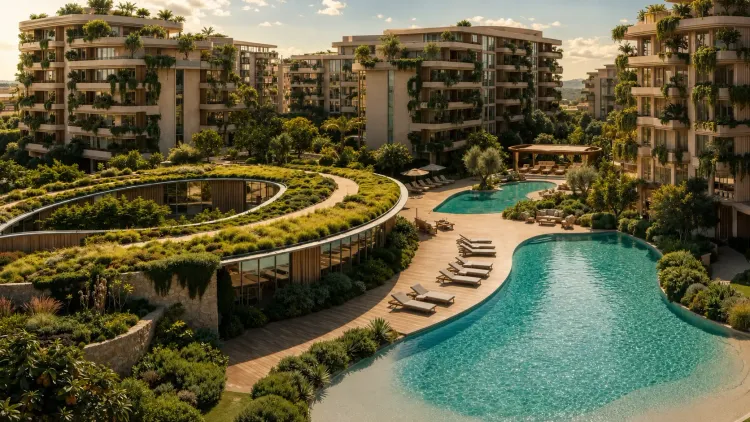
Arancia at The Yards: Beyond’s First Move Inland
Arancia The Yards by Beyond launches in City of Arabia from AED 1.1M, with a 40/60 plan and Q1 2029 handover. Explore prices and investment potential.
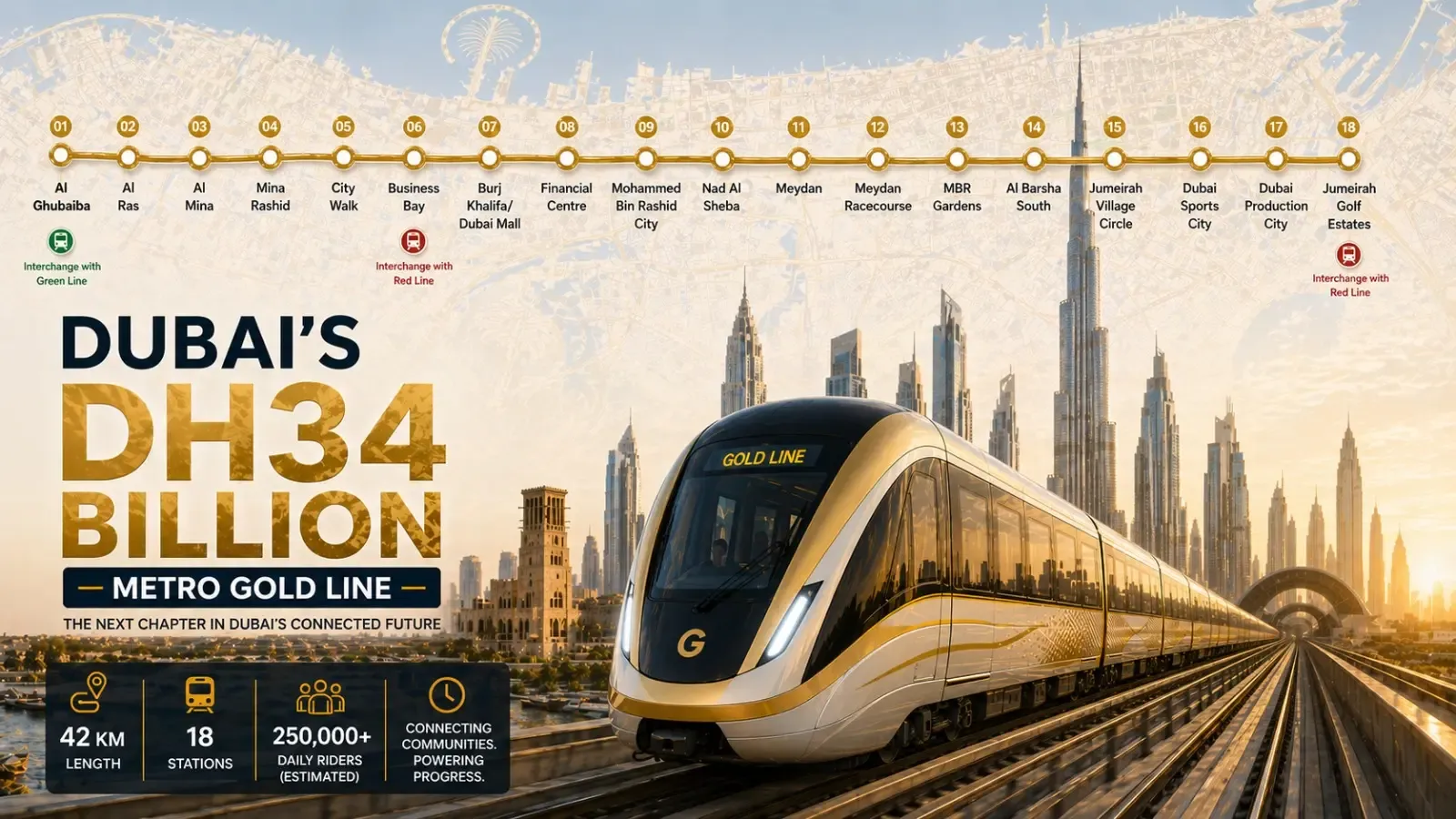
Dubai this week announced its largest transport project to date: a 42-kilometre, fully underground metro line with 18 stations, a Dh34 billion budget, and a target completion date of 9 September 2032. For owners, buyers, and investors, the headline is less important than the map. Where Dubai is willing to spend this kind of capital tells you where the city expects demand, population, and values to concentrate for the next decade.
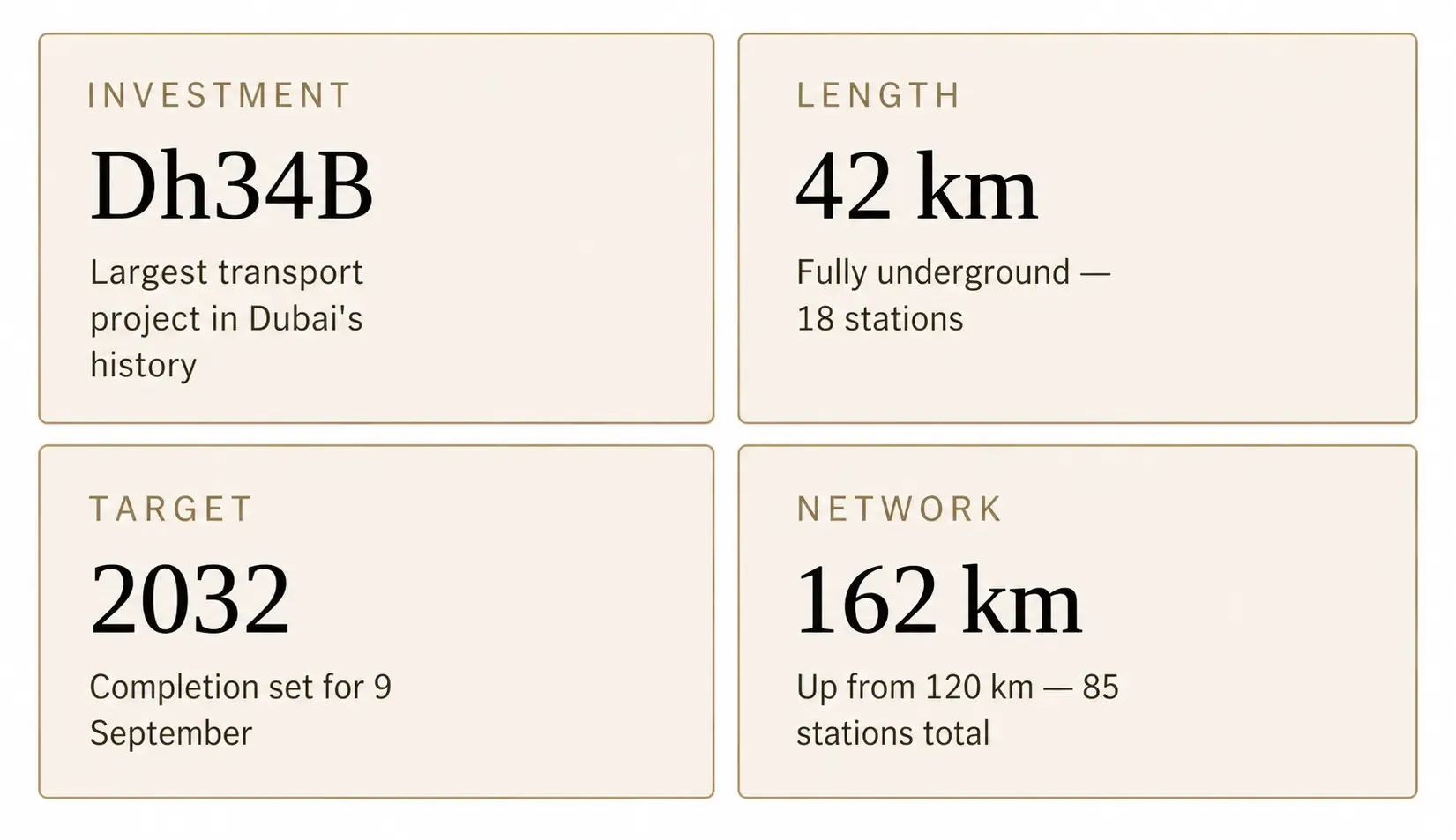
The Gold Line becomes Dubai's fourth metro line, after the Red, the Green, and the Blue Line still under construction. When complete, the network grows from 120 to 162 kilometres, and from 67 to 85 stations. The scale is meaningful, but what matters more is the route and the communities it opens up.
The Gold Line runs from Al Ghubaiba in old Dubai to Jumeirah Golf Estates. Along the way it passes through or near Mina Rashid, Bur Dubai, Al Satwa, City Walk, Business Bay, Mohammed Bin Rashid City, Nad Al Sheba, Meydan, Al Barsha South, and Jumeirah Village Circle. Secondary catchment extends to Dubai Hills Estate, Dubai Sports City, and Arabian Ranches.
It intersects the Green Line at Al Ghubaiba and the Red Line at two points: Business Bay and Jumeirah Golf Estates. Two stations, Meydan and Jumeirah Golf Estates, connect to Etihad Rail, giving residents a direct rail link to Abu Dhabi and other parts of the UAE. This is the first Dubai metro line to be built entirely underground, with tunnelling roughly twice the length of the city's existing metro tunnels combined.
The single most actionable number from this announcement is the RTA's own estimate: property values within the Gold Line catchment could rise by up to 20 per cent. That figure is not speculative. It is drawn from what actually happened along the Red and Green Lines once operational.
Mohammed Bin Rashid City, Meydan, Nad Al Sheba, and Jumeirah Village Circle are the clearest examples. These are high-growth neighbourhoods that, until now, have had no metro access. JVC in particular has been historically discounted on a per-square-foot basis relative to comparable communities partly because of its car-dependence. A station changes the investment profile of every building inside a reasonable walk of it. Al Barsha South, between Dubai Hills and Dubai Sports City, and the Sobha and Meraas pockets within MBR City, gain access to a buyer and tenant pool they couldn't previously reach.
For older, established areas the effect is different but still material. Business Bay already has Red Line access; the Gold Line adds a second interchange, which is what creates long-term rental stickiness.Tenants renew where the commute gets easier, not harder.
Dubai has crossed 3.9 million residents and continues to grow at a pace most mature cities cannot match. RTA modelling expects the Gold Line to carry 465,000 passengers a day by 2040 and take more than 40 million car trips off the road each year. Those numbers only hold if the city keeps compounding on population, tourism, and economic activity, which is the thesis every major infrastructure commitment is built on.
Metro adjacency in Dubai is not a given the way it is in London or New York. The city was designed around cars, and most premium communities are still defined by road access, not rail. That is precisely why a station carries a premium here that it wouldn't elsewhere. Each new station effectively creates its own micro-market.
Three points are worth internalising before acting on this news.
Announcement and completion are separate events. The runway is six and a half years. Properties along the corridor will not reprice in one move, they will reprice in stages. An initial announcement bump. A quieter construction phase. A second, more durable repricing once stations open. Each phase attracts a different buyer, and the entry point you choose determines the return profile.
Micro-location matters more than community. A villa in MBR City that is a ten-minute drive from a Gold Line station is not the same asset as one that is a two-minute walk. Over the next 12 to 18 months, pricing inside the same community will start to separate by distance to station. The closer, the more defensive.
Read the Gold Line alongside the Blue Line. The Blue Line opens in 2029 and connects Dubai Creek Harbour, Ras Al Khor, International City, Silicon Oasis, and Academic City. Combined with the Gold Line, Dubai's rail network by 2032 will cover most of the residential corridors that have absorbed the last decade of population growth. The map in 2032 is a different map from the one we are buying on today.
Dubai is not allocating Dh34 billion in isolation. The Gold Line sits inside a coordinated programme that includes Etihad Rail, the Blue Line, Al Maktoum International Airport expansion and the 2040 Urban Master Plan. Each project assumes the others. Together, they tell you that the city is building the capacity to grow not hoping it happens.
The right decision is not to buy something simply because it sits on the Gold Line. The right decision is to factor the Gold Line into a broader view of location, timing, and 2032 land-use. Investors who ignore infrastructure announcements miss windows to reposition. Investors who read the map early tend to hold better assets when the cycle matures.
Arancia The Yards by Beyond launches in City of Arabia from AED 1.1M, with a 40/60 plan and Q1 2029 handover. Explore prices and investment potential.
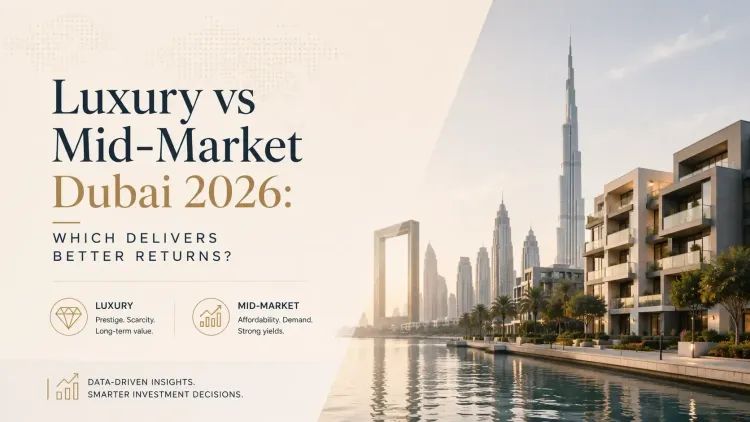
Dubai property investment 2026: luxury vs mid market analysis covering rental yields, capital appreciation, villa supply, and risk-adjusted returns for HNW investors.
Dubai’s property market continues its upward trajectory, crossing AED 252 billion in Q1 2026 transactions. Explore the latest market insights and opportunities with Xperience Realty.