
Dubai Property Market March 2026: What the Goldman Sachs Data Actually Means

Table of Contents
What actually happened to the Dubai market through Q1 2026, why the headlines got it wrong, and how sophisticated capital is positioning inside the disconnect between volume and price.
Key Takeaways
- Goldman Sachs reported Dubai real estate transaction values fell 51 percent month-on-month and 37 percent year-on-year in the first half of March 2026 during the regional conflict period.
- Despite the volume collapse, median apartment prices were down only 3 percent year-on-year, and villa prices were up 16 percent year-on-year through the same window.
- The volume collapse reflected the marginal buyer pausing while the core buyer continued transacting, producing a temporary disconnect between sentiment and structural demand.
- Knight Frank's Q4 2025 data showed Dubai's full-year residential sales reached AED 544.2 billion across 205,400 transactions, an 18 percent volume increase year-on-year.
- The Q1 2026 dislocation produced a roughly eight-week conviction premium window that closed quickly after the April 2026 ceasefire framework.
1. The contradiction you can feel if you are actually transacting
-
Ask most investors how Dubai feels through Q1 2026 and you will hear a version of the same answer. Things have slowed. Buyers are negotiating harder. People are waiting. The market feels softer.
-
Now put that next to what the data actually shows. Goldman Sachs reported through the conflict period in March that transaction values dropped roughly 51% month-on-month in the first half of March and 37% year-on-year over the first 12 days. Volumes collapsed. But median apartment prices were down only 3% year-on-year through the same window, and villa prices were up 16% year-on-year despite a 2% monthly dip. The volume collapse and the price collapse were not the same event. They were not even close.
-
Most analysis tries to resolve the contradiction by siding with one source. The sentiment crowd says the data is lagging and a correction is coming. The data crowd says sentiment is wrong and everything is fine. Both readings miss the actual point. When sentiment and data disagree, the right move is not to pick a side but to figure out what each one is measuring. Sentiment is measuring the hesitation of the marginal buyer. The data is measuring the conviction of the core buyer. When these signals diverge, you are not looking at a weak market. You are looking at a mispriced one.
2. Markets are priced by the marginal buyer
-
This is the single most important concept in understanding what happened through the conflict period. A real estate market does not clear at the average buyer's willingness to pay. It clears at the marginal buyer's, the one whose behaviour sets the price for the next transaction.
-
In 2023 and early 2024, the marginal buyer was typically yield-chasing, fast-moving, and operating on a short horizon. Many were post-pandemic Russian capital arrivals, Indian and Pakistani buyers compressing pre-LRS decisions, opportunistic flippers riding the price run-up. They were not price-sensitive. They were speed-sensitive.
-
Through the March 2026 conflict period the marginal buyer changed. Regional geopolitical tension, an apartment supply wave with Cushman & Wakefield reporting around 28,100 residential units delivered in the first three quarters of 2025 alone, and a natural cooling after years of double-digit appreciation pushed the marginal buyer into a different mode. Slower. More selective. More willing to walk away.
-
The core buyer did not change. HNWI migration into the UAE continues at the pace Henley projected, a record 9,800 net inflow in 2025 and 165,000 millionaires globally projected to relocate in 2026. Goldman's data through the worst weeks of March showed villa prices up 16% year-on-year, evidence that the core villa buyer was still transacting at premium. The cash-buyer share of Dubai overall remains in the high seventies, which is not the behaviour of a speculative market being unwound. The marginal buyer is negotiating harder. The core buyer is still closing. That is the structure of the current disconnect, and it is the structure of an opportunity.
3. The conviction premium
-
When prices are being set by low conviction buyers while high-conviction capital continues to transact, the high conviction capital enters at a structural discount. Not a discount to intrinsic value. A discount to what the market will re-price to once the marginal buyer recovers confidence. I call this the conviction premium.
-
It rarely shows up as a headline discount. It shows up in softer negotiation terms, more flexible developer payment plans, secondary market sellers accepting offers they would have rejected three months earlier, and off-plan allocations being offered with quiet sweeteners that were not available at launch.
-
Where the premium was available through Q1 2026 based on observable deal flow across the broker community: well-located secondary stock in Business Bay where 2023 buyers accepted offers within 3-5% of asking; select Dubai Creek Harbour inventory from Emaar where post-handover payment plan extensions were offered that were not on the table six months earlier; Emaar Beachfront resale where bid-ask spreads widened into a window that closed once sentiment recovered; certain Meydan and Business Bay off-plan launches where second-tier developers offered 60/40 and 50/50 post-handover plans to maintain absorption velocity. These are not distressed opportunities. They are the same assets, priced by a more hesitant counterparty.
4. Liquidity and velocity are not the same thing
-
Most investors collapse two different concepts into one. Liquidity is whether you can transact. Velocity is how quickly decisions are being made. Dubai through Q1 2026 had strong liquidity and slower velocity. That combination is almost always misread.
-
Goldman's data showed transaction values down 51% month-on-month while prices held within 3% year-on-year. That is a textbook liquidity-intact, velocity-down pattern. Buyers did not disappear, they took longer to decide and concentrated into higher-ticket transactions. Off-plan properties share strengthened through the period rather than weakening, which is the opposite of what defensive rotation looks like in a liquidity collapse.
-
Compare to a genuine liquidity event. In a liquidity collapse, transaction value collapses alongside volume. Bids disappear from stacks. Off-plan share falls as buyers rotate into safer ready inventory. Spreads widen until sellers pull listings. None of that happened. When velocity drops but liquidity holds, negotiation power temporarily shifts to the buyer. That is a buying window, correctly understood, not a market warning. The mistake retail commentary makes is pattern-matching slower transactions to 2008. The 2008 slowdown was a credit collapse, specific, structural, visible in bank balance sheets. The 2026 slowdown is geopolitical headline risk plus supply-wave psychology plus normal post-rally consolidation. These are not the same animal.
5. Sentiment lag is a feature, not noise
Sentiment lags structural shifts reliably.
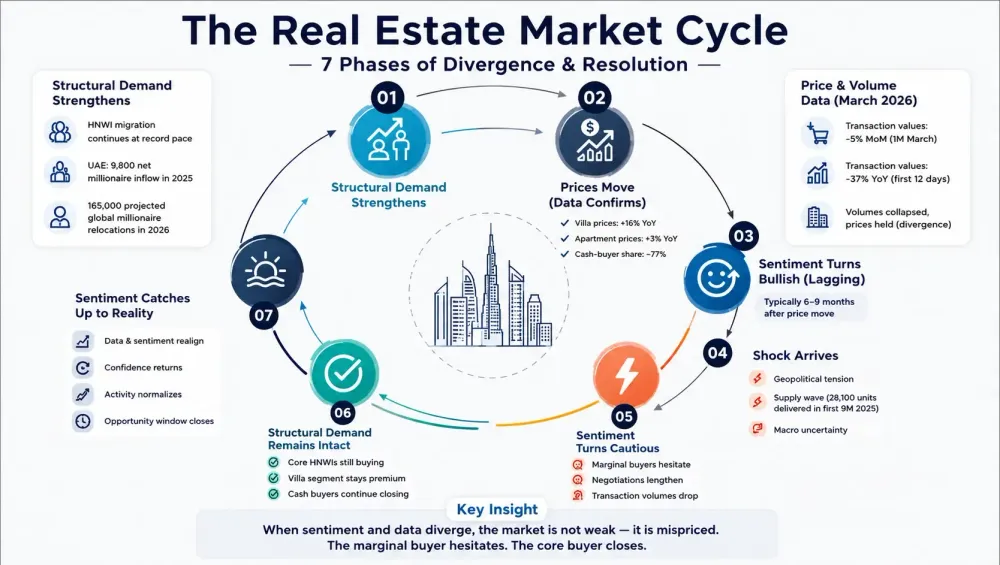
Dubai through Q2 2026 is sitting in phase six. Structural demand is holding. Sentiment is cautious. HNWI migration is accelerating, not decelerating, with Henley projecting 165,000 millionaire relocations globally in 2026. The UK non-dom exodus has another three to five years embedded in it. The post-war jurisdictional repricing has not reversed. Regional geopolitical tension, while real, has historically been a trigger for Dubai inflows rather than an outflow event, because Dubai sits on the safe side of every regional instability equation. The buyers who understand phase timing move during phase six. The buyers who wait for the all-clear are buying in phase seven at phase seven prices.
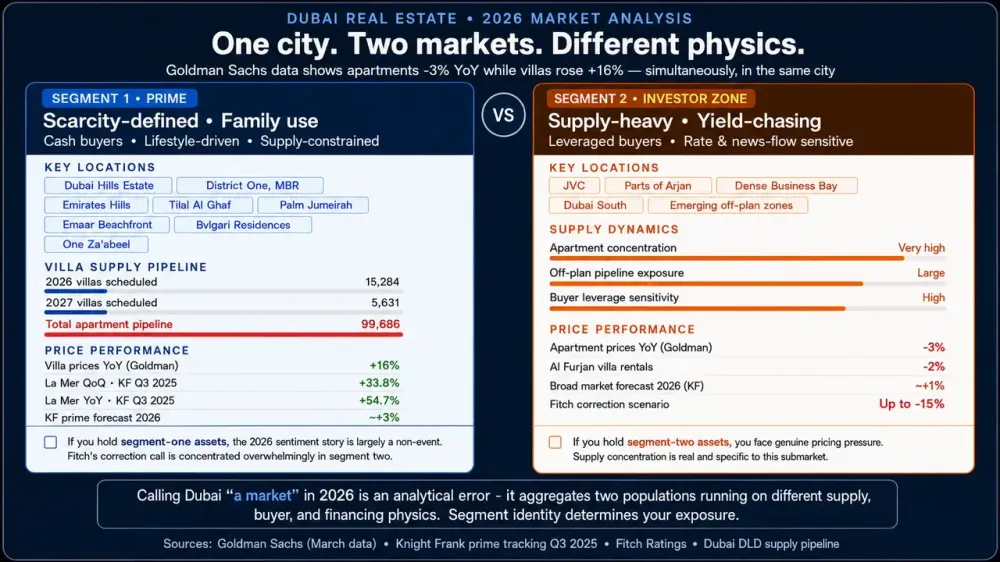
6. The bifurcation is sharper than most people realise
Calling Dubai "a market" in 2026 is an analytical error. It is two markets running on different physics. Segment one is prime, scarcity-defined, family-oriented product.
7. What Q1 2026 actually looked like in the market
Consider a representative Singapore-based family office principal, Indian-origin by background, evaluating Dubai allocations through late 2024 into Q1 2026. Initial mandate around AED 40m across two to three positions, preference for prime villa stock and a secondary interest in branded residence product. The decision sequence is worth working through because it shows what conviction-premium deployment actually looks like in practice.
When the conflict tension escalates in late February 2026, the internal committee pauses the decision. The original broker stops returning calls. The family's advisor flags regional risk and suggests postponing to Q3 2026. The principal, having lived through the 2013 taper tantrum and the 2015 oil correction, reads it differently. The family's view: if structural inflows continued during a regional shock, that was more informative than if they continued during calm. They move when Goldman's first-half-of-March data confirms villa prices up 16% YoY through the tension window.
Final deployment. A four-bedroom villa in Tilal Al Ghaf, secondary market, acquired at approximately 6% below January asking the seller for absorbing transfer costs. An Emaar Beachfront three-bedroom on a restructured payment plan with a 50% post-handover tail not in the published schedule. Total deployment around AED 38m. Within weeks of the April ceasefire framework, the comparable Tilal Al Ghaf inventory was listed at higher prices. The window closed that fast. This is the kind of execution sophisticated capital actually delivers during sentiment-driven dislocations.
This is what the conviction premium looks like in practice. Not a dramatic discount. 4-8% pricing, plus better terms, plus faster execution. Across a AED 38m ticket, that window was worth several million dirhams. For a buyer waiting for the all-clear, it is invisible, because it closes before the all-clear arrives.
8. What to expect through the rest of 2026
The sentiment-data gap will close, and it will close upward rather than downward. The structural drivers, HNWI migration, jurisdictional arbitrage, Golden Visa flows, operating-company relocations, have not reversed. What changes is the sentiment side, which typically requires two to three quarters from the triggering shock to recalibrate.
Segment-two apartment pressures will become more pronounced before it eases. The 2026 delivery wave is now arriving and will continue through year-end. Submarkets most exposed (JVC, parts of Business Bay, certain Dubai South clusters) will absorb rental and resale pressure through the second half of 2026 and into 2027. This is cluster-specific, not market-wide. The bifurcation will widen further. Villa supply is structurally limited through 2027. Prime waterfront inventory is largely spoken for at the developer level. The conviction premium opportunity is concentrated where core demand is least elastic to short-term sentiment. Dubai through 2026 is not defined by slowdown. It is defined by a temporary disconnect between how the market feels and how it functions. Markets do not misprice themselves when they are weak. They misprice when they are misunderstood.
Frequently Asked Questions
No. Goldman Sachs noted that transaction volumes fell sharply-about 51% month-on-month in early March 2026-as regional tensions spooked activity. But prices barely moved: apartments were down just around 3% year-on-year, while villas were still up about 16%. In other words, it was a breakdown in pricing.
-
The slowdown came from geopolitical tension in Feb-March 2026, which briefly cooled transactions as buyers paused.
-
Once the ceasefire framework was reached in April, confidence returned and activity started picking up again.
-
Villa prices were up about 16% year-on-year through March 2026 mainly because supply stayed tight - most owners chose not to sell during the uncertainty.
-
The few who did sell were often motivated but still achieved strong prices, supported by cash buyers who weren’t heavily affected by market conditions.
In Dubai, sentiment usually reacts slower than underlying demand.
During events like COVID in 2020, the 2022 geopolitical shock, and the March 2026 tensions, transaction volumes dropped, but prices didn’t fall in line with the panic.
In each case, those who waited for “calm” often ended up missing the early part of the recovery.
The conviction premium is the advantage patient buyers get when they invest during quiet, uncertain periods.
It usually isn’t big price drops, but small gains in the deal-better pricing, flexible payment terms, or reduced fees-typically adding up to around 4-9% better overall value.
Read More

Bvlgari, One Za'abeel, Dorchester - Why Dubai Is Becoming the Global Capital of Branded Living

JP Morgan's $20 Billion Gulf Bet: What It Means for Dubai Property Investors
Dubai Property Replacement Cost 2026: Why Today's Prices Are Tomorrow's Floor