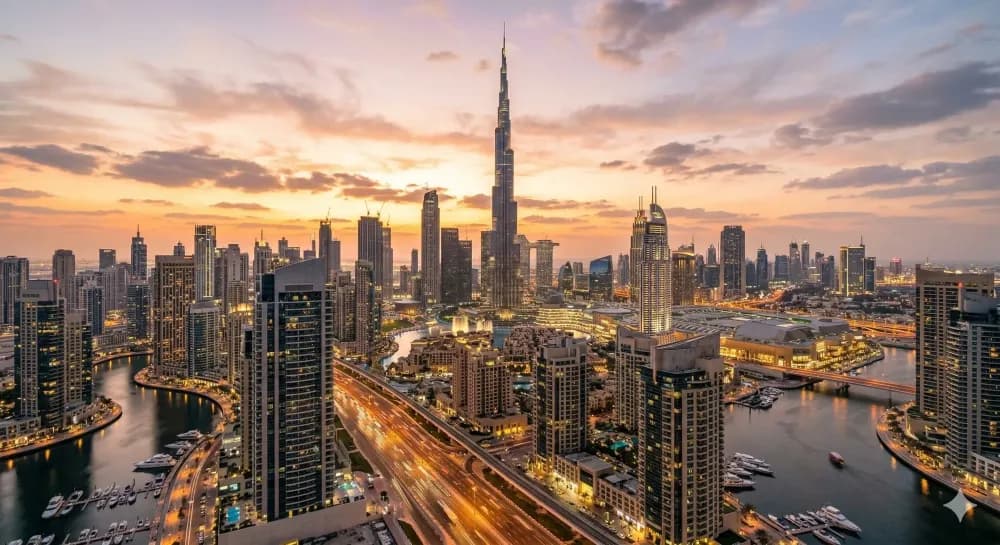
Why Dubai Is One of the World's Top Property Markets in 2026?

Table of Contents
Dubai's property market opened 2026 the way it closed 2025 with records. In Q1 2026, the Dubai Land Department confirmed AED 252 billion in total real estate transactions across 60,303 deals, a 31% year-on-year increase in value. January 2026 alone recorded the highest single month in Dubai real estate history. The question worth asking is not whether the market is performing. It is why and whether the foundations will hold.
The current picture: what Q1 2026 tells us
The most recent data available as of April 16, 2026 is from the Dubai Land Department's Q1 2026 release. The headline number AED 252 billion across 60,303 transactions represents a 31% increase in transaction value and a 6% rise in volume compared to Q1 2025. The gap between value growth and volume growth is the key signal. Deals are not just getting more frequent. They are getting larger. The market is shifting toward premium assets.
The residential segment specifically recorded 44,150 transactions worth AED 138.7 billion in Q1 2026, with transaction values up 21.2% year-on-year and the average residential price reaching AED 1,949 per square foot. Off-plan developments accounted for approximately 73% of all residential transactions, consistent with the pattern that has dominated since 2023.
48,448 investors entered the market during Q1 2026 an 8% increase including 29,312 new investors, up 14% year-on-year. Foreign investments grew 26% to AED 148.35 billion. This is not a domestically concentrated market. International capital is arriving, and it is increasing in scale.
The full year 2025 foundation
To understand where 2026 is heading, the 2025 baseline matters. Knight Frank's Dubai Residential Market Review Q4 2025 published February 2026 confirmed 205,400 residential transactions in 2025, an all-time high, up 18% from 2024. Total residential sales value reached AED 544.2 billion, a 25% year-on-year increase. CBRE's UAE Real Estate Market Review Q4 2025 independently recorded over 206,000 residential transactions for the same period.
The ultra-luxury segment was particularly remarkable. Knight Frank recorded 500 transactions above USD 10 million in 2025 up from 30 such deals in 2020. Prime values surpassed AED 4,300 per square foot. This is a market being bought at the top end by buyers who are not price-sensitive which means price discovery at the high end is being set by global competition for scarce assets, not by local demand cycles.
Reason 1: An economy no longer dependent on oil
The IMF's latest data confirms UAE real GDP growth accelerated from 4.0% in 2024 to 4.8% in 2025, with a 5.0% expansion projected for 2026, the fastest rate among all GCC countries and well above the global average of 3.0%. CBRE's Q4 2025 review explicitly noted that UAE's non-oil economy grew 4.8% in 2025. Trade, technology, tourism, and logistics are the growth drivers. Hydrocarbons are supplementary, not foundational.
The UAE's non-oil trade exceeded AED 2.0 trillion in the first three quarters of 2024, equivalent to 135% of GDP, per the UAE Central Bank's Quarterly Economic Review. The Dubai International Financial Centre manages over USD 1.2 trillion in assets and houses more than 3,600 companies. These are conditions that produce sustained housing demand from executives, professionals, and business owners not speculative flows.
IMF projection: UAE GDP growth of 5.0% in 2026, the fastest in the GCC. Euro Area comparison: 1.0%. The economic divergence between the UAE and its Western peers has widened materially over the past three years and shows no sign of narrowing in 2026.
Reason 2: Permanent wealth migration on a scale not seen elsewhere
Henley & Partners' Private Wealth Migration Report 2025 confirmed the UAE attracted 9,800 millionaires in 2025 more than any other country globally. The United States came second with 3,800. Between 2014 and 2024, Dubai's millionaire population grew 102%, according to Henley's World's Wealthiest Cities Report 2025. The city now hosts 81,200 millionaires, 237 centi-millionaires, and 20 billionaires.
The origin of this migration matters. These are not retirees seeking sun. They are entrepreneurs, family office principals, and senior executives from the UK which is projected to lose 16,500 millionaires in 2025 alone from China, from Europe, from India, and from markets experiencing currency or political instability. They are buying Dubai real estate as a long-term capital anchor, not a short-term trade. Average purchase values for HNWIs sit at AED 11.4 million per transaction according to Gulf Business data citing the Henley report.
Reason 3: The tax architecture is structurally unmatched
There is no annual property tax in Dubai. None. There is no capital gains tax. There is no income tax on rental earnings. The entire government cost at point of purchase is a 4% Dubai Land Department transfer fee paid once.
| Market | Entry cost for foreign buyer | Annual holding tax | Tax on rental income | Exit (CGT) |
|---|---|---|---|---|
| Dubai | 4% DLD fee (once) | Zero | Zero | Zero |
| London | 17% stamp duty surcharge | Annual council tax | Yes, at marginal rate | Yes |
| New York | ~2% transfer tax | 1–2% of value annually | Yes | Yes |
| Singapore | 60% ABSD for foreigners | Property tax applies | Yes | Yes (in some cases) |
Deloitte's 2025 Dubai Real Estate Predictions report confirmed gross rental yields of 6.7% across Dubai's residential market. On a zero-income-tax basis, this is the net yield. The most recent Q1 2026 data from the Dubai Land Department confirms rental yields across several communities remain between 6% and 8% among the most attractive returns for any major international city globally.
Reason 4: Population growth is policy-driven and permanent
Dubai's population reached 4.03 million in October 2025 growing at 4.47% year-on-year, equivalent to approximately 470 new residents per day. The Dubai 2040 Urban Master Plan targets 5.8 million residents by 2040. That is a 44% increase requiring approximately 175,000–225,000 new residents per year. The infrastructure investment, zoning and planning pipeline are all built around that target.
JLL's UAE Living Market Dynamics Q3 2025 report confirmed villa prices rose approximately 15% across Dubai, directly reflecting structural demand from this incoming population particularly families requiring larger-format housing. This is not speculative demand. It is people who have moved to Dubai and need a place to live.
Reason 5: The buyer base is globally diversified
Dubai Land Department data confirms foreign investors account for over 40% of total residential ownership. In Q1 2026, foreign investments grew 26% to AED 148.35 billion. The buyer pool spans India (approximately 22% of the foreign buyer pool), the UK (17%), China (14%), Saudi Arabia (11%), and Russia (9%), with buyers from more than 150 nationalities participating in the market.
This diversification is one of Dubai's most durable structural advantages. A market driven by one or two nationalities is hostage to their domestic economic conditions. A market with 150+ contributing nationalities absorbs individual shocks without systemic distress.
The risks: two documented concerns that require honest assessment
Risk 1 (Supply pipeline)
Knight Frank's Q3 2025 review flagged a genuine risk of supply outpacing demand if the registered pipeline is delivered on time. Over 160,000 units are registered for 2026. Fitch Ratings has formally modelled a possible 10–15% price correction in weaker market segments if this supply accumulates faster than absorption. Knight Frank projects mainstream price growth of approximately 1% through 2026, down from 12–15% in previous years.
Risk 2 (Off-plan concentration)
CBRE and Knight Frank both confirm off-plan transactions represent approximately 73% of all market activity in 2026. This level of concentration in pre-completion assets requires buyer confidence in developer delivery. Dubai's delivery record is imperfect: only 64% of promised housing was completed on time in 2025, per Knight Frank. Investors in off-plan must assess developer track records, not just location and price.
The key mitigating factor on supply: Knight Frank's long-term data shows Dubai's actual delivery rate averages approximately 36,000 units per year over 20 years regardless of what the registered pipeline shows. The best-case scenario Knight Frank modelled for 2026–2030 assumes approximately 66,000 homes per year delivered on time. The 160,000 pipeline number is a registration figure, not a completion forecast.
Where the market stands in April 2026
Knight Frank's Q4 2025 analysis, published February 2026, describes Dubai's residential market as operating from a position of strength rather than exuberance. Faisal Durrani, Knight Frank's Partner and Head of MENA Research, confirmed that structural drivers population expansion, wealth migration, and economic diversification remain firmly intact.
Q1 2026 data from the Dubai Land Department validates that assessment. AED 252 billion in transactions in a single quarter a 31% year-on-year increase in value is not a market that is cooling. It is a market that is maturing. Volume growth of 6% alongside value growth of 31% indicates a shift toward higher-ticket purchases. The buyers entering Dubai in 2026 are paying more per transaction and doing so with increasing conviction.
The IMF's 5.0% GDP growth projection for the UAE in 2026 provides the macro anchor. CBRE's full-year 2025 review noted ongoing economic diversification, robust population growth, and rising investor confidence as the defining structural conditions. Nothing in the Q1 2026 data suggests these conditions have reversed.
Archana Bhan's View
What 11 years in this market tells me — April 2026
I have been working in Dubai real estate since before the current cycle began. I was here during the 2014–2016 correction when prices fell 20–30% across many segments. I know what a market under stress looks like. The Q1 2026 numbers do not describe that.
But I also know that records do not make investments. Specific knowledge does. Here is what I believe based on what I see in transactions and client conversations every day not what a research report tells me.
The Golden Visa is the most underused tool in international real estate today. An AED 2 million investment is not just a property purchase. It is 10-year UAE residency for the investor and their immediate family. Zero income tax. World-class schools. One of the safest cities on earth. A USD-pegged currency. Most investors I speak to have not modelled the full picture, they model the rental yield and stop. Model the tax savings over 10 years. Model what a second passport-equivalent residency is worth to a family in an environment of deteriorating fiscal conditions. The total return picture is completely different.
The supply risk is real and I take it seriously. But it is segment-specific, not market-wide. Palm Jumeirah, Downtown Dubai, Emaar Beachfront, and Emirates Hills do not face the same dynamics as outer-ring emerging communities. When I look at the Q1 2026 data showing AED 87.71 billion in luxury transactions up 26% year-on-year, that is not a segment facing an oversupply problem. That is a segment being competed for by global capital with nowhere better to go.
The buyer quality has changed in a way that transaction statistics cannot fully capture. My clients today have 10–20 year horizons. They are not buying to flip. They are Indian business families establishing a second base. British executives who have decided London's direction of travel is not theirs. HNWIs from Europe where every budget cycle brings new taxes. These people stabilise this market in ways that previous speculative buyer cohorts never did.
My honest advice: Do not buy Dubai because Q1 2026 broke records. Buy because the tax structure, the yield, the residency framework, the economic trajectory, and the specific asset you are buying make sense together for your situation. When you are ready for that conversation, a real analysis, not a sales pitch, I am here.
Thinking about your next Dubai property?
Talk to an XRealty specialist — market guidance, shortlists, and honest advice, no obligation.
Frequently Asked Questions
Dubai’s property market is growing due to strong economic expansion, increasing foreign investment, tax-free policies and rising global demand for premium real estate.
Yes, Dubai offers high rental yields (6–8%), zero property tax and strong capital appreciation potential, making it one of the best global real estate markets.
Key risks include oversupply in certain segments and high reliance on off-plan developments, which require careful developer selection.
Average rental yields in Dubai range between 6% to 8%, which is significantly higher compared to cities like London or New York.
Foreign investors prefer Dubai due to zero income tax, no capital gains tax, residency benefits like Golden Visa and a globally diversified buyer market.

Related Articles
 Invest In Dubai
Why the World's Richest Are Choosing Dubai Over Every Other City
Discover why the world’s wealthiest investors and entrepreneurs are choosing Dubai for luxury real estate, tax advantages, global connectivity, safety and long term growth.
 Lifestyle and Community
Yas Island Abu Dhabi: The Complete Guide to Lifestyle, Property and Investment (2026)
Explore Yas Island, Abu Dhabi: top communities like Water's Edge, Mayan, Noya and Yas Acres, plus rents, schools, attractions and Golden Visa tips.
 Invest In Dubai
Where to Buy in Dubai in 2026: Five Areas for Different Buyer Priorities
A practical guide to five Dubai locations for end users, long term growth buyers and income focused investors.