The DLD Tokenised Property Pilot: Why This Resets Dubai's Buyer Pool by 2027

Table of Contents
The Dubai Land Department has launched the world's first sovereign-backed, regulated property tokenisation pilot - converting DLD title deeds into fractional digital ownership units traded within a regulated KYC/AML framework. Eram Parkar argues this unlocks three new buyer pools (global mass-affluent USD 50K-500K, institutional REIT allocators, and basket-buying family offices) and re-rates Dubai's tier-one assets ahead of the rollout. London, Singapore, New York and Hong Kong have all explored property tokenisation. None have launched. Dubai has. The tokenisation tailwind concentrates in branded residences, Dubai Hills, Creek Harbour, Palm Jebel Ali, Emaar Beachfront and Business Bay Grade A - the same tier one assets recommended throughout this series. Allocate ahead of the demand layer arriving.
Key Takeaways
-
The DLD has launched the world's first regulated property tokenisation certificate - not as a press release but as a live, sovereign-backed pilot with DLD-authenticated title traceability, KYC, AML, and on-chain settlement.
-
The pilot unlocks three buyer pools previously locked out of Dubai real estate: global mass-affluent (USD 50K-500K), institutional REITs and sovereign-adjacent allocators, and basket-buying family offices.
-
If the pilot scales to 1-3% of total Dubai property transactions by end of 2027, it becomes a structural second demand layer on top of the 9,800 millionaire migration.
-
The tokenisation tailwind concentrates in tier-one assets only - branded residences, Dubai Hills, Creek Harbour, Palm Jebel Ali, Emaar Beachfront branded, Business Bay Grade A office strata. Mass market secondary inventory does not get tokenised.
-
Dubai is years ahead of London, Singapore, New York, and Hong Kong on regulated property tokenisation - a sovereign-level governance signal that institutional capital allocators read closely.
-
The two step allocation: Direct ownership in tier one assets today, then layer fractional positions through tokenisation as the pilot expands.
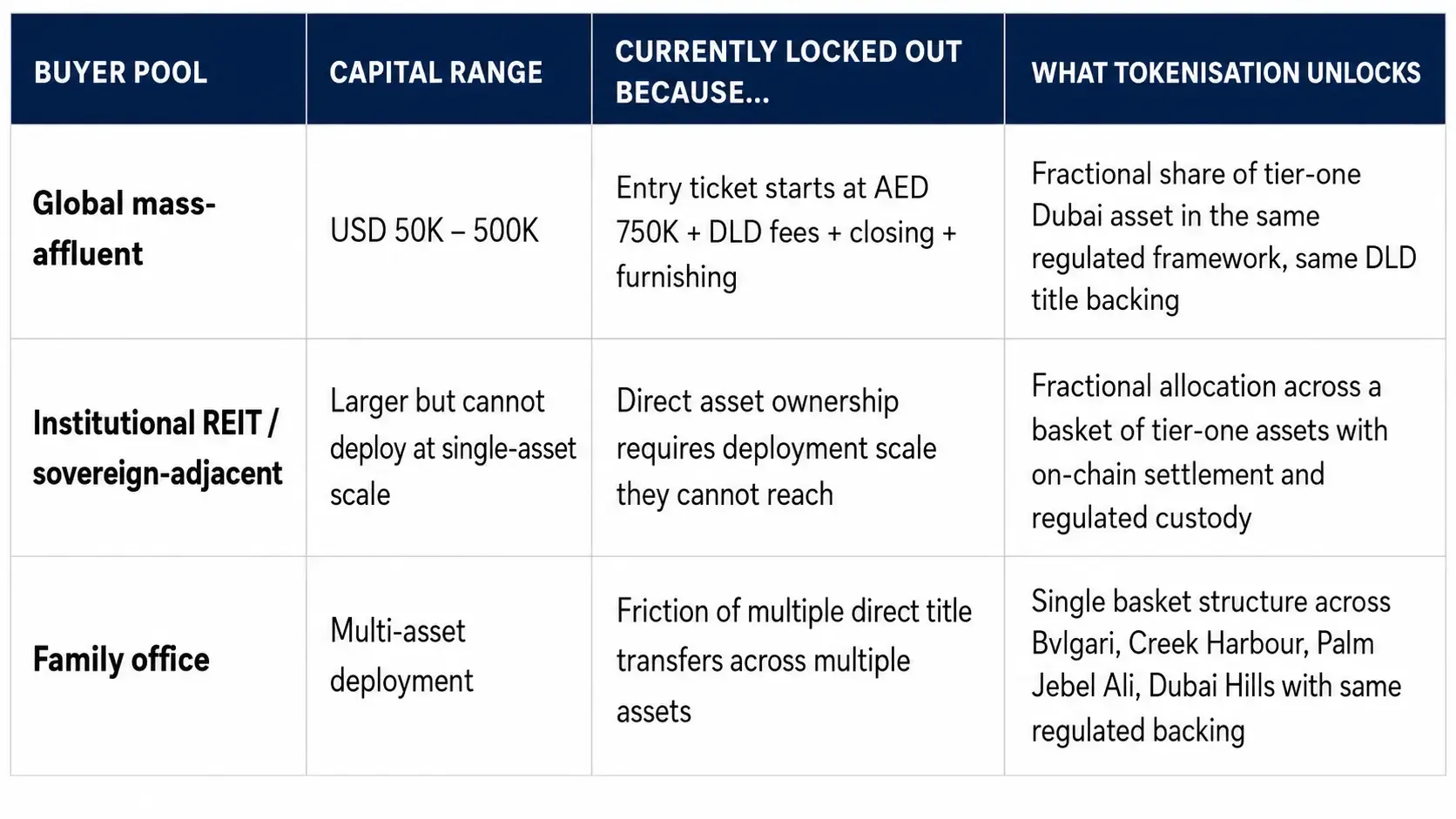
At a Glance: The Three Buyer Pools Tokenisation Unlocks
Opening
The Dubai Land Department launched the world's first regulated property tokenisation certificate. Not in a press release. As a live pilot. The structure converts a registered DLD title deed into a fractional digital ownership instrument that can be held, traded and settled within the regulated framework of the emirate.
Most real estate professionals I speak to have either not engaged with this or have dismissed it as a fintech experiment. I think both reactions are wrong. The tokenisation pilot, scaled appropriately over the next 18 to 30 months, will reset the Dubai property buyer pool in a structural way that the market is currently under-pricing.
What the Pilot Actually Does
A DLD title deed gets fractionalised into digital ownership units. Each unit represents a verified share of the underlying physical asset. The tokens are issued, registered and traded within a regulated framework that includes KYC, AML, investor accreditation and DLD title traceability. The exit liquidity is settled on-chain, with the underlying title custody managed by the DLD.
The structure is not crowdfunding. It is not the offshore unregulated tokenisation that has been tried elsewhere. It is a sovereign-backed, DLD-authenticated, fully regulated fractionalisation of a registered title deed. That distinction matters because it puts the structure inside the same risk and compliance framework that institutional investors require.
The Three Buyer Pools Unlocked by Tokenisation
There are three buyer pools currently locked out of Dubai real estate.
1. The global mass-affluent buyer
The first is the global mass-affluent buyer with USD 50,000 to USD 500,000 of deployable capital. Currently this buyer pool cannot buy a Dubai apartment because the entry tickets start at AED 750,000 plus DLD fees plus closing costs plus furnishing. Tokenisation lets them allocate the same capital to a fractional share of a tier-one Dubai asset, in the same regulated framework, with the same DLD title backing. The pool is large and currently has no clean access path.
2. The institutional REIT and sovereign-adjacent allocator
The second is the institutional REIT and sovereign-adjacent allocator that wants Dubai exposure but cannot deploy at the scale required for direct asset ownership. Tokenisation lets them allocate fractionally across a basket of tier-one Dubai assets with on-chain settlement and regulated custody. The buyer pool is much larger than direct institutional capital allocation to Dubai today.
3. The family office
The third is the family office that wants to construct a position averaging strategy across multiple Dubai assets without the friction of multiple direct title transfers. Tokenisation lets a family office allocate across Bvlgari, Creek Harbour, Palm Jebel Ali and Dubai Hills in a single basket structure, with the same regulated backing as the direct ownership.
Why This Re Rates the Existing Physical Market
If the tokenisation pilot scales to 1 to 3 percent of total Dubai property transactions by end of 2027, that is meaningful new buyer demand for the underlying physical assets.
The tokens are backed by real titles. Real titles require real units. Real units require ongoing supply absorption.
The 9,800 millionaire migration is the headline demand on its own. The tokenisation buyer pool, if the pilot scales as DLD's roadmap suggests, becomes the second structural demand layer. That is two distinct buying groups increasing the demand profile against a supply pipeline that is concentrated in specific clusters and tightly constrained in the tier-one communities.
What This Does to Pricing in the Existing Market
The new buyer demand from tokenisation does not flow evenly across the market. It flows into the tier-one assets that are eligible for the pilot. Branded residences. Tier-one developer inventory. Master-planned community core inventory. The tier-three mass-market apartment in JVC or Sports City does not get tokenised because the institutional and mass-affluent buyer does not want fractional exposure to that asset. So the tokenisation tailwind is concentrated in exactly the assets I have been recommending to clients in this entire blog series.
Tier-one assets where the tokenisation tailwind concentrates
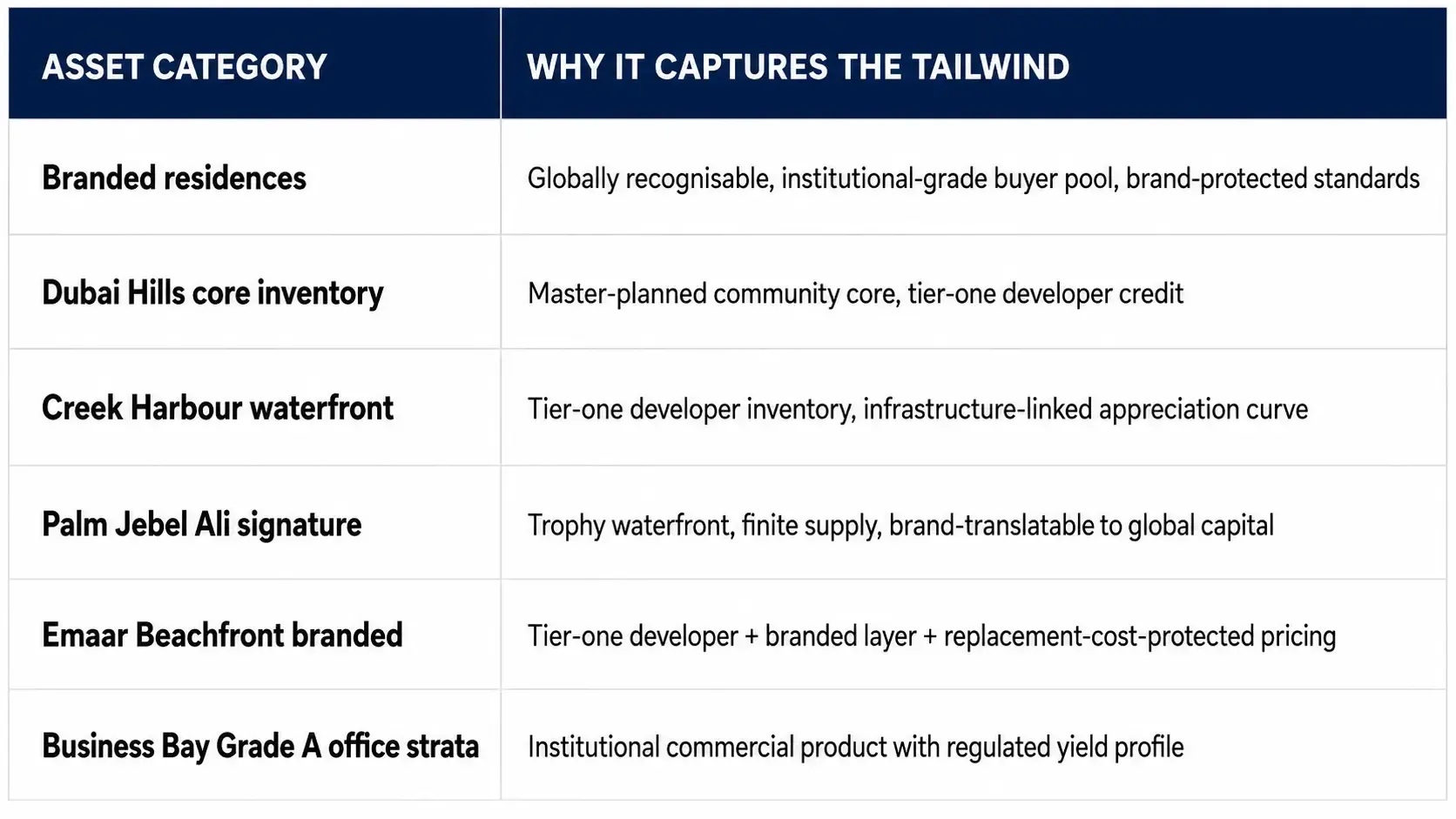
The group that owns those assets ahead of the tokenisation rollout is the set of buyers that benefits from the structural demand that tokenisation introduces. The buyers not yet positioned in those assets are buying into the tailwind before it fully prices in.
Why This Also Re-Rates Dubai's International Perception
The DLD launching the world's first regulated property tokenisation pilot is not just a financial structure. It is a sovereign-level signal about Dubai's positioning in the global capital architecture. Cities and jurisdictions are competing for the next decade of mobile global capital. The cities that win are the cities that make capital allocation easier, more liquid, more trackable and more compliant within institutional frameworks.
How Dubai compares on regulated property tokenisation
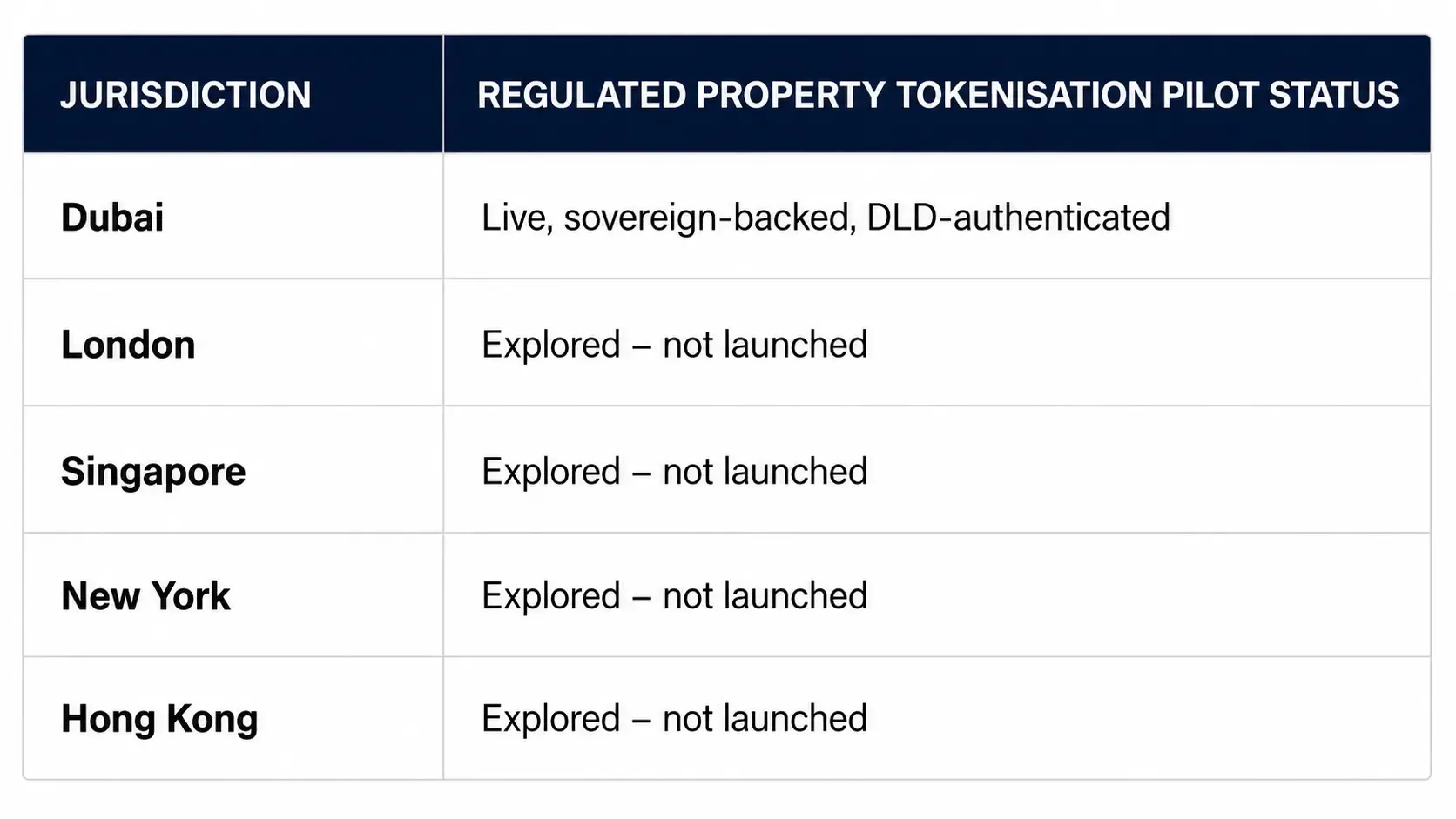
Dubai is years ahead of every comparable global financial centre on this. London, Singapore, New York and Hong Kong have all explored property tokenisation. None of them have launched a sovereign-backed, regulated, live pilot. Dubai has.
That is the kind of governance signal that institutional capital allocators read closely. The signal influences which jurisdictions get added to global wealth allocation models. The Dubai signal in 2026 is unambiguously positive on this.
What I Am Telling Clients to Do About This
Do not wait for the tokenisation pilot to scale before allocating. The point of buying ahead of structural demand is to be inside the asset before the demand arrives. Allocate to the tier-one assets that are eligible for the pilot through direct ownership today. Then layer fractional positions through tokenisation as the pilot scales.
The two step allocation approach
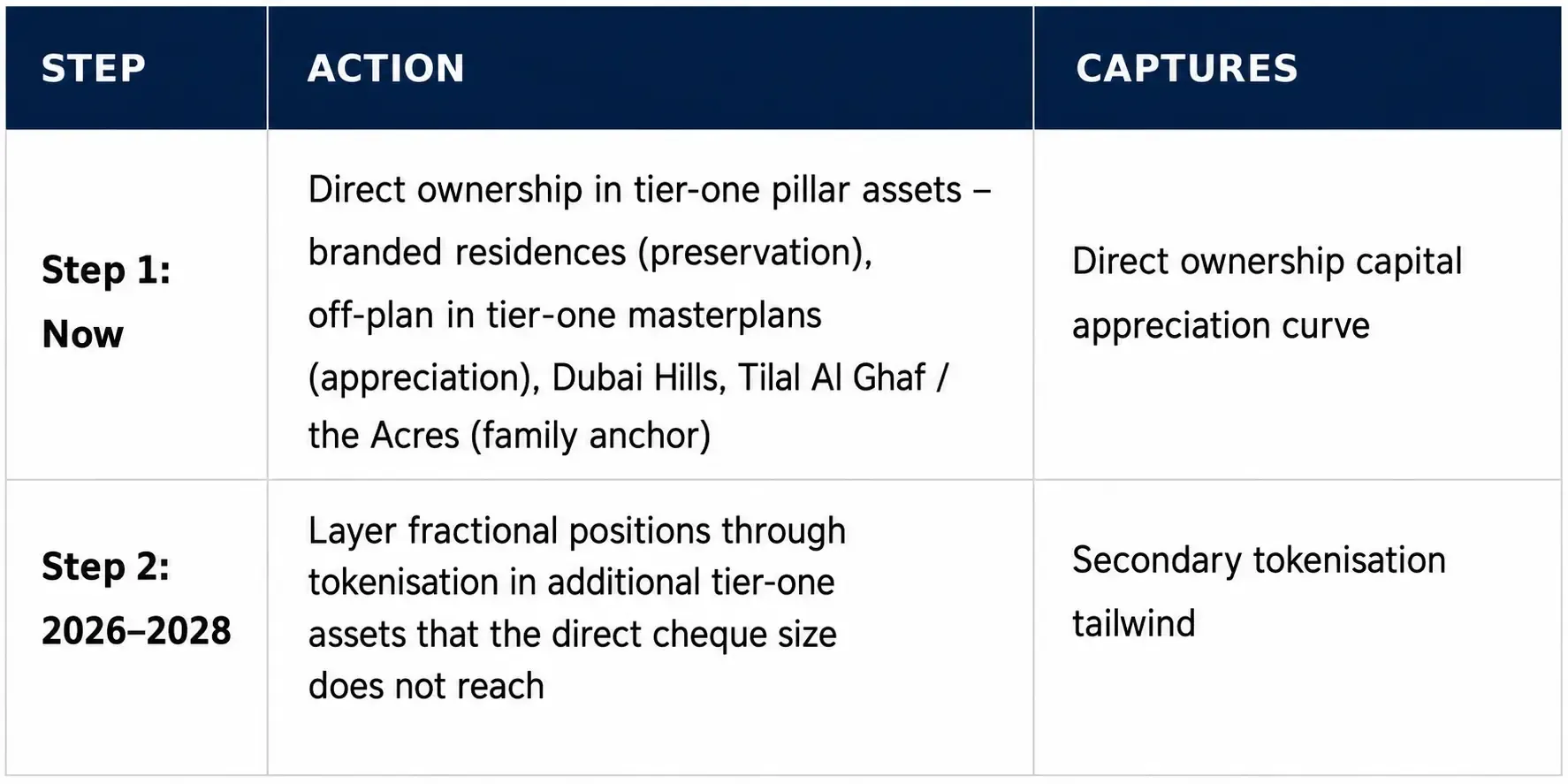
Specifically. Allocate the capital preservation pillar to branded residences. Allocate the appreciation pillar to off plan in tier one masterplans. Allocate the family anchor to Dubai Hills, Tilal Al Ghaf or the Acres. Then, as the tokenisation pilot expands, layer fractional positions in additional tier-one assets that the direct cheque size does not reach. That two step approach captures both the direct ownership capital appreciation curve and the secondary tokenisation tailwind.
One Closing Line
The DLD does not announce digital transformation. It executes it. The tokenisation pilot is live, regulated and consequential. The group that engages with it early is the pool that benefits from the second structural demand layer. The buyers who dismiss it are making the same mistake the set of buyers that dismissed Dubai itself ten years ago made.
Let's have that conversation
Thinking about your next Dubai property?
Talk to an XRealty specialist — market guidance, shortlists, and honest advice, no obligation.
Frequently Asked Questions
The Dubai Land Department has launched the world's first regulated property tokenisation pilot - a live structure that converts a registered DLD title deed into a fractional digital ownership instrument that can be held, traded, and settled within the emirate's regulated framework, with KYC, AML, investor accreditation, and DLD title traceability built in. The exit liquidity is settled on-chain, with the underlying title custody managed by the DLD.
The pilot opens Dubai property to three buyer pools currently locked out: global mass-affluent buyers with USD 50,000 to 500,000 of deployable capital, institutional REITs and sovereign-adjacent allocators that cannot deploy at direct-ownership scale, and family offices wanting to construct basket positions across multiple Dubai assets without the friction of multiple title transfers.
The tokenisation tailwind concentrates in tier-one assets eligible for the pilot: branded residences, Dubai Hills core inventory, Creek Harbour waterfront, Palm Jebel Ali signature, Emaar Beachfront branded, and Business Bay Grade A office strata. Tier-three mass-market apartments in JVC or Sports City do not get tokenised because the institutional and mass-affluent buyer does not want fractional exposure to those assets.
London, Singapore, New York and Hong Kong have all explored property tokenisation. None of them have launched a sovereign-backed, regulated, live pilot. Dubai has. The DLD pilot is years ahead of every comparable global financial centre.
Yes. The tokens are backed by real titles. Real titles require real units. Real units require ongoing supply absorption. If the pilot scales to 1 to 3 percent of total Dubai property transactions by end of 2027, that is meaningful new buyer demand for the underlying physical assets - concentrated specifically in tier-one inventory.
Do not wait for the tokenisation pilot to scale before allocating. Allocate to tier-one assets eligible for the pilot through direct ownership today, then layer fractional positions through tokenisation as the pilot expands. This two-step approach captures both the direct ownership capital appreciation curve and the secondary tokenisation tailwind.

Related Articles
 Invest In Dubai
Dubai Design District (D3): A Simple Guide for Property Investors
Explore Dubai Design District (D3) real estate investment opportunities, property prices, waterfront apartments, rental potential and future growth prospects.
 Market News
Dubai Office Market Stays Strong in Q3 2026 with More Affordable Deals
Explore Dubai's office market in Q3 2026, including commercial property prices, affordable office deals, investment opportunities and market trends.
 Market Pulse
Best Islands in Abu Dhabi to Live & Invest (2026)
Discover the best islands in Abu Dhabi for living and property investment, including Saadiyat, Yas, Al Reem, Jubail, Ramhan, Fahid and Hudayriyat. Compare lifestyle, property types, prices, rental yields and investment potential.