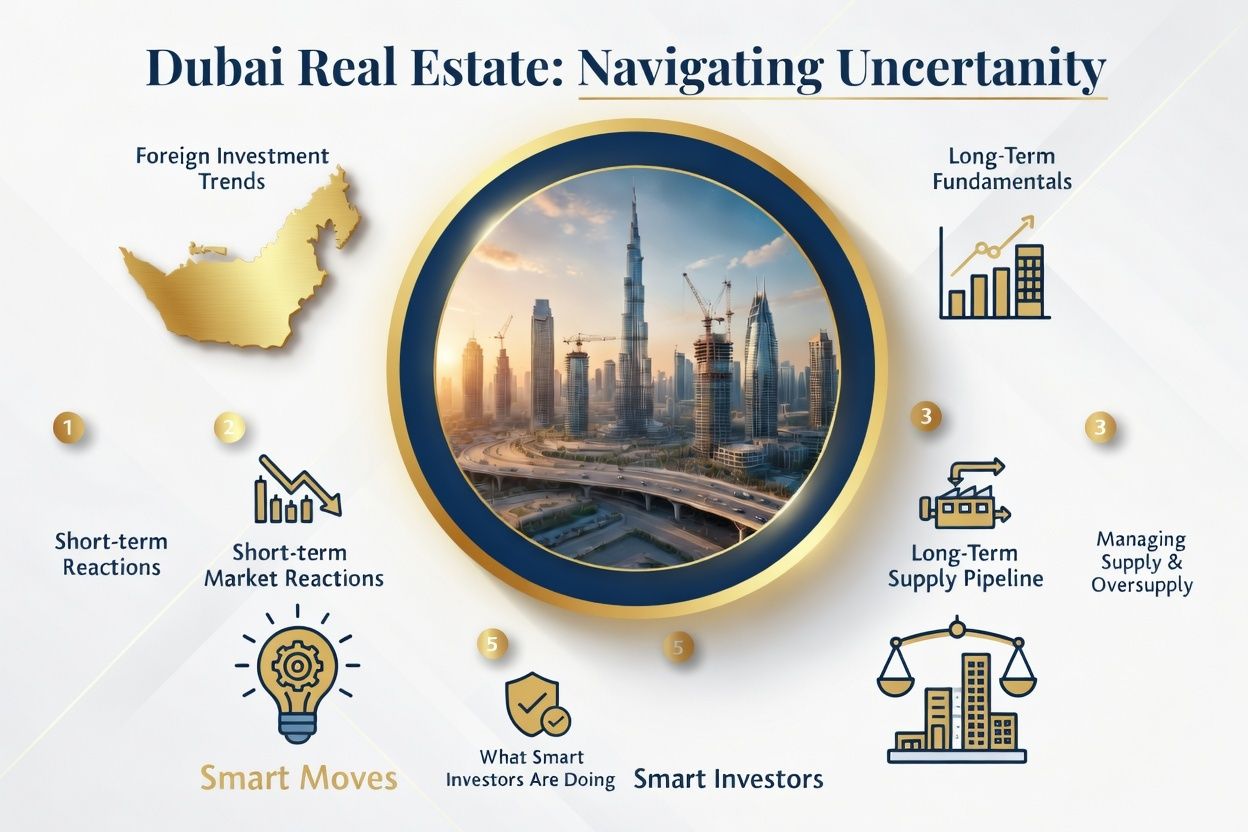
Short-term Market Reactions: Sentiment and Deal Delays
War in any region affects - Sentiment, transaction speed and buyer hesitation, especially in the early stages. In any geopolitical conflict, uncertainty tends to affect investor's sentiment. Buyers usually adopt the wait-and-watch approach, which can lead to temporary delays in property transactions.
This does not necessarily mean that there is no demand. It simply reflects caution among investors who prefer to monitor the situation before taking any large financial decisions. War does not affect population growth, rental demand, regulatory protection or economic infrastruture. Therefore short-term hesitation rarely translates into sustained decline in property values. So unless this war directly destabilizes the UAE core infrastructure, a structural crash is unlikely.
Long-Term Market Fundamentals Supporting Dubai Real Estate
When looking beyond short-term impact, Dubai’s property market continues to be supported by strong and powerful structural drivers.
Dubai has seen rapid population growth over the past few years as a result of HNI immigration, professionals and entreprenuers reloaction to the city. Residency programs such as Golden Visa have made it very easy for foreign investors to establish long-term roots in the country.
This shift is reflected in the scale of growth in the property market as well. In 2025, Dubai recorded over 202,000 sales transactions which is 460% more compared to the transactions in 2021. Price growth has also reflected this strong demand. Residential property values increased by 30% year-on-year in 2025.
These stats indicate the depth of global demand for Dubai property. With the correct infrastructure in place, Rera compliance and stronger banking oversight, analysts continue to maintain a positive Dubai property market forecast for 2026.
Supply pipeline and Oversupply Concerns
It is very natural for investors to think that during periods of geopolitical uncertainity, market sentiment could trigger panic selling or reduce demand temporarily, resulting in increased supply in the market.
However, Dubai’s real estate market structure is as such that oversupply scenario becomes highly unlikely.
Unlike other global property markets, Dubai real estate buyers do not rely heavily on debt. Large number of investors in Dubai purchase property with cash or high equity participation. This reduces the liklihood of force selling during uncertain times.
Secondly, a majority of transactions are currently happening in off-plan segment, where payment plan option is available. This payment structure usually discourages short-term exits and helps in maintaining market stability.
Thirdly, Dubai continues to benefit from Global demand, and during conflict if one region slows down temporarily, new investor groups often step in, maintaing the overall balance of the market.
For these reasons, even though in the short-term, headlines may create temporary caution and slow down demand, the underlying demand drivers will continue to support price stability and prevent any surge in supply.
Foreign Investment Trends During Uncertainity
Historically, global uncertainity has always strengthened Dubai’s position as a destination for international capital.
During geopolitical tensions, investors look for markets that combine political stability, strong legal frameworks and attractive tax facilities. Dubai has all these three, which is why investors look towards Dubai in difficult times.
Clear example was seen during the Russia-Ukraine conflict in 2022, when as per reports, more than $2 billion in Russian capital entered Dubai’s property market.
This clearly shows that investors seek a safe haven during global uncertainity and Dubai always delivers. It becomes a capital magnet rather than a market under pressure.
What Smart Investors Are Doing Right Now
Experienced investors do not take decisions based on geopolitical headlines, instead they look at the underlying fundamentals and long-term markert positioning.
Smart investors are currently shifting their strategies by allocating their capital towards off-plan developments with flexible payment plans. They are opting to enter emerging master-planned communities and diversifying their portfolios between ready properties and new developments. By following these approaches, investors are looking to benefit from long-term capital growth while reducing exposure to short-term sentiment fluctuations.
Conclusion
The ongoing geopolitical conflict has understandably created concerns about regional stability, but Dubai’s real estate market is standing on strong foundations.
While short-term caution among buyers is completely normal during war, the broader drivers of Dubai’s Real estate market are intact.
Therefore, for investors who are evaluating the short-term vs long-term outlook for Dubai property values, all factors prove that Dubai is one of the most resilient and safe real estate market which will always continue to attract global capital.