Why HNIs Are Moving Their Wealth to Dubai in 2026

Table of Contents

Something has shifted in the way the world's wealthy move money. It's not dramatic. There are no announcements. Dubai Land Department in 2024 recorded transactions of AED 407 billion, which no one could have expected three years earlier. Knight Frank's 2025 Wealth Report has ranked Dubai as the world's fastest-growing UHNW city for the third consecutive year. All the conversations I have been having with business families from India, a fund manager relocating from London, or a tech founder moving out of Singapore, all ask the same question: Is Dubai the next option? The short answer is yes. This piece is my attempt to lay out, without marketing language, exactly why Dubai has become the default relocation choice for HNIs in 2026, what's driving it, and what the decision actually looks like on the ground.

The Push Factors Nobody Is Talking About Loudly Enough

Most Dubai promotion focuses on what the emirate offers. That misses half the picture. Before investors decide where to go, they decide where they can no longer stay.

The UK's non-dom abolition. UK ended the non domicile tax regime that helped wealthy foreign residents over years to avoid the British Tax on offshore income. The impact landed harder than the headlines suggested. For an HNI with significant foreign income, the effective tax liability in the UK jumped overnight. Several clients I spoke to had their UK advisors running numbers and coming back with answers that made Dubai's 0% personal income tax look less like a luxury and more like arithmetic.

India's increasing scrutiny of offshore wealth. India's Black Money Act and successive FEMA amendments have made it progressively harder for Indian HNIs to maintain significant offshore structures without clear, defensible documentation. The regulatory climate is not hostile but it is tighter. For families with global businesses or multi-jurisdictional assets, the paperwork burden alone has become an argument for consolidating in a jurisdiction with cleaner structures. The UAE's DIFC and ADGM frameworks offer exactly that.

Global instability, again. After the Russia-Ukranie war the number of investors from both these countries have grown. The Middle East's own conflicts have, strengthened Dubai's position. When there is any uncertanity in the world it moves its wealth to a stable and strong banking infrastucture that Dubai has become.

Why Dubai, Specifically

There are other options Singapore, Lisbon, Monaco, Malta. HNIs are not choosing Dubai by default. They are choosing it deliberately, for specific reasons.

Zero Capital Gains Tax and What That Actually Means

The UAE has no personal income tax, no capital gains tax, and no inheritance tax. For an investor selling a property that has appreciated AED 3 million, that AED 3 million stays in their account. In the UK, they need to pay CGT at 24% for higher-rate taxpayers post 2024. In India, long-term capital gains on property are taxed at 20%. In the US, federal CGT charges at 20% for high earners, before state taxes. The math compounds significantly at HNI scale. What people miss is that the UAE did introduce a 9% corporate tax in 2023 the lowest in the G20, and applicable only to business profits above AED 375,000. Personal wealth, investments, and real estate gains remain untouched. The OECD's global minimum tax framework applies to multinationals, not to individuals. Dubai's personal tax position has not changed.

The Golden Visa: A Different Kind of Residency

Golden Visa is a 10-year renewable residency visa that gives the holder the right to live, work, and invest in the UAE without needing a local sponsor. For a property investor, the threshold is AED 2 million a single property or combined portfolio. For the investor's family, the same visa extends to spouse, children, and in many cases parents. What it creates, functionally, is a stable platform: a legal address in a low-tax jurisdiction, access to world-class banking, and residency rights that do not expire with an employer relationship. Several of my clients have structured their Dubai purchase specifically to anchor the Golden Visa, not because they plan to live in Dubai full-time, but because having the option changes how they think about everything else. It is an insurance policy with upside.

Real Estate as the Entry Vehicle

HNIs rarely arrive in Dubai and open a bank account first. They buy property first and for good reason. Real estate in Dubai is the most legible asset class in the jurisdiction. The DLD's online registry is transparent. Title is freehold for foreigners in designated zones. Off-plan contracts are governed by RERA, which holds developer escrow accounts. The framework is not perfect, but it is far more structured than comparable markets in Southeast Asia or Eastern Europe. The second reason is appreciation. Over the 2020–2025 period, prime Dubai real estate returned an average of 9.3% per annum in capital appreciation, before rental yield. In Palm Jumeirah and Emirates Hills, that number has been higher. In the branded residence segment Bulgari, OMNIYAT's One at Palm, Armani values have moved in a way that is structurally different from the broader market.

I want to be careful here: Past performance does not predict future returns, and anyone telling you Dubai property is a guaranteed investment is either naive or selling something. What I will say is that the fundamentals that drove 2022–2025 appreciation supply constraint in prime land, population growth, and increased international demand remain intact in 2026.

Who Is Actually Buying

Indians remain the top by transaction volume, according to DLD data. The profile has changed though. The 2014 buyer was often a speculator. The 2025 buyer is typically a business owner, a senior executive at an MNC, or a family with generational wealth looking for portfolio diversification and, increasingly, a clear plan B on residency.

  • British buyers have increased significantly since the non-dom abolition. This is a newer dynamic and it is not fully priced into the market yet which makes it interesting.

  • Eastern European and CIS nationals have been a structural buyer group since 2022 and continue to be. Their buying tends to concentrate in the ultra-prime segment.

  • GCC nationals particularly Saudis are now a meaningful slice of Dubai's buyer base as Vision 2030 reshapes domestic investment patterns and high-net-worth Saudis diversify beyond the kingdom.

What this mix tells you: the demand is broad, multi-origin, and not dependent on any single source country. That is a different risk profile than 2014.

What HNIs Actually Buy in Dubai

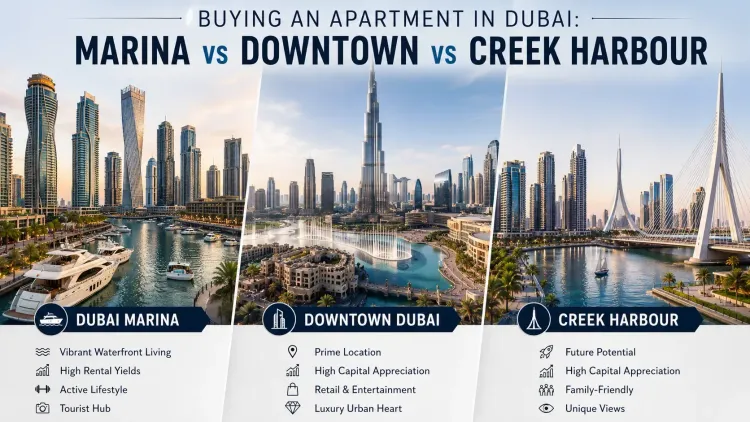
HNIs in a bracket of AED 5-20M range prefer to buy Grand Polo, The heights, The Oasis and other tie A developers Products. Below AED 5 million, the investor calculus is more about yield Dubai Marina, JVC, Business Bay, and the Arjan corridor where gross rental yields of 7–9% are achievable on professionally managed units. I work primarily in the AED 3–15 million range, and the question I get most is whether to go off-plan or ready. My honest view: it depends entirely on your timeline and your need for cash flow. A long-form answer is worth a separate read.

The Honest Caveats

Dubai is not for everyone, and it is not a risk-free decision. The legal system is civil law, not common law which matters if you are coming from the UK, India, Australia, or any other common-law jurisdiction. Dispute resolution works, but it works differently. Engage a good local lawyer before you buy anything.

The market has historically been cyclical. The 2008–2010 correction was severe. The 2015–2020 softening was prolonged. The current cycle has different underlying drivers, but no cycle is permanent. Buy on fundamentals, not on the assumption that prices only go up.

Currency is pegged to the USD. That is a feature for dollar-denominated investors and a complexity for those holding other currencies. Understand your FX exposure before structuring anything.

And finally: residency is not the same as citizenship. The UAE does not offer citizenship on investment at scale. The Golden Visa does not give you a UAE passport or voting rights. If you are looking for the citizenship Dubai isn’t fr you.

The Decision, In Practical Terms

If you are an HNI with global income, real assets outside your home country, and a desire for a stable, tax-efficient base Dubai deserves serious consideration in 2026. Not because of the Burj Khalifa or the tax brochures. Because of the legal infrastructure, the banking access, the residency framework, and the real estate market's demonstrated liquidity.

The process typically starts with a property purchase, anchors the Golden Visa, and from there builds out into banking relationships, entity structuring, and lifestyle infrastructure.

My role and what I do every week with clients at Xperience Realty is to work through that property piece carefully: the right asset for the right objective, in the right location, from a developer with a credible delivery track record. If you are at the stage of considering this seriously, the next step is a conversation not a brochure.

Frequently Asked Questions

Dubai uniquely combines zero personal income tax, zero capital gains tax, a 10-year Golden Visa, and a transparent freehold property market. For globally mobile wealth, no other city currently offers that full package with Dubai's level of banking infrastructure and political stability.

The Golden Visa is a 10-year renewable UAE residency requiring a minimum AED 2 million property investment. It covers the investor, spouse, children and often parents, no employer sponsorship needed. It provides a stable, tax-efficient legal address without requiring full-time residence.

Dubai's property framework is transparent freehold title, DLD registry, and RERA-governed escrow for off-plan purchases. Prime property averaged 9.3% annual capital appreciation from 2020–2025. The market is cyclical though, buying on fundamentals matters more than chasing momentum.

The UAE has no personal income tax, capital gains tax or inheritance tax. A AED 3 million property gain stays entirely yours. The UK charges CGT at 24%, India at 20% on long-term property gains. At HNI scale, that difference compounds significantly.

A AED 2 million+ property purchase qualifies for the 10-year Golden Visa, residency, not citizenship. The UAE doesn't offer citizenship through investment. The Golden Visa gives you the right to live, work and invest in the UAE without local sponsorship, but no UAE passport.

Contact Us