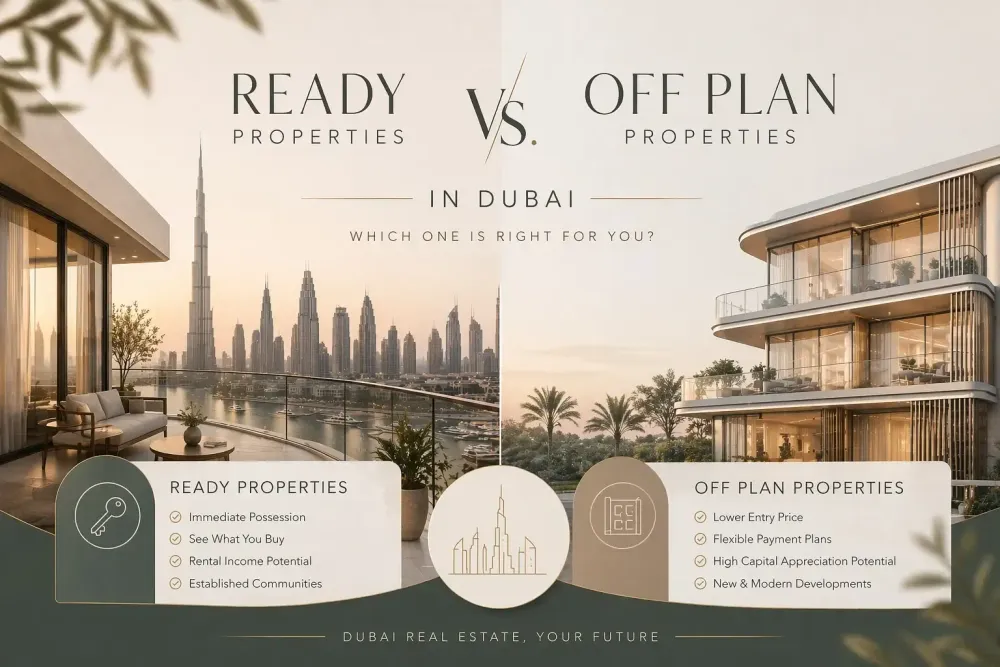
Off-Plan vs Ready Property in Dubai: Which is Better in 2026?

Table of Contents
Geopolitical uncertainty has a way of making even the most decisive investors pause. We all have been apprehensive about the regional disruptions, market volatility and timing and wondered if now is genuinely the right time to buy real estate in Dubai. That apprehension is understandable! However, what is equally understandable is what the data actually explains rather than losing focus due to the overwhelming headlines. Dubai has successfully navigated through all the global disruptions, may that be the financial crisis in 2008, the oil correction in 2014 or the global pandemic, with its residential market structurally stronger than before. Now, that leads us to a crucial question, which out of the off-plan or ready property suits your capital and your life?
Dubai Property Market Trends & Investment Outlook
In 2025, Dubai registered 205,000 residential transactions, the highest single-year figure in the city's recorded history at a combined value of AED 539.9 billion. That is not a speculative rally predicated on borrowed confidence. That is a functioning, high-velocity market converting global capital into tangible assets at a pace that rivals London and New York. Against that backdrop, one question dominates every serious investor conversation: off-plan or ready property, which warrants your capital in 2026?
Why Dubai Real Estate is Booming in 2026
Three forces are converging simultaneously. The UAE attracted 9,800 millionaires in 2025 alone, more than any other country on earth according to Henley & Partners, carrying an estimated USD 63 billion in investable wealth. The IMF projects UAE GDP growth of 5.0% in 2026, the highest rate across all GCC nations. The Dubai Economic Agenda D33, underpinned by a government running an AED 8.2 billion budget surplus, is systematically constructing the infrastructure that renders capital deployment here, not merely aspirational but arithmetically rational.
What is Off-Plan Property in Dubai
An off-plan property is purchased directly from a developer before construction is complete, at a price typically set below anticipated future market value. Buyers secure their position with a deposit, often 10% of the purchase price and pay in structured instalments tied to construction milestones, with the balance due upon handover. The fundamental appeal is straightforward: you acquire an asset today at launch price and if the market appreciates as Dubai's has historically done, you accumulate equity before you have fully paid for the property.
What is Ready to Move Property in Dubai
A ready property, more accurately described as a secondary market property, is a completed, registered asset carrying a title deed. It is available for immediate occupancy, capable of generating rental income from day one and qualifies for a UAE 10-year Golden Visa if valued at AED 2 million or above. The premium for this immediacy is precisely that “a premium”. You pay current market value, not the launch price of 3.5 or 4 years prior.
Off-Plan vs Ready Property: Key Differences
The distinction, at its core, is time versus price. Off-plan demands patience, handover periods in Dubai typically range from 3.5 to 4 years, in exchange for a lower entry price and the prospect of capital appreciation through the construction cycle. Ready property demands a higher capital commitment in exchange for immediacy: rental income, occupancy, and residency availability, all accessible now.
Price Comparison: Off-Plan vs Ready
In comparable Emaar communities, the differential is meaningful. Grand Polo Club launched in April 2025 at AED 5.67 million for a three-bedroom villa. Comparable established Emaar villas in Arabian Ranches, ready, operational, and fully community-embedded are transacting at an average of AED 8.15 million, as per Property Monitor data covering January 2021 to April 2026. The question is never which is the cheaper option. It is which represents superior value for your specific investment horizon and tolerance for construction-phase risk.
ROI & Rental Yield Comparison
Arabian Ranches villas currently yield rentals of 4% to 5% gross annually supported by structural undersupply and consistent demand from families who require established schools and community infrastructure. Off-plan villas in emerging corridors, project rental yields of 5% to 7% upon completion, benchmarked against comparable Emaar communities including Dubai Hills Estate. The caveat is fundamental: projected yields are projections. Established yields are evidenced data.
Pros and Cons of Off-Plan Properties
The advantages are considerable: lower entry pricing, flexible payment plans, capital appreciation from launch through to handover, and Golden Visa eligibility at the AED 2 million threshold. The risks, however, merit equal candour construction delays of 3 to 6 months are not uncommon; market conditions can shift materially before handover; and the asset generates no income during the construction period.
Pros and Cons of Ready Properties
The advantages: immediate rental income, verified physical condition, established community infrastructure, and the complete absence of construction-phase uncertainty. The disadvantage is equally transparent, you pay a premium of approximately 15% to 20% above comparable off-plan pricing in the same community for the certainty that premium purchases.
Hidden Costs & Fees Comparison
Both transaction types carry a 4% Dubai Land Department transfer fee and Trustee fee (depending on transaction price) for transfer of property from seller to buyer. Ready property transactions additionally carry a 2% agency commission. Off-plan purchases typically attract a 4% DLD registration fee at the point of launch booking. Both carry annual service charges in Arabian Ranches , these are billed by Emaar Community Management and vary by sub-community and villa size. Factor every line item into your acquisition model before committing.
Expert Verdict: Off-Plan or Ready in 2026?
I would respectfully submit that the framing of this question is, by virtue of its binary nature, the first error most investors make. The correct question is not which is better in the abstract. The correct question is: what is your investment horizon and what does your life require right now?
A family relocating to Dubai this quarter needs a ready property. A Golden Visa, a school commute, a home their children can inhabit none of that can reasonably wait four years for a handover date.
An investor deploying capital with a five-year horizon, who is watching the Al Maktoum Airport corridor develop, who understands the DIFC Zabeel expansion and what 125,000 additional financial professionals mean for surrounding residential demand, and who is comfortable with a structured payment plan that investor has a compelling, data-supported case for the best off-plan projects Dubai 2026 has to offer. The Dubai market is, in 2026, structurally sound enough and sufficiently diverse to reward both decisions. What it does not reward as it has never rewarded is the paralysis that masquerades as prudence. The data is clear. The trajectory is established. What remains is the decision!
Frequently Asked Questions
It depends on your goal. Choose ready property for immediate rental income or occupancy. Choose off-plan if you have a 4–5 year horizon and want lower entry pricing with flexible payment plans.
Off-plan properties project 5%–7% rental yields upon completion. Ready properties in established communities like Arabian Ranches currently deliver 4%–5%, backed by real market data, not projections.
Both property types attract a 4% DLD transfer fee. Ready properties add a 2% agency commission. Annual service charges also apply and vary by community and property size.
Yes, if the paid-up property value reaches AED 2 million or above, both off-plan and ready properties qualify for the UAE 10-Year Golden Visa.
Typically 3.5 to 4 years from launch, with possible delays of 3–6 months. No rental income is generated during this construction period.
Read More

The DLD Tokenised Property Pilot: Why This Resets Dubai's Buyer Pool by 2027
First-Time Buyer’s Guide to Dubai 2026: Mortgage Affordability at Current Rates
RERA, DLD and Oqood: Why Dubai’s Off-Plan Protection Model is Considered a Global Benchmark