Table of Contents
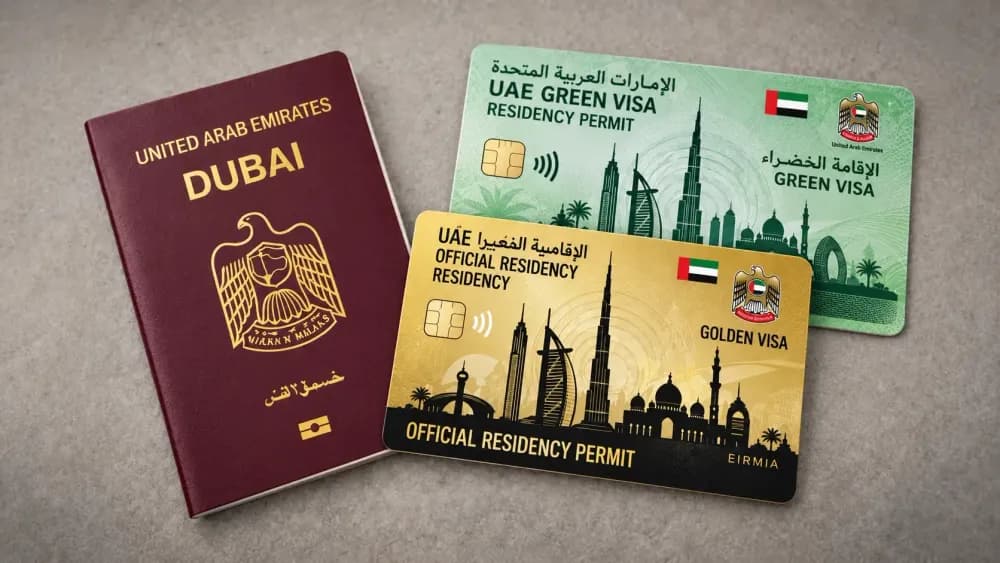
The UAE offers two long term residency visas: the Green Visa and the Golden Visa.
Both let you live in the UAE without needing an employer to sponsor you. That part is the same. What's different is who each visa is meant for.
The Green Visa is for people who are still building their income or business. The Golden Visa is for people who have already reached a certain level of investment.
This guide explains both visas in simple terms. By the end, you'll know exactly which one fits where you stand today.
Two Visas, Two Different Starting Points
The Green Visa lasts five years. It is made for:
- Freelancers
- Skilled employees
- Business owners or partners
It does not ask for a large investment upfront. This makes it a practical choice for professionals who are earning well but haven't yet built up enough capital for the Golden Visa.
The Golden Visa lasts ten years. It is built around bigger investments or strong personal achievement. Most investors qualify through property worth AED 2 million or more. Business ownership, scientific or medical achievement, and outstanding academic performance are also valid paths.
Many people don't stay on one path forever. Starting with a Green Visa and later moving to a Golden Visa, once your capital grows, is a common and sensible route.
Eligibility Requirements for Each Visa
For the Green Visa's employment route, you generally need a monthly salary of at least AED 15,000. Freelancers and business owners qualify a little differently, through their registered activity instead of a fixed salary.
For the Golden Visa's property route, you need AED 2 million or more in qualifying real estate. A few important details apply here:
- A single completed property, or an eligible off plan unit, works if it's from a developer approved by the Dubai Land Department.
- A mortgaged property can still qualify. What matters is the paid up value, not the full purchase price.
- Jointly owned property, such as between spouses, qualifies if each person's own share meets the AED 2 million mark.
- Depending on the manner in which they are registered, it is possible to combine multiple smaller properties to achieve the threshold.
These specifics are more important than the big number. It's always worth checking your specific case before assuming a property qualifies.
Family and Renewal, Explained Simply
Both visas let you sponsor family members without needing an employer based visa. The Green Visa covers your spouse and children. The Golden Visa goes a step further and also covers your parents, which matters if you're relocating a full household.
Renewing either visa works in a similar way. You simply show that you still meet the same criteria you qualified with, whether that's an updated title deed, a business licence, or proof of salary.
If a visa happens to lapse, there is still time to fix it. The Golden Visa gives a six month grace period. The Green Visa gives three months. Either way, you're able to stay in the UAE while sorting things out.
Costs Involved with Each Visa
Costs for both visas fall into similar categories:
- An application fee
- A medical fitness test
- An Emirates ID for each applicant and dependent
Together, these usually add up to a few thousand dirhams per person.
The Golden Visa's property route adds one more cost. Since the qualifying property needs to be purchased and registered, this includes standard DLD transfer fees and any agent commission from the sale.
One thing worth remembering: selling a qualifying property without replacing it with another eligible investment is the most common reason a real estate based Golden Visa gets cancelled. It helps to plan ahead of any resale.
Matching Each Visa to Your Situation
If you already hold AED 2 million or more in property, the Golden Visa is usually the better fit. It offers a longer term and covers more of your family.
If you're a business owner or freelancer still building toward that amount, the Green Visa is often more practical in the meantime.
A salaried professional earning above AED 15,000 a month, without property or a registered business, generally fits the Green Visa's employment route well.
A retiree or passive investor with a smaller property portfolio may also find the Green Visa a workable option while their investments continue to grow.
Final Thoughts on Choosing Between the Two
Neither visa is better in a general sense. The right one depends entirely on where you stand financially today, not on comparing the two as if one always wins.
If you already meet the Golden Visa's requirements, it gives you a longer term and wider family coverage. The Green Visa offers you a practical way to establish residency now, with a clear path to upgrade later, if you're still working toward that goal.
Thinking about your next Dubai property?
Talk to an XRealty specialist — market guidance, shortlists, and honest advice, no obligation.
Frequently Asked Questions
Yes. Business ownership, specialized talent, and strong academic achievement are all separate ways to qualify.
Yes. What matters is the paid up value of the property, not the original purchase price.
Yes, and it's a common step once your capital or professional profile meets the Golden Visa's criteria.
It's usually cancelled, unless the property is replaced with another qualifying investment around the same time.
The Green Visa covers your spouse and children. The Golden Visa also covers your parents, extending to a wider part of your household.
Related Articles
 NRI Investment
The Real Reason Indian Investors Never Stopped Buying Dubai Real Estate
Discover why Indian investors continue to choose Dubai real estate, from tax efficiency and rental yields to currency stability, residency benefits and long term growth.
 Legal Process
Power of Attorney for Property in Dubai: A Simple Guide
 Market News
Dubai Rent Now, Pay Later Scheme: What Tenants and Landlords Should Know?
Understand how Dubai’s Rent Now, Pay Later option works, including monthly rent payments, tenant benefits, landlord considerations, eligibility and key costs.