Table of Contents
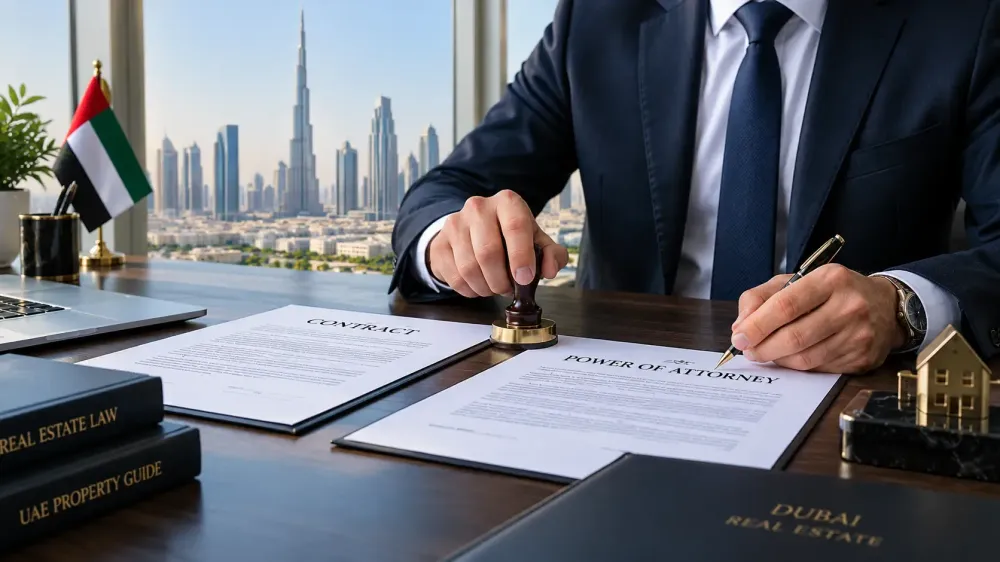
What happens to your Dubai property transaction if you can’t be present to sign the papers? Many overseas property owners ask themselves this question, and the answer is usually the Power of Attorney (POA), a legal document that allows a person of your choice to sign, manage, and represent your interests in the deal as if you were there yourself.
This guide aims to help the readers understand, what a POA (Power of Attorney) is, what types are there, how to set one up from within and outside the UAE, and what mistakes to avoid.
Understanding Power of Attorney
A Power of Attorney (often abbreviated to POA) is a legal document that allows one person (the principal) to give another person (the agent) the power to do a specific task for him/her. This can include signing a sale agreement, renting an apartment, receiving rent payments or paying off a mortgage. The document should be clear as to the extent of the authority given to the agent. It is also worth noting that the Arabic version of the document is considered legal in Dubai, so a POA in English alone will most likely be insufficient.
Common Reasons to Use a POA in Dubai
Dubai’s property market attracts a lot of foreign investors, and many locals have a lot of properties too. A POA can be useful in situations like these:
- You live abroad and cannot travel every time paperwork needs signing in the UAE.
- You have a number of properties that you cannot oversee yourself.
- You are purchasing an off-plan unit and require someone to sign installment payments and hand over documents over a long construction period.
- You want a property manager to deal with tenancy contracts and rent collection on a regular schedule.
- In emergencies or when you're unavailable, you need a trusted person.
Types of Power of Attorney
There are three common types of POA in Dubai, which determine the scope of authority for your agent. The type you choose defines the extent of your agent’s authority.
-
General POA grants authority to your agent over all of your assets, which include more than just your real estate. Therefore, it is not suggested for those looking to make only one transaction, as it involves too broad powers for the task at hand.
-
Special or Limited POA is appropriate when only one property is being sold, for instance, an apartment. It explicitly limits the scope of the agent’s activity to one specific task, such as the sale of a particular property.
-
Durable POA is meant to remain in force even if you become physically or legally unable to carry out your everyday tasks, for instance, due to an illness. It is primarily used in long-term planning and is not common in day-to-day business.
Therefore, for straightforward property purchases in Dubai, a Special or Limited Power of Attorney is the preferred choice among lawyers and government officials.
Setting Up a POA While You Are in Dubai
This procedure is relatively straightforward if you are physically present in the city:
-
Choose a trusted agent. This is the most important decision, because this person will be acting in your name and with your money on the line.
-
The document should be drafted in both Arabic and English. A lawyer experienced in the UAE property law will be able to set out the exact property details, the exact powers being given and a clear expiry date.
-
Have it notarized. You then take the document to the Dubai Courts Notary Public, where they will verify your identity and formally validate the document. Only the principal is required to be present for this step; the agent can collect the signed original later
-
Register with the Dubai Land Department when property is concerned. This registration is what allows your agent to sign on your behalf during a formal transfer.
Setting Up a POA From Outside the UAE
A POA signed abroad has to be authenticated by a few authorities before it can be used in Dubai. The process is as follows:
- Signing: Have it signed in front of a notary in your country.
- Authentication: Get the notary's seal authenticated by your foreign affairs ministry. This is also known as an apostille, a simple certificate saying, "this signature/stamp is genuine."
- Attestation: Take it to the UAE embassy/consulate in your country. They (unlike some other countries) do not accept a foreign apostille on its own.
- Verification: Have it attested again upon arrival in the UAE by the Ministry of Foreign Affairs.
- Translation: Get it translated into Arabic by a certified legal translator; this is the only language that carries any legal weight in Dubai.
Costs Involved
The overall cost depends on the type of POA, its location (UAE or abroad), whether it requires translation into Arabic or not. On average, you can expect to pay for notary fees, legal drafting, Dubai Land Department registration (if applicable), embassy or apostille fees (for those created abroad) plus Ministry of Foreign Affairs attestation upon arrival in Dubai.
Using a POA for Specific Property Situations
-
Buying or selling: The agent can sign the sale agreement and attend the transfer appointment at the Dubai Land Department, as long as the document names the specific unit and clearly gives that power.
-
Mortgages: Most banks will accept a POA to sign loan documents, but some prefer the borrower to appear in person for the first application, and banks usually want a relatively recent document.
-
Rental management: An agent, often a property management company, signs tenancy contracts, registers them, collects rent, and deals with maintenance requests on your behalf.
-
Off plan purchases: A POA can cover signing the purchase agreement, making installment payments, attending handover, and dealing with the developer over the life of a long construction project.
Mistakes to Watch Out For
- You should decide on a general POA rather than one restricted to the specific property and task.
- Leaving out important property information like the unit number, plot number, or title deed reference.
- Overlooking the extra verification phase once a foreign-produced POA reaches Dubai.
- Allowing the document to expire before completing a transaction; plan ahead of time to allow for such delays.
- Letting the agent transfer their power to another individual without your consent.
- Skipping legal advice in order to save time or money.
Ending or Cancelling a POA
You are free to terminate a POA at any time. Cancelation should be done using a formally notarized revocation document, and it only takes effect after the agent has been properly notified, so simply signing the cancellation is not sufficient. It is also best practice to notify your bank, property manager, and the Dubai Land Department when a POA is revoked, and to cancel it as soon as its purpose is fulfilled rather than keeping it active.
Final Thoughts
If you own property in Dubai but don’t always have the time to be there to manage it, then a Power of Attorney is an essential tool. By choosing a trustworthy agent, keeping the powers narrow and specific, following the correct attestation steps and defining a clear expiry date, you can use this tool with confidence and keep your property secure.
Thinking about your next Dubai property?
Talk to an XRealty specialist — market guidance, shortlists, and honest advice, no obligation.
Frequently Asked Questions
Yes. A Special or Limited Power of Attorney allows your appointed agent to sign the sale contract and appear at the Dubai Land Department to complete the transfer of the property on your behalf.
A Special or Limited power of attorney is a document that specifies the precise property and task. Also, the scope of authority is narrowly defined for an agent in this legal arrangement. A General POA is generally not advised for real estate matters.
Yes. A notarized revocation document is required, and the cancellation is only effective after the agent has been officially notified.
No. A POA authorizes someone to act on your behalf for the specific tasks outlined in the document; the property remains yours unless the agent successfully completes the sale you authorized.
Related Articles
 Market News
Dubai Rent Now, Pay Later Scheme: What Tenants and Landlords Should Know?
Understand how Dubai’s Rent Now, Pay Later option works, including monthly rent payments, tenant benefits, landlord considerations, eligibility and key costs.
 Market Pulse
What Makes Dubai So Resilient?
Discover why Dubai’s real estate market remains resilient, supported by population growth, investor demand, infrastructure, tourism and a strong economy.
 Buyer and Seller Guide
How To Build a Strong Property Portfolio in Dubai ?
Build a smarter Dubai property portfolio with the right locations, property mix, rental returns and long term investment strategy.