UAE Central Bank AED 1 trillion shield protecting Dubai property investments

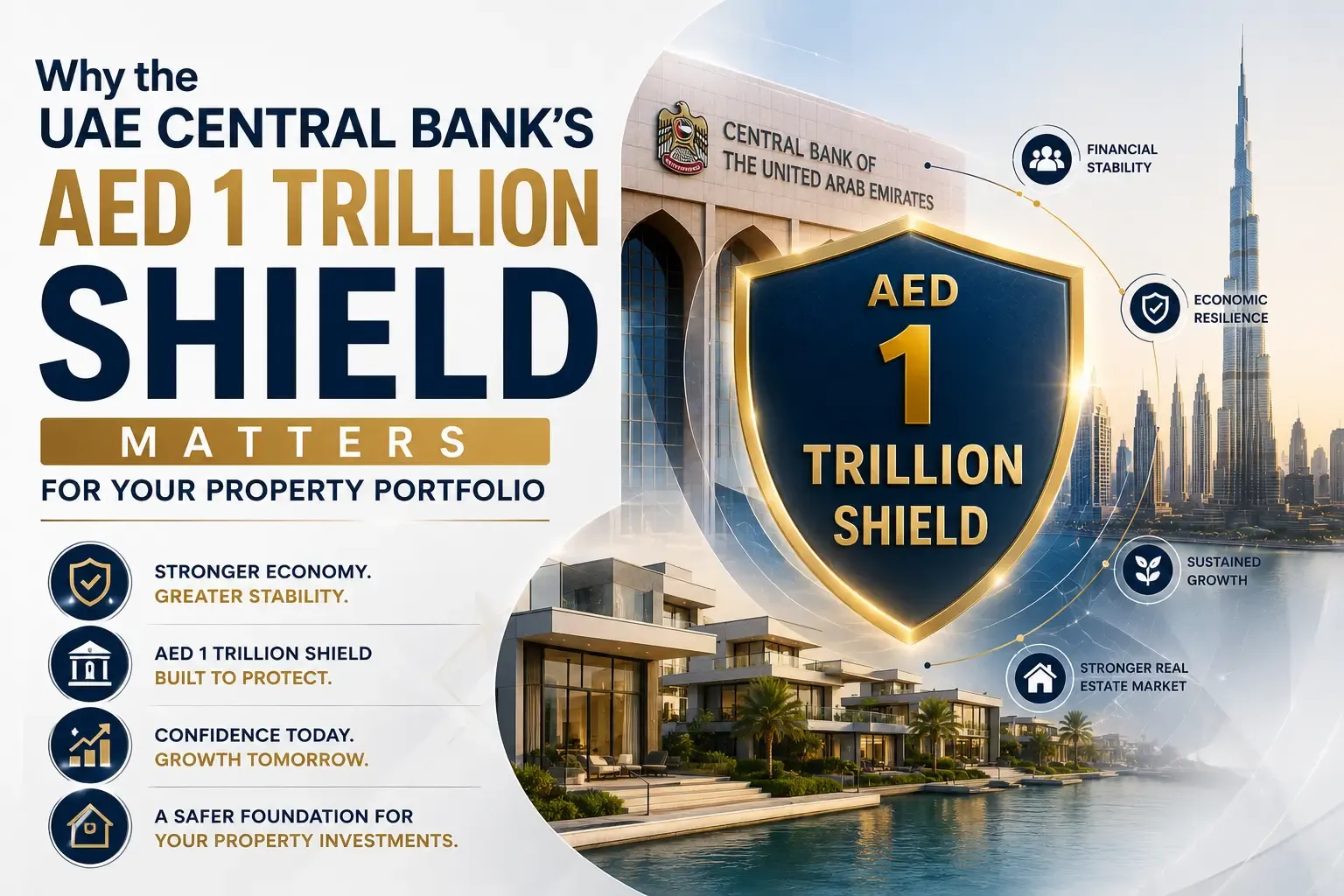
Why the UAE Central Bank's AED 1 Trillion Shield Matters for Your Property Portfolio

Table of Contents

Why the UAE Central Bank's AED 1 Trillion Shield Matters for Your Property Portfolio

Key Takeaways

  • On 17 March 2026, the UAE Central Bank deployed a Five-Pillar Financial Institution Resilience Package backed by AED 1 trillion in foreign exchange reserves
  • The package was chaired personally by Sheikh Mansour bin Zayed — UAE Vice President — signalling this was a government-level decision, not a routine banking measure.
  • Banks were instructed to keep lending. Your mortgage, your payment plan, and your investment are legally protected.
  • Loans affected by the regional conflict will not be reclassified as bad debt. This is written into the package.
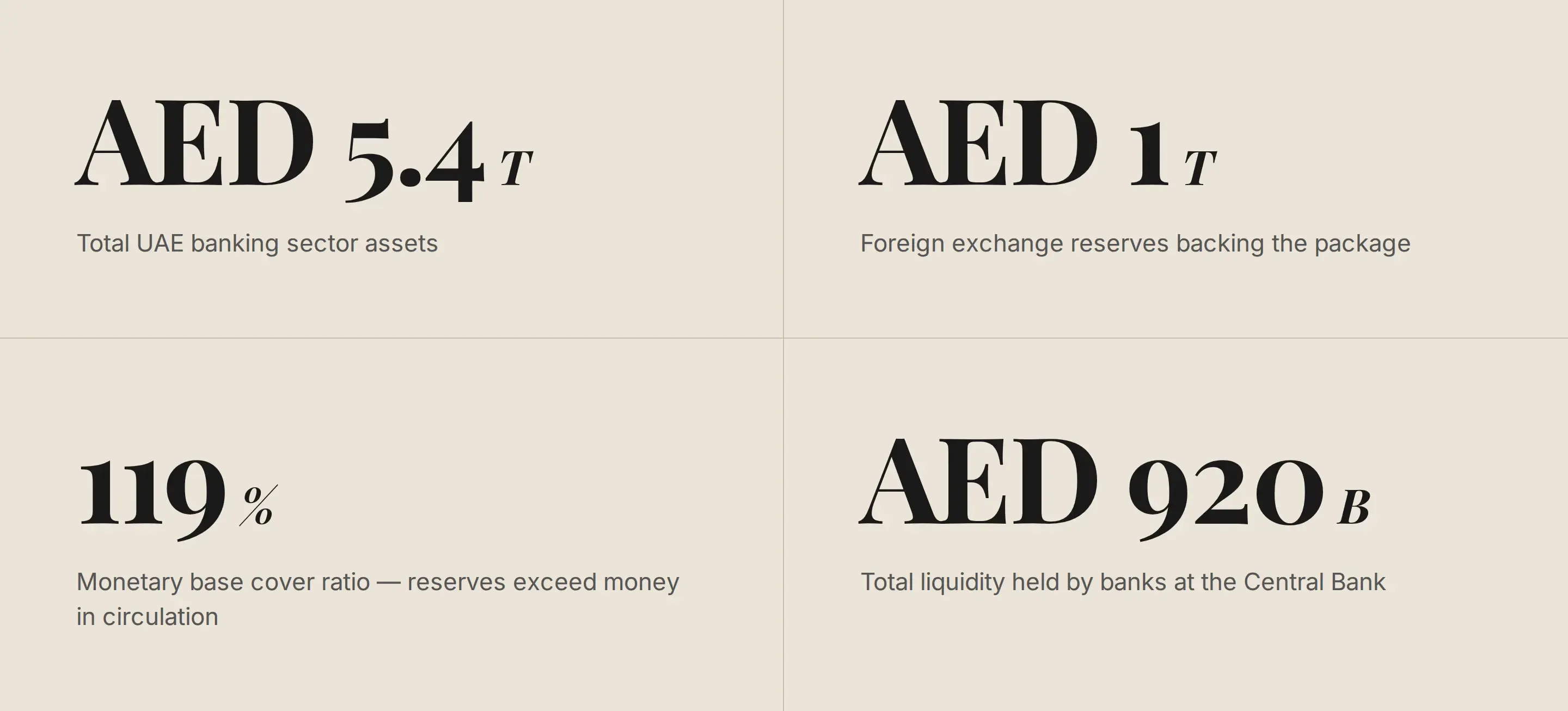
  • The UAE banking sector holds AED 5.4 trillion in total assets. The monetary base cover ratio is 119%. The system is not under stress.
  • If you own property in Dubai, this package directly protects the financial infrastructure around your investment.

What Happened

February 28 changed everything — and the government moved fast.

On 28 February 2026, the US-Israel-Iran conflict escalated. Missiles were intercepted over UAE airspace. Global markets reacted. Investor sentiment in Dubai dropped sharply.

In the first half of March, real estate transaction values fell 51% month-on-month. The Dubai Financial Market Real Estate Index dropped 21% in days. International investors paused.

Then, on 17 March 2026, the Central Bank of the UAE acted.

Sheikh Mansour bin Zayed, UAE Vice President and Chairman of the Central Bank Board, personally chaired an emergency meeting. The board approved the Five-Pillar Financial Institution Resilience Package — backed by over AED 1 trillion in foreign exchange reserves.

This was not a routine policy update. This was the UAE government putting its full financial weight behind the stability of the banking system — and by extension, your investment.

What Happened

February 28 changed everything — and the government moved fast.

On 28 February 2026, the US-Israel-Iran conflict escalated. Missiles were intercepted over UAE airspace. Global markets reacted. Investor sentiment in Dubai dropped sharply.

In the first half of March, real estate transaction values fell 51% month-on-month. The Dubai Financial Market Real Estate Index dropped 21% in days. International investors paused.

Then, on 17 March 2026, the Central Bank of the UAE acted.

Sheikh Mansour bin Zayed, UAE Vice President and Chairman of the Central Bank Board, personally chaired an emergency meeting. The board approved the Five-Pillar Financial Institution Resilience Package — backed by over AED 1 trillion in foreign exchange reserves.

This was not a routine policy update. This was the UAE government putting its full financial weight behind the stability of the banking system — and by extension, your investment.

Why the Central Bank Matters Here

This is not a banking story. It is an investor protection story.

The Central Bank of the UAE controls the financial system that every property transaction in Dubai runs through. Your mortgage. Your payment plan. Your escrow account. All of it flows through banks that the Central Bank regulates.

When the Central Bank acts decisively — and publicly — it sends one message to the market:

"The system is stable. Keep investing. Keep lending. We are in control."

The UAE banking sector holds AED 5.4 trillion in total assets. Foreign exchange reserves exceed AED 1 trillion. The monetary base cover ratio is 119% — meaning the UAE has more in reserves than it has in circulation.

This is not a fragile system being propped up. This is a strong system being reinforced.

Web.webp

What the Package Does

The five pillars — explained simply.

The Five-Pillar package is a structured set of measures. Each pillar does one thing. Together they make sure the banking system keeps working for you, not against you.

  1. Liquidity Access Banks can now tap up to 30% of their cash reserves immediately — in AED and USD. They do not need to slow down lending.

  2. Funding Relief Liquidity ratios have been temporarily eased. Banks have more room to lend to businesses and individuals.

  3. Capital Buffer Release Emergency release of capital buffers. Banks can now deploy more capital directly into the economy.

  4. Credit Flexibility Loans affected by the conflict will not be classified as bad debt. If your payment plan has been disrupted, the bank cannot penalise you for it.

  5. Additional Support Banks are explicitly instructed to keep lending to businesses and individuals. There is no credit freeze. There is no withdrawal of support.

Three Signals Investors Should Read Together

The package does not stand alone.

There are three things that happened in the same period. Read them together.

First. On 30 March 2026, Dubai's Executive Council approved a full Economic Initiatives Package — fee deferrals, customs grace periods, and relief across licensing, tourism, and residency. This was the government protecting businesses on the ground while the Central Bank protected the financial system above.

Second. Despite the conflict, Q1 2026 real estate transactions reached AED 252 billion — a 31% year-on-year increase. By April, transactions jumped another 20% month-on-month. The market dipped in March and came back immediately.

Third. On 29 April 2026, the UAE removed the minimum property value requirement for the two-year investor residency visa. A rule that had been in place since 2009 was abolished. The government was not contracting. It was expanding access.

Three separate government actions in sixty days — all pointing in the same direction. That is not a coincidence. That is a policy framework.

What This Means for You

If you own property in Dubai, read this carefully.

- If you own a property with a mortgage — your bank cannot restrict your loan because of the conflict. The Central Bank has prevented that. Your mortgage is protected. - If you are on an off-plan payment plan — any disruption caused by the conflict will not be treated as a default. Your payment structure is protected. - If you are looking to buy — mortgage rates are currently at some of their lowest levels in years. The Central Bank cut its base rate to 3.65% in December 2025. Banks are actively lending. - If you are worried about the market — look at the April 2026 numbers. Transactions rose 20% month-on-month after the conflict began. The dip was real. The recovery was faster. - If you are reviewing your portfolio — now is the right time. The market has separated into investors who understand what happened and those who are still reacting to headlines.

My View

I have been working with clients in Dubai for 11 years.

In that time I have seen the 2008 crash. I have seen the 2020 pandemic. I have seen every cycle this market has gone through.

This is the first time I have seen the UAE government respond to a crisis with a trillion-dirham financial package, a full economic relief program, and a major visa reform — all within sixty days of each other.

That is not a government that is managing a problem. That is a government that is protecting an asset.

The asset is Dubai. And if you own property here, it is also your asset.

Returns in this market may look different from what they were in 2021 or 2022. This is not a market for short-term speculation anymore. The government has made it clear that stability and long-term value are the direction.

For investors who understand that, this is still one of the best places in the world to hold property.

You need to be selective. You need to understand what you own. And you need to know what the government is doing around you.

That is why I write these pieces. Not to sell you something. To make sure you understand what is happening.

Contact Us