Dubai Property Market March 2026: What the Goldman Sachs Data Actually Means
Dubai property market 2026: institutional data, price trends & what Goldman Sachs research reveals and what it means for your portfolio.

Most of the calls I take from clients in early 2026 keep coming back with one question, just worded differently each time. Is the Dubai property market still going up, or are we at the top? Honestly, both things can be true at once, and the data sort of confirms that. This piece of writing reviews current numbers, past trends, forecasts, and investment strategy.
This is meant to be a real outlook, not a sales pitch. I. have stuck deliberately to data sources that have no commercial interest in selling property, the Dubai Land Department, the Central Bank UAE, the IMF, Fitch, Moody's and Henley & Partners. The numbers are what they are.
Going by Dubai Land Department records, the market kept setting records right into early 2026. January alone broke the all time monthly transaction record, with sector transactions clearing AED 72 billion. For full-year 2025, the official DLD numbers showed roughly 205,000 residential transactions worth approximately AED 540 billion. That was a 24.7% jump on 2024. Off-plan properties continued to dominate the activity, and mortgage transactions were up about 7.5% by volume and 46% by value year-on-year. So the financed buyer is meaningfully back in the market, not just cash.
There are some softer signals worth flagging too. March 2026 was the slowest month of the quarter and transaction volumes were down compared to the prior year. Bloomberg and Reuters both reported the DFM Real Estate Index dropping roughly 21% in the two weeks following the late February regional security incident. Goldman Sachs noted transaction values were down 51% month-on-month in early March. These look more like sentiment shocks than structural breaks. Median apartment prices per square foot were only down around 3% year on year through mid-March, and villa prices were actually still up roughly 16%.
Before assuming we're near the top, it's worth checking where Dubai's been before. There have been three notable cycle moments since the financial crisis, and each one had a different driver.
Back in 2014, prices peaked after the recovery that followed 2009. The cycle was largely speculation driven, off-plan flipping, new investor capital pouring in from Russia and the CIS region, easy credit. When oil collapsed in late 2014 and the dollar strengthened sharply against most currencies, Dubai prices started falling. Over the next four years they were down roughly 25%. The takeaway from that cycle was that markets built on flippers correct hard when the conditions change.
By 2017, the picture had changed. Dubai had absorbed the post 2014 fall, but Expo 2020 supply was now coming online faster than demand could absorb it. Prices essentially flatlined for nearly three years and then started declining again into 2020 with the pandemic. That cycle wasn't really speculation-led, it was supply driven. The correction was slower and a lot shallower as a result.
The current cycle, which got going in early 2022, looks different again. It started with Russian capital relocating after sanctions and then expanded into a much broader wealth migration story. Fitch's tracking puts current prices roughly 60% above where they were in early 2022. That's a bigger run than 2014 in dollar terms, but the buyer base today is more diverse and a lot more end-user oriented. Indian UHNI families, Chinese capital coming back, GCC families, and the residency driven inflow that Henley & Partners tracks are all replacing the speculative flipper base of past cycles.
That doesn't make a correction impossible. What it probably means is that the correction, if it does come, will be shallower and slower than 2014's was. A market driven by people who actually want to live somewhere just doesn't behave the same way as a market driven by people trying to flip.
We aren't at the start of a cycle anymore. We're also not in a crash. The most accurate way I can describe where we are is mature, late stage upcycle, with strong fundamentals underneath but some real localised risks. Prices have moved a long way in three years and the easy gains are largely behind us.
What's actually shifting beneath the headline numbers is the buyer mix. The market is moving from speculation led to end user led. Investors flipping off-plan properties used to drive much of the volume. In 2026 the buyer base is increasingly people who genuinely want to live in Dubai, run businesses here, get a Golden Visa, or relocate family. That's a healthier base, and it's why a lot of the more cautious institutional voices are calling this maturing rather than cooling.
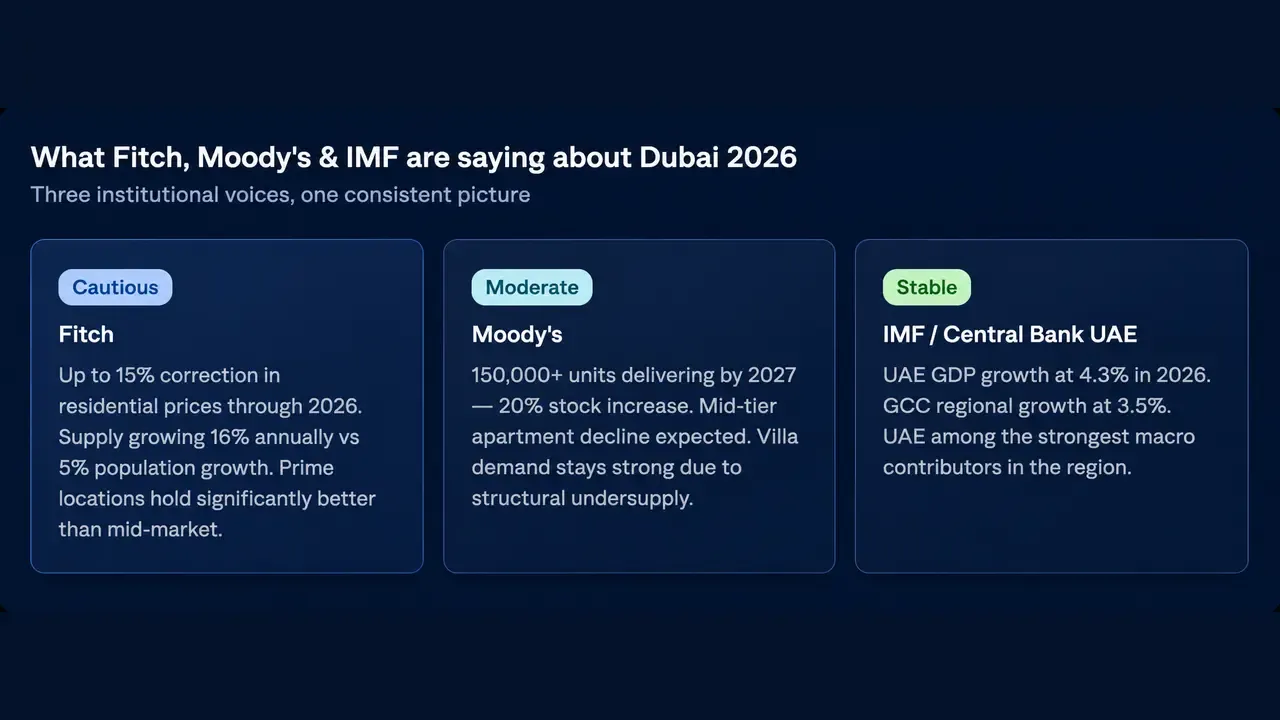
Fitch has been the cautious voice in this market. Their published outlook expects a moderate correction of up to 15% in residential prices through late 2025 and 2026, driven mostly by supply-absorption risk. The numbers behind that view are pretty straightforward: residential supply could grow at an average 16% annually over 2025 to 2027, against forecast population growth of only around 5%. Worth flagging though, Fitch says explicitly that this would be a market normalisation rather than a crash, and that prime locations should hold up considerably better than mid-market.
Moody's has taken a similar view but framed it differently. They project more than 150,000 new apartments and villas delivering across the UAE by 2027, which would lift Dubai's total housing stock by roughly 20%. Their expectation is moderate price decline from 2026, particularly in mid-tier apartments. Villa demand, on the other hand, they expect to stay strong because that segment is structurally undersupplied.
On the macro side, the Central Bank UAE Quarterly Economic Review has UAE GDP growth at around 4.3% in 2026, accelerating from 2025 on the back of both oil and non-oil sectors. The IMF puts GCC regional growth at 3.5% for 2025 with the UAE among the strongest contributors. Reuters reported in March that Citi cut its Dubai population growth forecast from 4% to 1%, which if it holds up would meaningfully soften the demand assumptions for the apartment pipeline.
This is the one risk worth taking seriously. Headlines often quote 71,000 to 120,000 residential units due in 2026. Sounds alarming until you compare those numbers to what actually delivers on time. Fitch noted that between 2022 and 2024, only 97,000 of 174,000 projected units were actually completed. That's a 56% historical completion rate. If you apply that to the 2026 forecast, likely deliveries are closer to 34,000 units.
More importantly, supply pressure isn't evenly distributed. The bulk of the new inventory lands in apartment-heavy corridors like Jumeirah Village Circle, Business Bay, and Dubai South. The villa pipeline is much tighter, which is the main reason villa prices keep outperforming apartments. Villa demand is high because of the family relocation story, supply is constrained, and the gap is what's pushing the segment up.
Headline market forecasts often hide what's actually going on underneath them. Different parts of the Dubai market are heading in different directions over the next two years, and lumping them together obscures more than it reveals.
Most of the supply pressure is landing here. Moody's expects mid-tier apartments to see the clearest price decline through 2026 and into 2027. The communities carrying the most risk are the ones with heaviest pipelines: Jumeirah Village Circle, Business Bay, Dubai South, and Azizi Venice. Prime apartment locations like Downtown, Marina-front, and Palm Jumeirah branded residences should hold up better. Within the apartment segment in general, branded residences and limited-supply boutique buildings are the safer bets.
Villas tell a very different story. The pipeline numbers from Knight Frank's tracking are well below what's coming online for apartments, both in 2026 and 2027. Demand is being driven by the wealth migration story, the Henley & Partners data points to nine thousand eight hundred millionaires expected in the UAE in 2025, most of them buying for occupancy rather than as an investment. They want villas. Established communities like Emirates Hills, Palm Jumeirah, and District One shall outperform, and off-plan villa launches from Tier-1 developers look strong on a five year view.
This segment is more resilient because the buyer pool here is family office and wealth migration driven, not yield-driven. The broader supply correction Fitch and Moody's are projecting shouldn't really affect it much. Branded residences from OMNIYAT, Bulgari, One&Only, and similar tier-1 names should continue setting per-square-foot records through 2026 and 2027.
Commercial sits on a separate cycle to residential. Office demand is being driven by financial services migration and family office relocation, and Grade A office space in DIFC and Downtown is structurally tight right now. Retail is more mixed and depends a lot on tourism numbers, which the IMF is expecting to stay strong through 2026.
The Henley & Partners 2025 Wealth Migration Report has the UAE as the world's leading destination for relocating millionaires for the fourth year running. The record net inflow they're forecasting is around 9,800 millionaires settling in the UAE in 2025, up from 6,700 in 2024. That's the structural demand backdrop, and it doesn't go away because Fitch flagged a possible 15% correction.
If you're holding a portfolio, this isn't really a moment to sell. The structural drivers GDP growth, sustained wealth migration, regulatory maturity are all still firmly in place. If you're buying, segment matters more than ever. Prime villas and constrained supply communities still look strong on a five-year view. Apartments in the heavy supply corridors are carrying real correction risk through 2026 and into 2027. Off-plan in tier-1 developer projects in supply-constrained locations is probably the most resilient play available right now.
None of this is a guarantee on direction. What it does suggest is that the case for selective Dubai real estate exposure remains intact, even at this stage of the cycle. The investor who does well over the next three years is unlikely to be the one who buys everything or sells everything. It's the one who picks the right segment in the right location at the right entry price.
Most of the conversations I have aren't with first-time Dubai buyers. Most are with people who already own here and want to know how to position for what's coming. A few practical observations from those calls.
If your portfolio is sitting heavy in apartments in the high-supply corridors, this is probably the year to think about rebalancing. Selling a unit or two in JVC, Business Bay or Dubai South ahead of the correction Moody's is expecting, and rotating that capital into prime villa or branded apartment exposure, is a reasonable move. Transaction costs are real and they will eat into the gain, but the segment shift matters more than the friction.
If you're holding legacy off-plan positions in tier-1 developer projects with handovers scheduled for 2027 or 2028, the rational move is usually just to hold. The structural undersupply on villas means handover values are likely to come in meaningfully above your purchase price, and exiting now generally locks in less profit than waiting it out.
On mortgaged property, the Central Bank's most recent quarterly review suggests UAE policy rates should ease modestly through 2026 alongside the global rate cut cycle. So refinancing existing facilities in the second half of this year may be worth modeling. This isn't a recommendation, every situation is different and the answer depends on your specific facility, your loan-to-value, and your lender. But it's worth running the numbers with your bank.
And if you are holding properties as a non-resident with no immediate plans to relocate, this is also a good moment to think about the Golden Visa pathway. The recent regulatory changes have made it materially easier to convert AED 2 million-plus property holdings into a long-term residency anchor. That changes how the asset behaves in the rest of your portfolio. It stops being a passive investment and starts working as a residency platform too.
If you are thinking about how to invest in Dubai real estate, or how to adjust an existing portfolio for the cycle ahead, reach out for a private conversation. My practice handles family office portfolios, NRI investors, and international UHNI clients and the right call for any one of them in 2026 is segment-specific. Generic advice doesn't really work in this kind of market. All conversations are confidential.
A crash isn't what credible analysts are forecasting. Fitch's published outlook flags the possibility of up to a 15% correction in residential prices through late 2025 and 2026. Moody's expects moderate price decline in mid-tier apartments specifically, with villas continuing to outperform.
The Oasis by Emaar, The Valley by Emaar, Bay Villas at Dubai Islands by Nakheel and the upcoming Bay Estates phase.
Dubai property market 2026: institutional data, price trends & what Goldman Sachs research reveals and what it means for your portfolio.
Dubai property in 2026 is driven by institutional data, disciplined supply, investor demand, tax advantages and stable yields. Invest with data, not noise
Dubai's real estate market hit AED 917B in 2025 transactions. Discover why family offices and HNW investors are making Dubai a structural portfolio allocation.