
Dubai Real Estate The Ultimate Guide for First-Time Investors
Looking to invest in your first property in Dubai. Here is an ultimate guide for Dubai Real Estate. Read about returns, ROI, ROE. Know more with Xperience Realty.
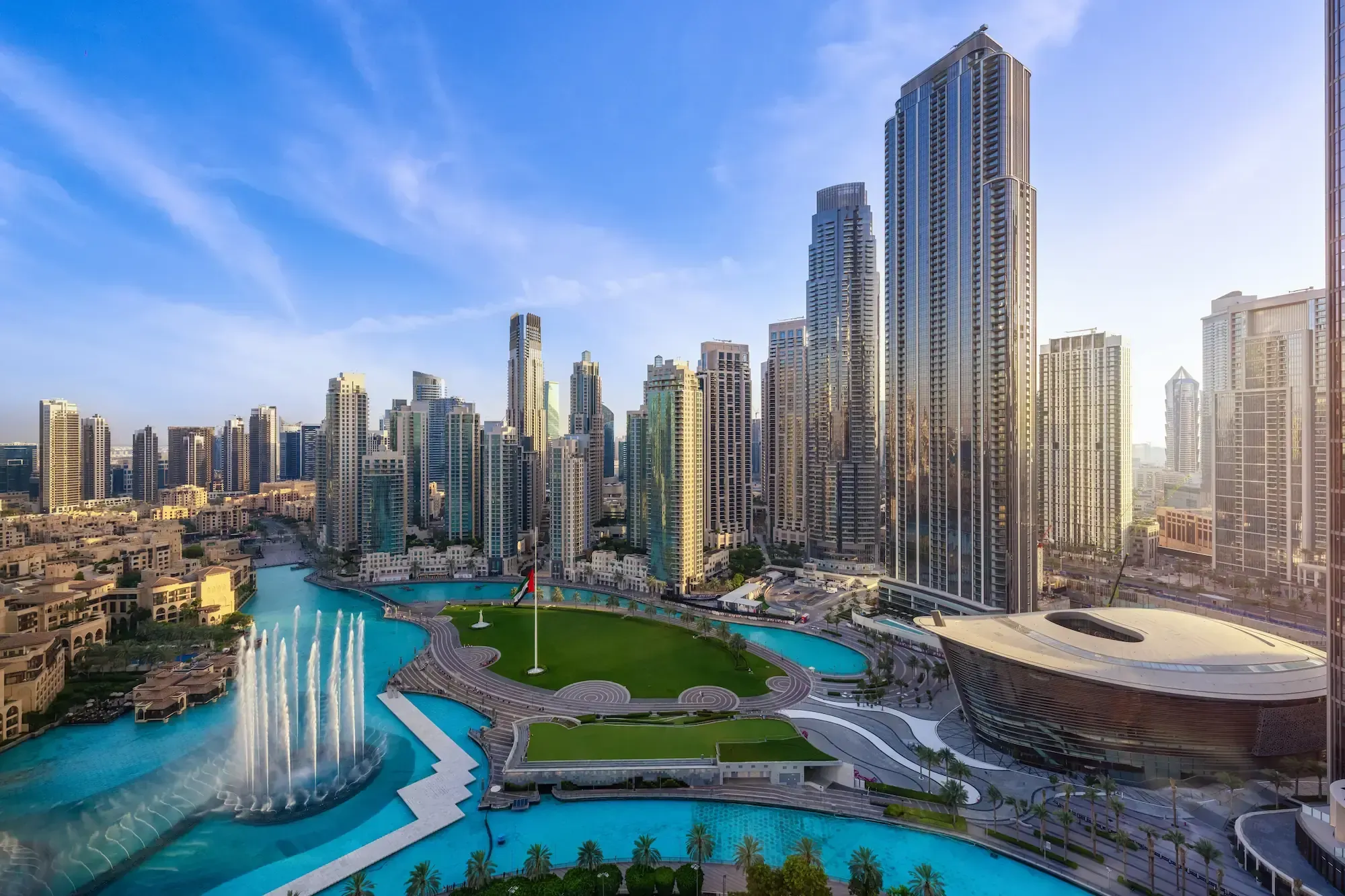

With the instability in the region and various doubts with investors across the globe. Here is what the data, the fundamentals, and the ground-level deal flow actually say beyond the headlines. Yes for disciplined investors focused on asset quality. Dubai has served as a safe harbour for capital during periods of regional tension .With residential yields of 5–8%, population above 4 million , and consistent top-3 global ranking for millionaire inflows the real risk is not geopolitics , it is buying the wrong asset.
Most investors are conflating two separate questions. Understanding the distinction is the first step to making a clear-headed capital allocation decision.
Question one: Is Dubai safe as a city and jurisdiction? The answer is unambiguous yes. Dubai is not a conflict zone. It has deliberately positioned itself as a neutral financial hub where capital from all sides of every geopolitical divide flows freely. That neutrality is not accidental; it is strategic national policy, maintained consistently across decades.
Question two: Does geopolitical uncertainty in the broader region negatively affect Dubai real estate as an investment? That is a far more nuanced question and it is the one this briefing is designed to answer with data, not sentiment.
The most consistent mistake investors make during periods of uncertainty is conflating short-term sentiment with long-term fundamentals. These are two different signals requiring two different responses.
According to Reuters (2026), Dubai has seen short-term moderation in transaction volumes amid geopolitical tensions. Buyer decision timelines have extended on average, by 2 to 4 weeks. Hesitation, not exit, is the defining characteristic of current market behaviour.
In a global environment where developed markets are offering yields of 2–3% with significantly higher tax burdens, Dubai's combination of income yield, liquidity, and zero personal income tax remains structurally compelling.
Sentiment creates hesitation. Fundamentals create opportunity. Right now, you have both operating simultaneously which is precisely why disciplined investors are paying close attention.
Theory is one thing. Ground level deal flow is another. Here is what is consistently visible across current investor conversations and active transactions.
According to data from the Dubai Land Department and CBRE, transaction activity has moderated from peak 2023–2024 levels while remaining structurally above pre-cycle averages. Three patterns are visible in current deal flow:
Buyers are delaying, not exiting.
| PROPERTY TYPE | NEGOTIATION RANGE | CONDITION |
|---|---|---|
| Ready properties motivated seller | 10–15% | Seller requires liquidity |
| Ready properties standard prime market | 5–8% | High-liquidity, proven locations |
| Near-ready off-plan Tier-1 developer | 3–5% | Strong completion track record |
| New off-plan launches generic | Minimal | Avoid — overpriced relative to supply |
When others pause, strategic investors position. That is not a comfortable place to operate from but it is consistently where the best long-term entry points occur. As PwC notes, the combination of pricing inefficiency and reduced competition from non-strategic buyers creates a risk-adjusted return profile that does not exist in high-confidence market environments.
At Xperience Realty, we use a three-part framework when advising investors allocating capital into Dubai in the current environment. We call it: Buy Reality. Buy Liquidity. Buy Demand.
Off-plan speculation carries higher risk in the current cycle particularly from developers without a verified track record. Ready assets offer income from day one and eliminate construction delivery risk. If buying off-plan, verify the developer has a documented history of on-time delivery at quality: EMAAR, OMNIYAT, and Nakheel are benchmarks.
Downtown Dubai, Business Bay, Dubai Marina, and Dubai Hills have structural demand floors deep tenant markets, strong resale liquidity, and consistent international buyer interest. Peripheral locations dependent on infrastructure that does not yet exist do not offer the same exit certainty. In uncertain periods, liquidity is not a bonus it is a requirement.
This is where corporate and expatriate tenant demand is deepest, where international buyer concentration is highest, and where the yield-to-price ratio is most compelling. The segment also offers the strongest exit optionality neither too illiquid (ultra-luxury) nor too exposed to oversupply (entry-level).
| METRIC | CURRENT RANGE | NOTES |
|---|---|---|
| Entry price (Business Bay apt.) | ~AED 2.8M | Mid-luxury, prime location |
| Rental yield | 6–6.5% | Strong corporate tenant base |
| Negotiation potential | 5–8% | On asking price, current market |
| Recommended holding horizon | 3–5 years | For income + capital upside |
| Risk profile | Moderate | Asset-specific: due diligence required |
Note: Individual deals vary. Figures reflect broader ranges currently transacting in prime mid-luxury segments. Always conduct independent asset-level due diligence.
It is equally important to be clear about where capital should not go. Not everything in Dubai will perform from here and in a selection-driven market, the wrong asset in a strong city is still the wrong asset.
According to Deloitte, Dubai's infrastructure expansion continues to reinforce long-term real estate demand but that long-term thesis does not apply uniformly across all sub-markets or asset types. The biggest risk in Dubai real estate today is not the geopolitical backdrop. It is buying the wrong asset in a city that, at the headline level, still looks strong.
| DRIVER | DATA POINT | SOURCE |
|---|---|---|
| Wealth migration | Consistent top-3 globally for net millionaire inflows | Henley & Partners |
| Population growth | Projected ~5M residents by 2030 | Dubai Government. |
| Apartment yields | 5–7% in prime locations | JLL, Savills 2026 |
| Villa yields | 4–6% in prime locations | JLL, Savills 2026 |
| Infrastructure expansion | Reinforcing long-term real estate demand | Deloitte |
| Tax environment | Zero personal income tax, zero capital gains tax | UAE Federal Tax Authority |
Markets like Dubai do not collapse during uncertainty they pause. And then they reward those who moved with clarity while others were waiting for comfort. In 2026, the question is no longer whether Dubai is a good market. The real question is whether you are buying the right part of it.
Yes Dubai is a politically neutral financial hub and has historically served as a safe harbour for capital during periods of regional tension. Fundamentals remain intact: residential yields of 5–8% (JLL, Savills 2026), population above 4 million (Dubai Statistics Center, 2025), and consistent top-3 global ranking for millionaire inflows (Henley & Partners). Short-term transaction moderation has been observed, but long-term structural drivers are unchanged.
Historically, regional conflict has caused short-term sentiment-driven moderation in Dubai transaction volumes, but has not reversed long-term price trends. According to Reuters (2026), transaction activity has seen temporary softening. However, CBRE notes that periods of reduced velocity shift pricing power toward buyers creating negotiation opportunities of 5–15% on ready properties in select cases.
Dubai apartments in prime locations are currently yielding 5–7%, and villas 4–6%, according to JLL and Savills 2026 market reports. The AED 2M–5M mid-luxury apartment segment particularly in Business Bay, Dubai Marina, and Dubai Hills is achieving the upper end of the apartment yield range.
Motivated sellers with liquidity requirements have shown willingness to adjust pricing by 10–15% on ready properties in select cases. Standard prime-market negotiation is running at 5–8%. Tier-1 developer off-plan pricing remains largely firm at list rates.
The AED 2M–5M mid-luxury segment in prime, liquid locations Downtown Dubai, Business Bay, Dubai Marina, Dubai Hills offers the strongest combination of yield, tenant depth, and exit optionality. Focus on ready or near-ready assets from Tier-1 developers (EMAAR, OMNIYAT, Nakheel) with a 3–5 year holding horizon.
According to JLL, sub-markets with aggressive future supply pipelines face pricing pressure. Avoid overpriced off-plan launches without product differentiation, peripheral locations dependent on unbuilt infrastructure, and developers without a verified on-time delivery track record.
Looking to invest in your first property in Dubai. Here is an ultimate guide for Dubai Real Estate. Read about returns, ROI, ROE. Know more with Xperience Realty.
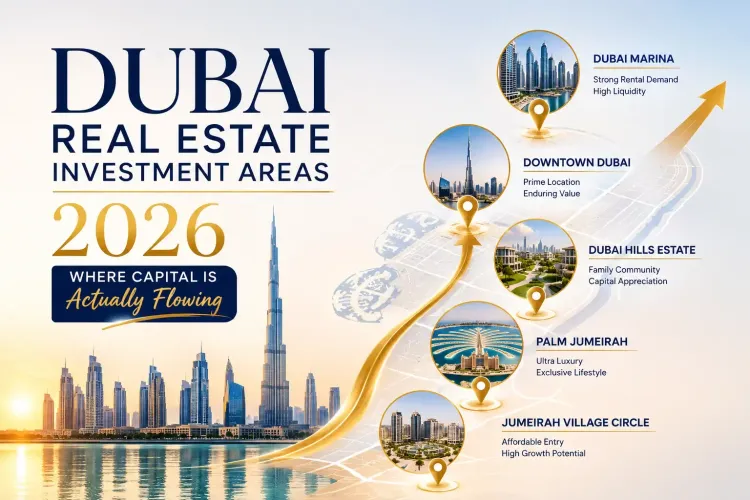
Discover the best Dubai real estate investment areas in 2026, from Dubai Hills Estate and Palm Jumeirah to Dubai South, where capital is actually flowing.
Discover why the UAE Central Bank’s AED 1 trillion financial expansion could strengthen Dubai’s real estate, boost investor confidence, and create new opportunities for property buyers and global investors. Read to know more