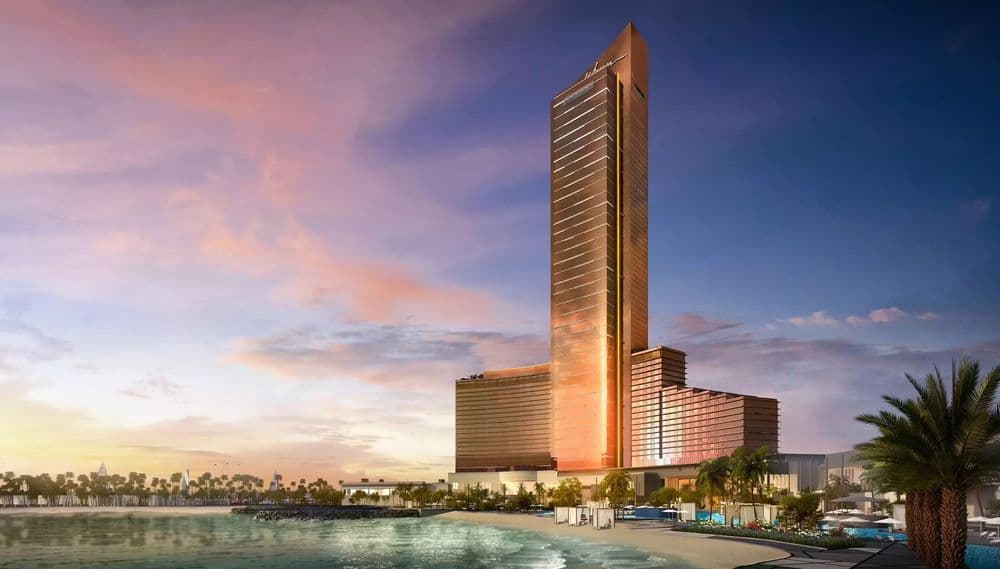
Wynn's resort is running late, and instead of pulling back, it put another $600 million in

Table of Contents
Wynn Resorts moved its Ras Al Khaimah opening to September 2027 and raised the budget by about $600 million. The delay led every headline. The $600 million is the part that carries information.
What Wynn actually said on 4 August
On 4 August 2026, Wynn Resorts reported its second-quarter results. It was a routine earnings call. It also contained the clearest thing anyone has said about the UAE this year.
Wynn Al Marjan Island is the resort being built on a man-made island in Ras Al Khaimah. It holds the UAE’s first commercial gaming facility operator licence, issued by the General Commercial Gaming Regulatory Authority in October 2024. It will have 1,530 rooms and suites. Wynn owns 40% of the joint venture building it. Marjan and RAK Hospitality Holding hold the rest.
Two things changed that day.
-
The opening moved to September 2027. Chief executive Craig Billings said Wynn "now expect the project to open its doors to the public in September 2027". Wynn’s last published guidance, in February 2026, was "the first quarter of 2027".
-
The budget went up. Billings: "We are increasing the total project budget for Wynn Al Marjan Island by approximately $600 million."
That is about six months, and about 12% more money.
One correction first. Much of the coverage says the resort slipped from March 2027. March 2027 was never Wynn’s date. It came from Marjan’s chief executive in September 2025. Wynn’s own guidance was a quarter, not a month. Wynn had also already flagged a delay in May 2026, without sizing it. So 4 August was the number being put on a known problem. It was not a surprise.
The reason, in the company’s own words
Billings gave the cause in the prepared remarks, on the record, to shareholders:
"As development of Wynn Al Marjan Island progresses, regional conflict-related disruptions initially impacted global supply chains and continue to impact the shipping insurance markets."
"This has required certain materials and equipment to be resourced, rerouted or expedited to ensure the project’s construction time line."
In plain English: the war broke the shipping routes. Insurance for ships is still expensive. So steel, stone, lifts and kitchens had to be bought somewhere else, sent a different way, or flown in. All three cost money.
A delay with a reason is information. A delay with no reason is a rumour with a date on it. This one has a reason. A chief executive gave it, on a call his company files with the SEC.
The "HALF" is being reported wrongly
Several outlets ran a version of "about $300 million of war costs". That is not what he said.
His words: "Of that, approximately half is directly attributable to disruption from the regional conflict, material cost increases, shipping cost increases and the preopening and capitalized interest costs."
-
Read the list. That is four cost buckets in one sentence, not one. The conflict is the first item. It is not the whole item. Capitalised interest, the last item, is just the interest on the money borrowed to build, added to the cost of the building. Six more months of building means six more months of that.
-
J.P. Morgan reads the other half differently again. Its analysts put it down to scope: the project got bigger. Wynn disclosed a separate all-suite tower, the Enclave, earlier in 2026.
So the $600 million splits roughly like this. Some is the war. Some is inflation on materials and shipping. Some is the cost of building for longer. And about half is Wynn choosing to build more. That last part is not an overrun. It is a decision.
The commitment is in the cash, not the language
Any chief executive can say he is committed. The filing is where you check.
-
$1.06 billion. Wynn’s own cash put into the project since it started, as at 30 June 2026. It contributed $48.1 million in the second quarter alone.
-
$525m to $650m. What Wynn still expects to put in, on its 40% share. This figure includes the neighbouring Janu hotel, not only the Wynn resort.
-
40%. Wynn’s exact stake. Not a licence deal. Not a management contract. Equity.
Billings, same call: "We continue to believe this will be the most exciting integrated resort opening globally in over a decade, and we remain as committed to and confident in the UAE as ever."
Then, answering an analyst on geopolitical risk, he said this about the country:
"This is a country that absorbs pressure and keeps functioning rather than one that gets knocked off course by it."
He did not stop there, and neither should anyone quoting him: "I’m not going to tell you there’s no risk, but when we underwrote the project, we didn’t underwrite a region with zero geopolitical risk. We underwrote a country with the demonstrated ability to manage through it."
That is the honest version, and it is better than the clean one.
Now the part you need to hear
Wynn added money into a market that had a hard six months.
Ras Al Khaimah’s tourism authority reported that hotel occupancy in the first half of 2026 fell 19 percentage points against the same period in 2025. Airport arrivals dropped by about 80% within two months of the conflict starting. European guests fell by close to 90%. Room rates held, and a domestic campaign brought in 127,000 extra UAE visitors, which is why total arrivals still set a record. But the international guest, the one a $5 billion resort is built for, largely stopped coming.
Philippa Harrison runs the Ras Al Khaimah Tourism Development Authority. In August she said it is "still too early to describe international travel as recovered", and that recovery "remains vulnerable and volatile".
The property market moved with it. The ValuStrat Price Index for Ras Al Khaimah fell 0.5% in the second quarter of 2026. That is its first quarterly fall since the index was set at 100 in early 2024. Transaction value across the emirate had already fallen 24.7% in 2025, on Cavendish Maxwell’s count.
None of that is a reason to look away. It is the context that makes the capital decision worth reading. Wynn saw those six months from the inside and put more money in.
Anton Lopatin, Senior Director covering UAE banks at Fitch Ratings, told Fortune on 1 June 2026: "It’s a much more mature market now with better oversight and the government would step in if they needed to because they know that investor confidence is crucial for Dubai." He was talking about Dubai. The mechanism he is describing is the same one Billings is pricing.
One island, four price numbers, all of them real
If you have been shown a price per square foot for Al Marjan Island, check what it measures. Four figures are in circulation and they do not agree.
-
AED 2,200 per sq ft. Ras Al Khaimah average asking price, June 2026, on Bayut’s listings data. Down just over 3% over 12 months.
-
AED 2,428 per sq ft. Prime Ras Al Khaimah apartments, prices actually achieved in 2025, per CBRE. A cycle high.
-
AED 1,160 per sq ft. Al Marjan Island apartments, second quarter of 2026, on ValuStrat’s valuation of built stock.
-
AED 3,092 versus AED 1,525 per sq ft. Knight Frank’s median asking prices on Al Marjan for branded and non-branded homes, December 2025.
Asking price is what a seller wants. Valuation is what a surveyor says finished stock is worth. Achieved price is what someone paid. The gap between AED 2,200 and AED 1,160 is not one of them being false. It is the difference between unsold new towers and homes people already live in. Ask which one you were quoted. Then ask which one your exit depends on.
My view
Read the action, not the date.
A company listed on Nasdaq looked at a war, a broken supply chain and a six-month slip. It has shareholders, and it files with the SEC. It chose to spend $600 million more rather than walk. It has $1.06 billion of its own cash in already. That is a capital decision, made in public, under scrutiny. The people making it know more about that island than I do. It is worth more than any forecast I could give you.
But conviction is not a timeline, and it is not a price.
Here is what I actually do. I plan for 8 to 12% growth a year. Not the numbers Ras Al Khaimah printed in 2024 and 2025. If a deal only works because a casino opens on time, it is not a deal. It is a bet on a building schedule. That schedule has now moved once.
So, by situation:
-
If you own on Al Marjan and planned to sell at handover. Your date moved. The thing that reprices that island now lands in September 2027, not the first quarter. Check whether your payment plan and your exit still line up, because for a lot of 2027 handovers they no longer do.
-
If you own and rent it out. Very little has changed for you. Room rates held through the worst of it, and your tenant did not read the earnings call. Do nothing.
-
If you are buying now. You are buying into a market where asking prices are ahead of valuations and 97% of the pipeline is apartments. That is not an argument against apartments. It is an argument against buying the one that is identical to the 400 handing over beside it. Buy the floor, the view or the frontage that cannot be repeated. Sameness is the risk, not the category.
-
If you are buying branded at AED 3,000 per sq ft. You are paying roughly double the non-branded price on the same island. That can be right. Make it a decision rather than an assumption.
That is my view. It is a position, not a prediction. I have been wrong on timing before and I will be again.
Why I wrote this
A chief executive of a Nasdaq-listed company was asked about the UAE. He answered carefully, with numbers, on the record. Almost nobody quoted him. The headline was the delay.
The delay is a construction story. The $600 million is a conviction story. And the four price numbers on one island are the reason you should never buy from a single figure.
I track Al Marjan pricing every month. If you own there, or you are looking at it, message me and I will send you the file.
Thinking about your next Dubai property?
Talk to an XRealty specialist — market guidance, shortlists, and honest advice, no obligation.
Frequently Asked Questions
Yes. It will have 1,530 rooms and suites and holds the UAE’s first commercial gaming facility operator license. Wynn’s ongoing capital investment, despite regional disruptions, is proof of its long-term confidence in the project and the broader UAE market.
Wynn owns 40% of the joint venture developing Wynn Al Marjan Island, with the other stake held by Marjan and RAK Hospitality Holding. This is an equity stake, not a licensing or management agreement.
Wynn added about $600 million to its overall project budget. The increase is due to conflict disruption, increased material costs and an increase in project scope.
It is a resort being constructed on a manmade island in Ras Al Khaimah, UAE. It has the country’s first commercial gaming facility operator license, issued in October 2024.

Related Articles
 Invest In Dubai
Where to Buy in Dubai in 2026: Five Areas for Different Buyer Priorities
A practical guide to five Dubai locations for end users, long term growth buyers and income focused investors.
 Market News
One Visa, Six Gulf Countries: What the GCC Grand Tours Visa Could Mean for Dubai Property
Explore how the planned GCC Grand Tours Visa could influence Dubai tourism, holiday homes and property demand—and what remains unconfirmed.
 Off Plan
Dubai Islands Explained: Five Islands, Five Different Property Decisions
Understand Dubai Islands through its five planned districts, from Central and Shore Island to Golf, Marina and Elite Island, before choosing a property.