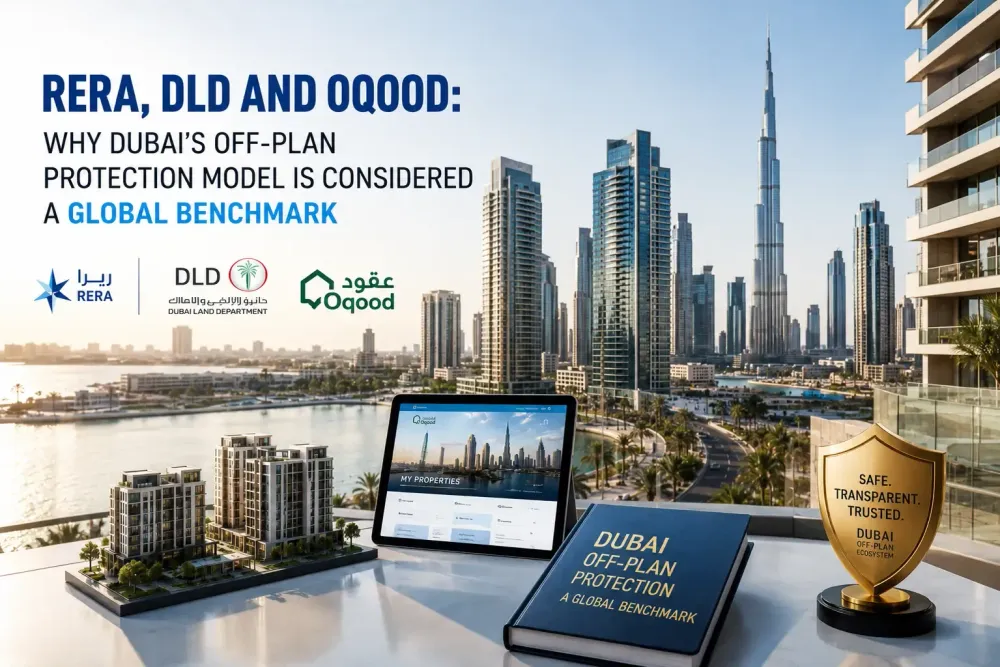
RERA, DLD and Oqood: Why Dubai’s Off-Plan Protection Model is Considered a Global Benchmark

Table of Contents
Every year, many HNI's, UHNI’s, institutional investors, and seasonal investors commit millions of dirhams to Dubai’s real estate market, and such large scale investments are secured by strong legal and regulatory frameworks that build greater confidence of investors and promote transparency at every stage. However, local or international investors and homebuyers hesitate to make any significant investment, as everyone wants clarification regarding their rights and protection before taking any big step. Hence, it is important to understand how Dubai’s real estate system works and how the regulatory authorities offer genuine protection and security to investors by strict regulations and strong management frameworks.
The Escrow Account System: Where your Money Actually Goes?
-
The escrow account system is a mandatory account according to the guidelines of RERA, which is the Real Estate Regulatory Agency in Dubai that comes under the Dubai Land Department (DLD) itself.
-
This offers one of the strongest protections to buyers' investments because once an off-plan property is approved by RERA, then all the investment goes into a dedicated escrow account, and the funds are only released after specific milestones are verified by the regulatory authorities.
-
This ensures that your investment does not directly go to the developers but is safe in an escrow account, and developers can only claim the money installments after certain construction goals are verified and approved by the authorities.
RERA protections for NRI's
This mechanism is considered a benchmark for the protection of investors, as investors who want to invest in an off plan property in Dubai from overseas can feel confident that their money will be safe and protected; and it prevents developers from using funds from one project to finance some other project or use the investors' money in any unrelated business activity.
Oqood: Your Legal Claim Before the Title Deed Exists
Oqood is an official registration certificate for an off-plan property in Dubai before it is completed. This system is to protect investors regarding their rights over the off-plan property because the property is not ready yet, and so a title deed cannot exist at this stage. In order to secure ownership rights, Oqood serves as legal evidence that the property has been registered under the buyer or investor’s name. Later when the off plan property is completed, at the time of handover, Oqood is converted into a title deed.
RERA’s Role: Project Registration, Audits and Cancellation Rules
Along with an escrow account, the regulatory authorities also do regular inspections and audits to monitor the construction progress throughout the construction period and track the development and construction milestones to maintain accountability and to ensure the developers are meeting their obligations or not.
- Even before an off-plan property or project is launched in Dubai, the involvement of RERA is already there. This is because no developer can simply start any project; they first have to get the project approved by the authorities, like establishing an official escrow account and proving the ownership of the land for the off-plan project and other approvals by the Dubai Land Department. If these commitments are not met, then no developers are permitted to sell any units.
- Even after the project is approved to be marketed or advertised publicly, RERA continues to monitor the construction progress. This ensures transparency and security that gains the confidence of the investors and buyers, making Dubai’s real estate market one of the most sought-after markets for investing in an off-plan property.
What Happens If a Project is Delayed or Cancelled?
The Dubai real estate market is actually well immune to delays, although sometimes, delays due to shortages of construction materials or labor or unforeseen events like natural calamities, wars or pandemics that are beyond human control can happen. But a delay does not mean that your investment is at risk.
However, if any significant delay occurs, then RERA intervenes and investigates the whole process. The authorities require the developer to address the issues or revise the construction plans accordingly and take suitable measures so that the project can move forward. Meanwhile, the funds are still safe in the escrow account, as the money cannot be freely used.
Sometimes in rare cases, when a project cancellation is required, the Dubai Land Department oversees the whole cancellation process, and a refund policy is also available for those it is applicable to based on the agreements between the parties.
Red Flags: How to Verify a Project Before Paying
While Dubai’s real estate market is highly secure and regulated, it is always recommended that buyers and investors perform diligence before making any significant investments on their own end to not get caught up in any unauthorized project.
- The very first thing is to verify if the off-plan property is registered with Dubai Land Department/RERA or not, as without approval of the authorities, no developer can sell any units.
- Next, verify the official escrow account dedicated to your project to confirm if the transactions or payments are deposited into it or not. In case a developer refuses or seems unwilling to share these details, then consider it a warning sign.
- One of the most important steps you can take is to track the history of a developer to understand their reliability and accountability related to the completion of the projects.
- Read the agreements, clauses, and documents related to your off-plan property carefully to avoid any misunderstandings later.
- It is also recommended to be cautious about any claims that seem too good to be true, promising any unrealistic returns or extreme values.
Off-Plan Risk vs Ready Property Risk: An Honest Comparison
Where an off plan property offers lower investment rates, a ready property provides instant ownership rights. However, the choice completely depends upon investors' personal planning and goals. An off plan property can be a long-term investment as the prices may appreciate in the future after the property is completed, but the buyers and investors must wait throughout the construction period.
On the other hand, with a ready property, you can inspect it properly before making any investment, begin a lifestyle with your family, or even start earning through rental income once the purchase is completed. Also, investors don’t have to go through any waiting period, as the property is already completed. However, sometimes because of competitive market or area design strategy, only limited units are available. So, the final decision depends on investors’ personal preferences, and factors like budget, long-term goals, and other objectives like risk tolerance should be considered to understand the safer side for you.
Thinking about your next Dubai property?
Talk to an XRealty specialist — market guidance, shortlists, and honest advice, no obligation.
Frequently Asked Questions
Yes. Developer bankruptcy is highly unlikely in Dubai due to its strong regulatory frameworks and safeguards. The escrow account system further ensures that payments are only released when construction milestones are verified.
All the payments made by investors are deposited into an escrow account. However, the developers don’t receive the funds directly or all at once, but the funds are released in stages only after regulatory authorities approve the construction progress.
Yes, buyers and investors can get a refund if a project is cancelled, depending on the financial situation of the project and the funds left in the escrow account. After proper authority checks and assessments, eligible buyers may receive refunds accordingly.
Oqood is an official registration document before an off-plan property is completed, issued under the name of the buyer or investor to protect their ownership rights during the construction period of the property. And later when the property is completed, Oqood is converted into a title deed after the handover.

Related Articles
 Market News
Dubai Office Market Stays Strong in Q3 2026 with More Affordable Deals
Explore Dubai's office market in Q3 2026, including commercial property prices, affordable office deals, investment opportunities and market trends.
 Market Pulse
Why Invest in Abu Dhabi?
Discover why investing in Abu Dhabi real estate in 2026 makes sense. Explore property market trends, rental yields, capital growth and top investment areas.
 Invest In Dubai
Why the World's Richest Are Choosing Dubai Over Every Other City
Discover why the world’s wealthiest investors and entrepreneurs are choosing Dubai for luxury real estate, tax advantages, global connectivity, safety and long term growth.