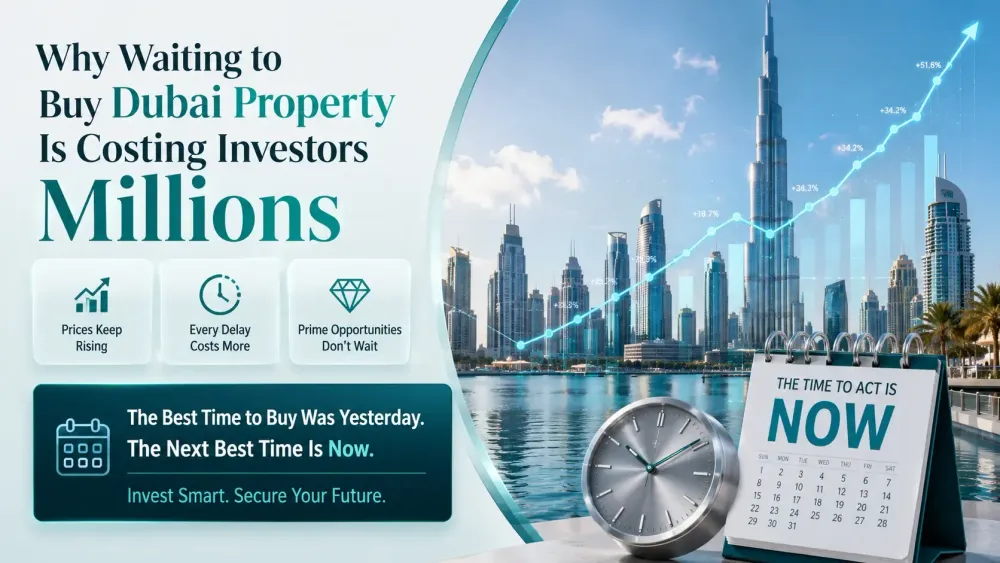
Why Waiting to Buy Dubai Property Is Costing Investors Millions

Table of Contents
The Wait-and-Watch Trap Why "I'll Buy When Things Settle" Is the Most Expensive Strategy in Dubai
Why investors who delay during volatility consistently underperform those who act during it, what the historical data on Dubai cycles actually shows, and why the impulse to wait for clarity is the single most expensive habit in the Dubai market today.
Key Takeaways
- Waiting for clarity feels prudent but is structurally the most expensive strategy available in Dubai real estate, costing roughly 7 to 15 percent of entry price plus worse terms over a typical cycle window.
- Knight Frank's 2020 to 2025 cycle data shows buyers who deployed during the COVID panic captured the full 78 percent cumulative price appreciation; buyers who waited until clarity captured roughly half.
- The information cycle has four phases: shock, sentiment-driven dislocation, normalisation, and clarity. The window for advantageous deployment is phase two; clarity arrives after pricing has already re-rated.
- DALBAR Quantitative Analysis of Investor Behavior research shows individual investors lose 200 to 400 basis points annually to behavioural timing decisions across asset classes, and the same pattern operates in Dubai real estate.
- The March 2026 window stayed open approximately eight weeks before terms tightened and pricing recovered; the next window will probably be shorter as the Dubai information environment continues to densify.
1. The most popular strategy in any uncertain market
Through Q1 2026, with the conflict tensions and Goldman's reports of a 51% month-on-month volume drop and apartment prices off 3% year-on-year, the most popular strategy among prospective Dubai buyers was the same one that emerges in every uncertain market. I'll wait. Let things settle. See where the dust lands. Buy when there's more clarity.
This sounds prudent. It feels safe. It is also, by a meaningful margin, the most expensive strategy in the Dubai market. Not in absolute return, the buyer who waits and never enters at all is simply absent. Among investors who eventually do enter, those who waited for clarity systematically underperformed those who acted during volatility. The data on this is unambiguous, the mechanism is explainable, and the trap is repeating right now in real time.
PwC Economics Advisory training, Accenture mortgage modelling through the post-2008 recovery, and the institutional research on Dubai cycles all converge on the same conclusion. Waiting feels rational because uncertainty is uncomfortable. Acting during uncertainty produces measurably better outcomes than acting after it resolves. The investor's instinct and the data are pointing in opposite directions, and almost everyone follows the instinct.
2. What "clarity" actually costs
Clarity is not free. It carries a price in the form of higher prices, worse terms, and reduced selection. The clarity premium is what every buyer who waits ends up paying. Knight Frank's retrospective on the 2020-2025 cycle shows roughly 78% cumulative price appreciation across the run. Buyers who deployed during the COVID panic in 2020 captured close to the full curve. Buyers who waited until the recovery was visible in 2021 captured roughly half. Same asset, different timing, dramatically different decade. The 2020 panic looked like the obvious moment to wait. It was, in fact, the obvious moment to act.
Consider a specific kind of decision pattern that played out across multiple buyer mandates through Q1 2026. A buyer with around AED 25m evaluates a Dubai Hills Estate four-bedroom and an Emaar Beachfront three-bedroom in February 2026. Specific units identified, provisional terms in place. When the conflict period begins, the buyer pauses. The instinct: prices will fall further, more inventory will emerge. By the time the committee reaches alignment in late May, the Dubai Hills villa has transacted to another buyer at approximately 8% above the February negotiation. The Emaar Beachfront unit is no longer available at the original payment plan. The buyer closes comparable positions in July at roughly 7-9% above March pricing, with less favourable terms. The clarity the buyer waited for cost approximately AED 2m in entry price across the two positions. This is not an unusual case. It is the standard outcome for buyers who wait through Dubai uncertainty windows, and the pattern has repeated through every major cycle on record.
3. The information cycle, and why clarity arrives late
Clarity is a lagging signal, not a leading one. By the time the market is clearly recovering, prices have already adjusted to reflect that recovery. The window where uncertainty creates negotiating leverage closes before clarity arrives. Phase one is shock arrival, sentiment turns sharply cautious, transaction velocity drops, prices hold. Phase two is sentiment-driven dislocation, motivated sellers emerge with specific timing pressure, terms move significantly even when prices do not. Phase three is normalisation, sentiment recovers, prices rise to reflect the structural reality, terms normalise. Phase four is clarity, the buyer who waited now arrives, but at phase three pricing on phase three terms.
The window for advantageous deployment is phase two, exactly when sentiment is most cautious and the impulse to wait is strongest. Goldman Sachs' March data captured this in the current cycle. Volumes collapsed in the first half of March. By April, the ceasefire framework was emerging. By May, comparable inventory was relisting at higher prices in Tilal Al Ghaf and Dubai Hills. The phase-two window in Q1 2026 was open for roughly eight weeks before it began to close. The next equivalent window will probably be shorter, because the Dubai information environment is denser now and global buyers read the same data within hours. Buyers who pre-defined their positions and were ready to act captured the window. Buyers who waited for clarity captured phase three pricing.
4. Two specific historical cycles
-
Dubai 2008-2009 was the deepest dislocation in the market's history. Prices fell roughly 50% peak-to-trough across multiple submarkets through 2009. Buyers who deployed during the worst quarters of the crisis, when the headlines were unrelenting and the structural picture was genuinely uncertain, were positioned for the recovery curve that began in late 2010 and ran through 2014. Average price recovery in tier-1 submarkets like Downtown, Dubai Marina core, and Emirates Hills was roughly 80-100% over the 2010-2014 window. Buyers who waited until clarity, post-recovery 2011-2012, captured 30-50% of the same curve.
-
Dubai 2020 COVID. The panic moment was March-April 2020, with global capital markets in distress and Dubai-specific tourism shock layering on top of the broader uncertainty. Knight Frank's tracking shows the buyers who deployed during this window captured roughly the full 78% cumulative price appreciation through 2025. The buyers who waited until the recovery was visible by Q1 2021 captured roughly half. Both cycles produced the same pattern. The act-during-uncertainty cohort outperformed the wait-for-clarity cohort by a wide margin. This is not anecdotal. It is a structural feature of how recovery curves work in real estate markets, and it is why every cycle's wait-for-clarity strategy underperforms despite its intuitive appeal.
5. The behavioural economics underneath
Why does the wait-for-clarity strategy persist when the data is clear? Behavioural finance research, including the long-running DALBAR Quantitative Analysis of Investor Behavior series, identifies several reinforcing biases that explain it. Loss aversion makes uncertainty disproportionately uncomfortable. The pain of buying just before further declines is felt more acutely than the pleasure of buying near the bottom. Investors avoid the pain by waiting, even though the expected value calculation favours acting.
Recency bias makes the most recent information disproportionately weighted. When sentiment is cautious, the most recent headlines feel like the most relevant signal. The structural reality, which has not changed, gets discounted relative to the immediate news flow. Confirmation seeking means investors who are inclined to wait will find data points supporting that decision. Bear-case analyst reports, soft transaction prints, anecdotal evidence of motivated sellers will be over-weighted, while contrary evidence will be discounted.
The combination produces a predictable pattern. Investors wait for clarity. By the time clarity arrives, prices have re-rated. The investors who waited then face a worse decision: chase higher prices or remain on the sidelines indefinitely. Most chase, paying the clarity premium. Some remain sidelined, missing the structural opportunity entirely. Both are worse outcomes than acting during the uncertainty window. The behavioural pattern is so reliable that institutional investors construct explicit frameworks to override it. Pre-defined positioning criteria. Committee structures that compress decision timelines. Cash reserves earmarked specifically for deployment during volatility. The frameworks exist because the natural impulse runs in the wrong direction, and because individual investors who do not impose structure on themselves consistently make the wrong choice.
6. What "acting during uncertainty" does not mean
It is worth being precise about what the framework does not advocate. Acting during uncertainty does not mean buying anything at any price during volatility. It does not mean ignoring fundamentals. It does not mean catching the falling knife on declining assets. The wait-for-clarity trap and the buy-anything-during-volatility error are both bad strategies; the right approach lies between them.
The right approach is positioning. Pre-defined criteria for what constitutes an acceptable position, identified before the volatility window opens. When the window arrives, the buyer is ready to act on opportunities that meet the pre-defined criteria, not on opportunities that simply exist. The criteria do the work of separating genuine opportunities from apparent bargains. In current Dubai context, the criteria might be: tier-1 submarket, top-tier developer counterparty, demonstrated secondary market liquidity, price within a defined range relative to recent comparable transactions, terms that reflect the seller's specific timing pressure rather than a general market view. A position meeting these criteria during a volatility window is a clear act. A position that doesn't is a clear pass, regardless of how attractive the headline price looks. This is what professional capital does, and it is what the wait-for-clarity instinct prevents retail capital from doing. The instinct says wait. The discipline says wait for what you actually want, then act fast when it appears.
7. The current window
Through Q1 and into Q2 2026, the wait-for-clarity instinct has been extremely strong. The March conflict period is recent enough to remember. The April ceasefire framework is being processed. The supply wave is genuinely arriving. Sentiment is cautious. Most buyers are still waiting. This is, almost certainly, the wrong response. The structural drivers of Dubai demand have not weakened. Knight Frank reported 2025 residential sales at AED 544.2bn across 205,400 transactions. Henley projected another 9,800 net HNWI inflows through 2025 and 165,000 globally relocating in 2026. Q4 2025 was the highest quarterly sales total on record at AED 187.47bn. December 2025 alone showed 51.98% year-on-year growth in sales value. The structural picture is unchanged. The sentiment picture is temporarily disconnected from it.
Specific opportunities currently visible in the broader market. Secondary market motivated sellers, particularly UK non-doms accelerating sales to redeploy, are accepting offers 5-10% below January 2026 asking on tier-1 inventory in Dubai Hills, Tilal Al Ghaf, and Emaar Beachfront. Top-tier developers are quietly extending post-handover payment plans on select inventory in ways not advertised at launch. Off-market inventory is appearing through broker networks at terms that would not be available six months from now. None of this will persist into a phase-three normalisation. The window will close, probably in the second half of 2026, possibly faster. Buyers who pre-define their positions and execute through the window will outperform meaningfully. Buyers who wait for clarity will pay phase-three pricing.
8. The structural argument against waiting
The waiting strategy is asymmetric in the wrong direction. The upside of waiting is bounded by the magnitude of further price decline (which historical data suggests will be modest in tier-1 product). The downside is uncapped, you may pay a clarity premium that materially exceeds any decline you avoided, or you may remain sidelined and miss the structural opportunity entirely.
Acting through pre-defined positioning has the opposite asymmetry. The downside is bounded by the structural quality of the asset and the discipline of the pre-defined criteria. The upside is the full structural opportunity, captured at terms that will not be available in phase three. Over a 5-10 year hold, the difference between acting in phase two and acting in phase three is typically 7-15% of entry price plus meaningfully better terms, which compounds into a portfolio outcome that is significantly better. This is what waiting actually costs in Dubai. The instinct is to think waiting is the safe choice. The data says waiting is the most expensive strategy available, more expensive than acting during the worst sentiment, and far more expensive than choosing not to participate in the cycle at all. If you are evaluating Dubai right now and your default is to wait, the structural arithmetic is working against you. The window for advantageous deployment is open. It will not stay open through the end of 2026.
About the Series
The Dubai Allocation is a 20-part research release published by Xperience Realty in May 2026, treating Dubai real estate as a capital allocation decision rather than a transactional one. The release functions as a 2026 mid-year house view, written for principals, family offices, and internationally mobile capital evaluating Dubai through the rest of 2026 and beyond. The full research package is available at xrealty.ae.
Thinking about your next Dubai property?
Talk to an XRealty specialist — market guidance, shortlists, and honest advice, no obligation.
Frequently Asked Questions
Probably not, in tier-1 segments. Knight Frank forecasts 3 percent prime growth in 2026 even within the dispersion cycle, and the structural drivers of Dubai demand remain intact. Mid-market segments in supply-pressured clusters may offer some price softening, but the highest-quality positions are unlikely to see meaningful declines.
Across multiple Dubai cycles, waiting for clarity has cost buyers roughly 7 to 15 percent of entry price plus meaningfully worse terms, compounded into significantly worse total returns over typical 5 to 10 year holds. The 2020 COVID window cost waiters roughly half the cycle's 78 percent cumulative appreciation.
Behavioural finance research identifies three reinforcing biases: loss aversion makes uncertainty disproportionately uncomfortable, recency bias overweights immediate news flow versus structural reality, and confirmation seeking finds reasons to support an already-formed inclination to wait. The combination produces a predictable pattern of late entry.
The most recent meaningful conviction premium window was March to early April 2026 during the regional conflict period, when tier-1 inventory transacted at 4 to 9 percent better terms than were available in February. The window closed within roughly eight weeks of the April ceasefire framework.
Pre-define the submarket, developer, price range, and acceptable terms before any window opens. Build broker relationships during normal markets so information flow is in place during volatility. Maintain liquidity reserves earmarked specifically for deployment during dislocations. Act on pre-defined criteria when conditions appear, rather than waiting for clarity.

Related Articles
 Lifestyle and Community
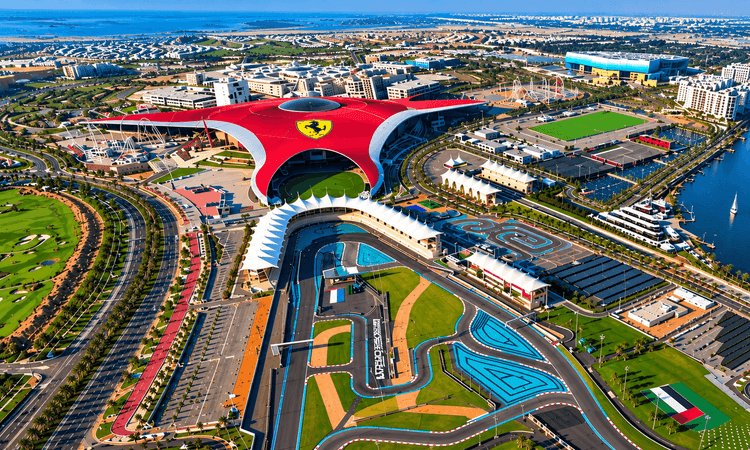
Yas Island Abu Dhabi: The Complete Guide to Lifestyle, Property and Investment (2026)
Explore Yas Island, Abu Dhabi: top communities like Water's Edge, Mayan, Noya and Yas Acres, plus rents, schools, attractions and Golden Visa tips.
 Invest In Dubai
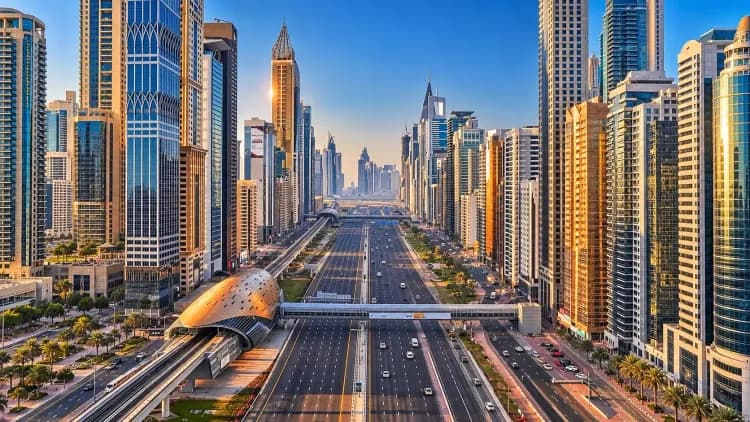
Where to Buy in Dubai in 2026: Five Areas for Different Buyer Priorities
A practical guide to five Dubai locations for end users, long term growth buyers and income focused investors.
 Market News
One Visa, Six Gulf Countries: What the GCC Grand Tours Visa Could Mean for Dubai Property
Explore how the planned GCC Grand Tours Visa could influence Dubai tourism, holiday homes and property demand—and what remains unconfirmed.