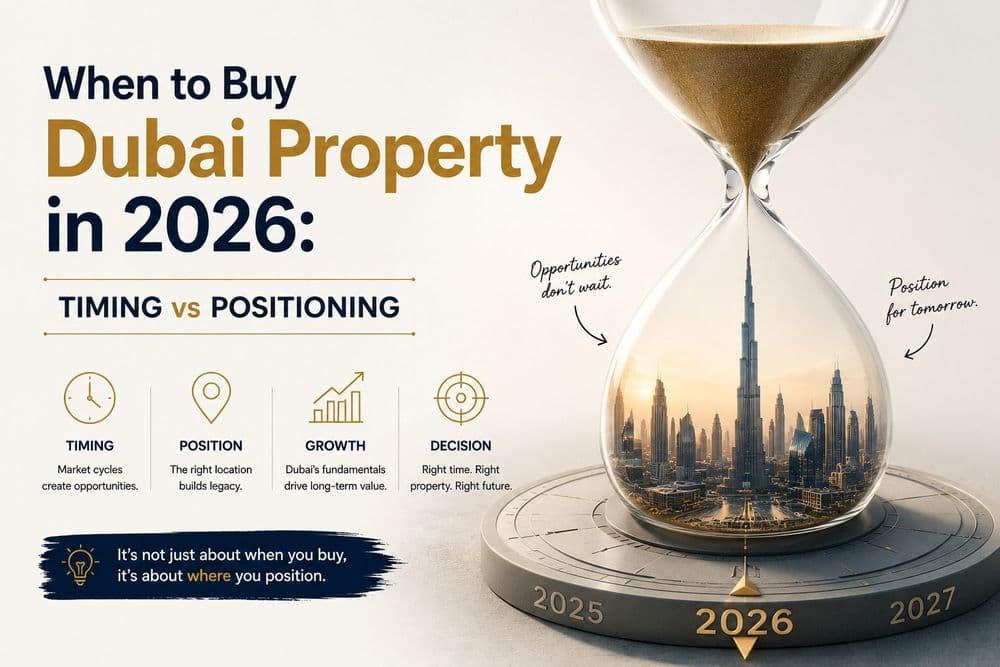
When to Buy Dubai Property in 2026: Timing vs Positioning

Table of Contents
Key Takeaways
- Timing is the attempt to enter at the lowest price; positioning is the attempt to enter the right asset at terms that reflect the structural case rather than the news cycle.
- Dubai 2026 is a dispersion environment with Knight Frank projecting 3 percent prime against 1 percent mainstream growth, where within-segment selection dominates timing by a wide margin.
- Five variables define a position: asset tier, developer credibility, supply concentration in the immediate cluster, exit liquidity profile, and price relative to fundamentals (not relative to peak).
- Knight Frank's 2020 to 2025 retrospective shows roughly 78 percent cumulative price appreciation in this third freehold cycle; buyers who deployed during the COVID panic captured close to the full curve while those who waited for clarity captured roughly half.
- The March 2026 conviction premium window stayed open approximately eight weeks; the next equivalent window will probably be shorter as the Dubai information environment continues to densify.
The wrong question, asked confidently
The question that comes up first in almost every Dubai conversation is some version of: should I buy now, or wait? It is reasonable. It is also, almost always, the wrong frame for the decision in front of the buyer.
Timing is the attempt to enter at the lowest price. Positioning is the attempt to enter the right asset, in the right submarket, from the right counterparty, at a price that reflects the structural case rather than the news cycle. These look similar from the outside. They produce very different results over a decade. The post-2008 US residential mortgage cycle, which I worked on for four years at Accenture during the recovery period, made the lesson visible at scale. When an asset class is dispersing across segments, within-segment selection dominates timing by a wide margin.
Dubai 2026 is dispersing. Knight Frank's house view for the year is around 3% growth in prime against around 1% in mainstream. That is a 3x spread inside the same city. Inside those numbers, individual submarkets are running on different physics. A buyer focused on timing is optimising the wrong axis.
What bad timing actually costs
-
The cost of bad timing on a tier-1 Dubai asset is bounded. Buy a four-bedroom villa in Dubai Hills Estate at the absolute peak, hold for ten years, and the structural drivers will probably bring you back to a respectable total return even if the next 18 months are flat. Supply constraint, replacement cost, sticky end-user demand. None of these depend on you having timed the entry well.
-
The cost of bad positioning is not bounded. Buy a one-bedroom in a peripheral JVC tower at the cycle low, and you can hold for a decade and still trail cash equivalents because the asset itself faces yield compression and a thin secondary market. Even perfect timing into a structurally weak position is hard to rescue. Behavioural finance research on equities, the DALBAR Quantitative Analysis of Investor Behavior series being the most cited, finds investors lose more to bad asset selection than they ever lose to bad timing. The asymmetry widens when within-market spreads are largest, which is exactly where Dubai sits now.
-
The cleanest illustration in the current market is what happened to off-plan resale activity by late 2025. Cavendish Maxwell's Property Monitor data showed in-construction resale activity sitting at single-digit percentages of off-plan flow. Most of the buyers who acquired in the 2024 launch frenzy on the assumption they could flip before handover are now stuck holding. The bottoms and tops they thought they were timing turned out to matter much less than the inventory they ended up with.
Five variables that actually define a position
-
A genuine position in Dubai real estate is defined by five things, and timing is not one of them. The first is asset tier. Is this prime villa or branded waterfront in a supply-constrained submarket; an infrastructure-led growth corridor; or high-density apartment stock in a supply-pressured cluster? Knight Frank's 2026 split between 3% prime and 1% mainstream is the public version of this. The submarket-level variation is wider.
-
The second is developer credibility. Emaar, Nakheel, Sobha, Aldar, and Meraas have delivery records that span cycles. The next tier down has a much wider distribution of execution risk. A merely-good unit from a top-tier developer is, in my experience, a structurally better position than a well-located unit from a marginal counterparty, because the payment plan is doing real credit work in the first case and it is not in the second.
-
The third is supply concentration in the immediate cluster. Cushman & Wakefield's research has noted that around 45% of all under-construction residential stock in Dubai concentrates in just five districts: JVC and JVT, Dubai South, MBR City, Business Bay, and Dubailand Residence Complex. A unit in any of those five is competing with a wave of comparable inventory at handover, regardless of how attractive the headline numbers look at booking.
-
The fourth is exit liquidity. Some submarkets transact at institutional-grade depth: Palm Jumeirah villa stock, Dubai Hills four-bed family product, Emaar Beachfront secondary. Others transact thinly. The same purchase price means very different things in those two environments, and most retail buyers do not figure this out until they try to exit.
-
The fifth is price relative to fundamentals, not relative to peak. The honest baseline is recent comparable transactions in the actual Dubai Land Department record for the specific submarket and product type. Anything priced against a broker's stated market value is marketing.
The opportunity uncertain markets actually create
-
Uncertainty does not just create timing windows. It creates positioning windows that are invisible to capital focused on price. When the March 2026 conflict period compressed velocity, Goldman Sachs reported transaction values down around 51% month-on-month and roughly 37% year-on-year in the first half of March, with apartment prices off only 3% year-on-year and villa prices still up 16% year-on-year. The headline was a small price discount. The actual opportunity was different.
-
Sellers with specific timing pressure (relocations, restructurings, divorce, currency stress) became willing to negotiate on terms that had little to do with peak-to-trough pricing. Extended post-handover payment tails on premium developer product. Waived DLD registration fees. Free service charge periods. Off-market access to inventory that never made it to the public portals. These are positioning concessions, and they are available to capital that arrives with cash and decisiveness rather than with a bid for the absolute bottom. Across the broker community in March, multiple transactions closed at terms that would not have been available in February, and almost none of them were because of a price collapse. They were because sellers under specific pressure wanted certainty more than they wanted maximum price.
How position-driven capital actually thinks
-
Timing-driven capital asks: is this the right time to buy? Position-driven capital asks: is this the right asset, at terms that reflect the structural case, with a counterparty I am willing to credit-underwrite? The first question has no defensible answer in real time. The second has an answer that can be tested against data.
-
Position-driven capital pre-defines the target. Before the window opens, the buyer knows the submarket, the developer, the price range that reflects fundamentals, the role this position plays in the portfolio. When the window arrives, the decision is fast, because the analytical work is already done. The remaining question is whether a specific opportunity meets the pre-defined criteria. This is the discipline that separates institutional money from retail money across dispersion cycles. The institutional version is comfortable being inactive when the market is loud and active when it is quiet, because the trigger is not sentiment, it is the appearance of an asset that fits a position the buyer already knows they want. Retail capital does the opposite, because retail capital is responding to attention, and attention is loudest at the worst times to deploy.
Two buyers, same window: an illustration
-
Consider two AED 15m mandates moving through the Dubai market in parallel through Q1 2026. Both buyers equally informed. Both facing the same March uncertainty window. The decision logic produces materially different outcomes, and the comparison is worth working through in detail because it illustrates how the timing-versus-positioning distinction plays out in real allocation decisions.
-
The first approached it as a timing problem. Are prices going to fall further? They pulled together views from Fitch, Moody's, and broker commentary, looking for a directional signal. The analysis was thorough and inconclusive, which is the structural fate of timing analysis in real time. Each new data point produced fresh reanalysis. The window closed sometime in late April. By the time the buyer reached internal alignment in late May, the specific Dubai Hills Estate four-bedroom they had been tracking had transacted to someone else, and the closest comparable was around 6% above what was available in mid-March. They eventually bought a similar villa at a higher price, on a less differentiated plot.
-
The second buyer approached it as a positioning problem. Their pre-defined target was a four-bedroom Dubai Hills Estate villa in a mature sub-community with visible secondary transaction history, ideally with golf-facing orientation, from a seller with specific timing pressure who would accept cash and a 21-day close. They had identified the position before the window opened. When the March uncertainty produced motivated seller inventory, they were ready. They closed at around 5% below January asking, with the seller absorbing the transfer fees. The structural case had not changed. Only the terms moved. Twelve months on, the position is appreciating roughly in line with Knight Frank's prime forecast, and rental achievement is on projection.
The pattern across cycles
-
The same pattern has played out through every meaningful Dubai dislocation on record, and through the post-2008 US residential cycle that I spent four years inside the data of at Accenture. The 2008-09 cycle in Dubai produced extraordinary positioning opportunities, but only for capital that knew which submarkets would recover first and which would stay weak. Downtown, Dubai Marina core, Emirates Hills came back. Older International City, undifferentiated peripheral stock did not, or at least not on the same curve.
-
The 2020 COVID window followed the same pattern. Knight Frank's retrospective on this third freehold cycle shows roughly 78% cumulative price appreciation across the run from 2020 through 2025. Buyers who deployed during the COVID panic captured close to the full curve. Buyers who waited until the recovery was visible captured roughly half of it. Same asset, different entry, different decade. The 2022 Russia-Ukraine window produced a smaller version of the same dynamic. In each case, the positioning thesis was straightforward in retrospect. Tier-1 assets in supply-constrained submarkets from credible developers, acquired during sentiment-driven volume freezes. The timing thesis was unanswerable in real time.
What this means for the next eighteen months
-
Through 2026 and into 2027, my working expectation is that velocity will recover faster than sentiment, and that the positioning windows will get shorter than they used to be. The Dubai information environment is denser now. Buyers globally read the same data within hours. The 2008 window stayed open for the better part of two years. The 2020 window stayed open for nine months. The March 2026 window was open for roughly eight weeks before it began to close. The next one will probably be shorter.
-
Buyers who try to time those windows in real time will mostly miss them. Buyers who pre-defined their position, identified the developer counterparty, established what terms would constitute a deal worth taking, will move fast when the conditions appear. The arithmetic of the next decade rewards decisions made against structural analysis far more than it rewards predictions made against sentiment. That is what positioning actually is. It is doing the work in advance, so that when the moment arrives the decision is ready.
About the Series
The Dubai Allocation is a 20-part research release published by Xperience Realty in May 2026, treating Dubai real estate as a capital allocation decision rather than a transactional one. The release functions as a 2026 mid-year house view, written for principals, family offices, and internationally mobile capital evaluating Dubai through the rest of 2026 and beyond. The full research package is available at xrealty.ae.
Thinking about your next Dubai property?
Talk to an XRealty specialist — market guidance, shortlists, and honest advice, no obligation.
Frequently Asked Questions
For tier-1 prime villa stock in Dubai Hills Estate, Tilal Al Ghaf, and similar communities, and for branded residences and prime waterfront, 2026 offers a positioning window with structural support from supply scarcity and HNW migration. For undifferentiated mid-market apartment stock in supply-pressured clusters, the entry timing is less favourable.
Waiting for clarity is structurally the most expensive strategy in Dubai. The 2020 COVID buyers captured the full 78 percent cumulative cycle appreciation; buyers who waited until recovery was visible captured roughly half. The March 2026 window closed in eight weeks. Acting on pre-defined criteria during volatility consistently outperforms waiting for clarity.
Most investors should not attempt market timing. The institutional approach is positioning: pre-define the submarket, developer, price range, and terms that constitute an acceptable position before any window opens, then act fast when the conditions appear. Across multiple Dubai cycles, positioning beats timing by 200 to 400 basis points annually.
The worst entry times are late-cycle phases when sentiment is loudest and pricing has fully re-rated to reflect the recovery. Buyers who arrive after clarity systematically pay phase-three pricing on phase-two opportunities, capturing roughly 50 percent of the structural opportunity that was available 12 to 18 months earlier.
Positioning-driven investing pre-defines the target asset, submarket, developer, price range, and acceptable terms before any volatility window opens. When the window arrives, the decision is fast because the analytical work is already done. The institutional version is comfortable being inactive during loud markets and active during quiet ones.

Related Articles
 Invest In Dubai
Where to Buy in Dubai in 2026: Five Areas for Different Buyer Priorities
A practical guide to five Dubai locations for end users, long term growth buyers and income focused investors.
 Market News
One Visa, Six Gulf Countries: What the GCC Grand Tours Visa Could Mean for Dubai Property
Explore how the planned GCC Grand Tours Visa could influence Dubai tourism, holiday homes and property demand—and what remains unconfirmed.
 Off Plan
Dubai Islands Explained: Five Islands, Five Different Property Decisions
Understand Dubai Islands through its five planned districts, from Central and Shore Island to Golf, Marina and Elite Island, before choosing a property.