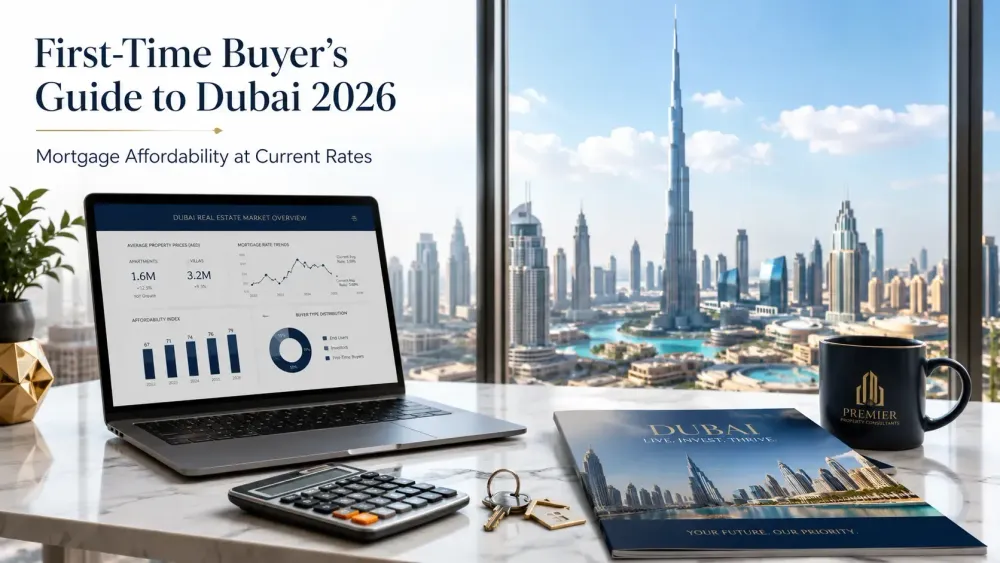
First-Time Buyer’s Guide to Dubai 2026: Mortgage Affordability at Current Rates

Table of Contents
Most first-time buyers I meet in Dubai worry about the wrong number. They fixate on the sticker price and the monthly installment, and forget the cash they actually need on the table to complete. Let me lay out both, using where rates and rules sit in mid-2026, so you can see where you realistically fit.
Short version, if you’re skimming: as an expat buying your first home, plan on having about 25 to 30% of the price in cash before you get the keys. That’s a 20% deposit and another 5 to 7% in fees. Rates today land around 4 to 4.5% on a decent fixed deal, which is roughly AED 5,300 to 5,600 a month for every million you borrow over 25 years. And your salary caps all of it, because a bank won’t let your repayments cross 50% of your monthly income.
Renting vs Buying in 2026: The Break-Even Math
The honest answer to “should I rent or buy” is a question back at you: how long are you staying? Buying only pulls ahead once you’ve held the place long enough to earn back the fees you paid to get in. In Dubai that’s usually three to four years.
Here’s how it works with real numbers. A one-bed in Dubai Hills at AED 1.2 million, 20% down payment, leaves you a loan of AED 960,000. At 4.5% over 25 years, that’s about AED 5,340 a month. Add service charges of roughly AED 900 a month and you’re at AED 6,250 to own it. Renting the same apartment runs around AED 80,000 a year, call it AED 6,650 a month, and you already know that number only climbs at renewal.
So owning costs about the same each month as renting, except a good chunk of your payment is buying you equity instead of disappearing. What really decides it are the fees, around AED 84,000 on this deal, that you never see again. Stay past three or four years and buying wins comfortably. Think you might leave sooner? Keep renting. I’d rather tell you that now than after you’ve paid the DLD.
If you take one number from this guide, make it this: you need 25 to 30% of the price in cash, not 20%. The deposit is only the start. Here’s the full picture on an AED 1.5 million apartment.
| Cost | Rate | AED 1.5M example |
|---|---|---|
| Deposit | 20% | 300,000 |
| DLD transfer fee | 4% + admin | 60,580 |
| Agency commission | 2% + VAT | 31,500 |
| Mortgage registration | 0.25% of loan | 3,000 |
| Bank arrangement fee | ~1% of loan | 12,000 |
| Property valuation | fixed | ~3,000 |
| Trustee / transfer office | fixed | ~4,200 |
| Total upfront | ~27% | ~AED 414,000 |
None of these can be rolled into the loan. They come out of your own pocket at transfer, which is exactly why buyers who budget for the 20% deposit get caught short. Sort this money out first, before you fall for a listing.
Mortgage Rates Right Now and What They Mean per AED 1M Borrowed
As I write this in July 2026, the sharpest fixed rates start around 3.75% for a one-year fix, and three to five-year fixes sit in the high threes to mid fours. Three-month EIBOR is 3.87%, so anything on a variable rate works out closer to 5 to 6%. If you’re salaried and your income runs through the lender, budget around 4 to 4.5% and you won’t be far off.
What that actually costs you, per million borrowed on a 25-year term:
- 4.0%: about AED 5,280 a month
- 4.5%: about AED 5,560 a month
Keep that figure in your head Double it, roughly AED 11,100 a month. That one shortcut is most of what you need to calculate mortgage affordability in Dubai without opening a spreadsheet.
Salary-to-Property Table: What AED 15k/25k/40k per Month Affords
Your ceiling comes from one rule. Total repayments can’t be more than half your monthly income. Assume a 25-year term, because it’s the fastest way to sanity-check any price. Borrowing two million?
At 4.5%, nothing else on your credit file, and the usual 20% deposit, and it shakes out like this.
| Monthly salary | Max repayment (50%) | Property you can target | Cash needed upfront (~27%) |
|---|---|---|---|
| AED 15,000 | AED 7,500 | up to ~AED 1.65M | ~AED 450,000 |
| AED 25,000 | AED 12,500 | up to ~AED 2.8M | ~AED 760,000 |
| AED 40,000 | AED 20,000 | up to ~AED 4.5M | ~AED 1,200,000 |
Two things I tell every client looking at that table. First, 50% is the legal maximum, not a comfortable one. A car loan or a credit card balance comes straight off the top, and living on the other half is harder than it looks on paper. Aim for 35 to 40% and you’ll sleep better. Second, the bank stress-tests you at a rate above the one you’re actually paying, so your approval can land a little under these numbers. Don’t shop right at the edge.
The First-Time Buyer Process, Step by Step
-
Get pre-approved first. The bank tells you in writing what it’ll lend, usually valid for 60 days. Do this before you view anything, or you’re just window shopping.
-
Shortlist and view. There are apartments for sale in Dubai at every price point, so pin down the community and size before you start, not after.
-
Sign the MOU (Form F) and pay the 10% deposit through the agency, held safely until transfer.
-
The bank sends a valuer to confirm the property is worth what you’re paying for it.
-
Get the final offer letter, and the seller applies for a No Objection Certificate from the developer.
-
Complete at the DLD trustee office. You settle the remaining fees, the bank releases the funds, and the title deed comes out in your name.
On a mortgage, the whole thing usually takes four to six weeks.
Off-Plan vs Ready for First-Timers
This one comes down to cash now versus certainty now. Off-plan properties lets you in with less upfront, often 10 to 20% on a payment plan with the balance due at handover. You lock today’s price, but you carry construction and market risk until the keys arrive. Ready costs you the full 25 to 30% at once, but you walk away with a title deed, a home or rent from day one, and nobody’s build schedule to lose sleep over.
For a first home you’ll actually live in, I usually steer people towards ready. If cash is tight now and you’ve got time on your side, a sensible off-plan unit in a proven area can also work. This is where Dubai Hills as a starter community earns its reputation, because it already has ready stock, fresh launches, schools, a mall and a resale track record, and that history is what protects your money if you ever need to sell.
Mistakes First-Time Buyers Make in Dubai
The classic mistake is budgeting for the deposit and forgetting the 5 to 7% in fees, then scrambling at transfer. Right behind it, stretching to that 50% ceiling and feeling the squeeze within a year. Some buyers skip pre-approval, find a place they love, then hear the bank won’t lend the full amount. And plenty chase a slightly higher yield in an area they don’t know instead of buying something solid in a community they do. Buy where the fundamentals hold up, keep a cash cushion after you complete, and treat the fees as part of the price from the start.
Thinking about your next Dubai property?
Talk to an XRealty specialist — market guidance, shortlists, and honest advice, no obligation.
Frequently Asked Questions
There’s no official minimum, but most banks want to see around AED 15,000 a month before they’ll approve a mortgage. On that income you can carry a repayment near AED 7,500, which supports a property up to roughly AED 1.6 to 1.7 million, as long as you have the deposit and fees in cash.
It’s 20% on a property under AED 5 million, and 30% once you go above AED 5 million. Add 5 to 7% for the DLD and other transfer fees on top, so the real cash you need is closer to 25 to 27% of the price.
Competitive fixed rates currently run from about 3.75% up to the mid fours, depending on how long you fix for. Variable rates track three-month EIBOR, now 3.87%, plus the bank’s margin. If you’re salaried, plan around 4 to 4.5%.
Not on a normal mortgage. The 20% deposit is a Central Bank rule for expats on a first home under AED 5 million. The only real way to start with less is off-plan, where a developer’s payment plan can begin at 10 to 20% spread across construction.
If you’ll hold the place beyond three to four years, yes, because that’s roughly how long it takes to earn back the fees. With rents sitting close to mortgage payments in a lot of communities, owning builds equity that renting simply doesn’t. If your plans are shorter or uncertain, renting is the safer call.

Related Articles
 Market Pulse
Best Islands in Abu Dhabi to Live & Invest (2026)
Discover the best islands in Abu Dhabi for living and property investment, including Saadiyat, Yas, Al Reem, Jubail, Ramhan, Fahid and Hudayriyat. Compare lifestyle, property types, prices, rental yields and investment potential.
 Market News
Dubai Office Market Stays Strong in Q3 2026 with More Affordable Deals
Explore Dubai's office market in Q3 2026, including commercial property prices, affordable office deals, investment opportunities and market trends.
 Market Pulse
Why Invest in Abu Dhabi?
Discover why investing in Abu Dhabi real estate in 2026 makes sense. Explore property market trends, rental yields, capital growth and top investment areas.