

Dubai Real Estate News: How to Read the Market Beyond the Headlines
Dubai's 2026 property market is dispersing, not correcting. Understand the structural difference before making your next capital allocation decision.
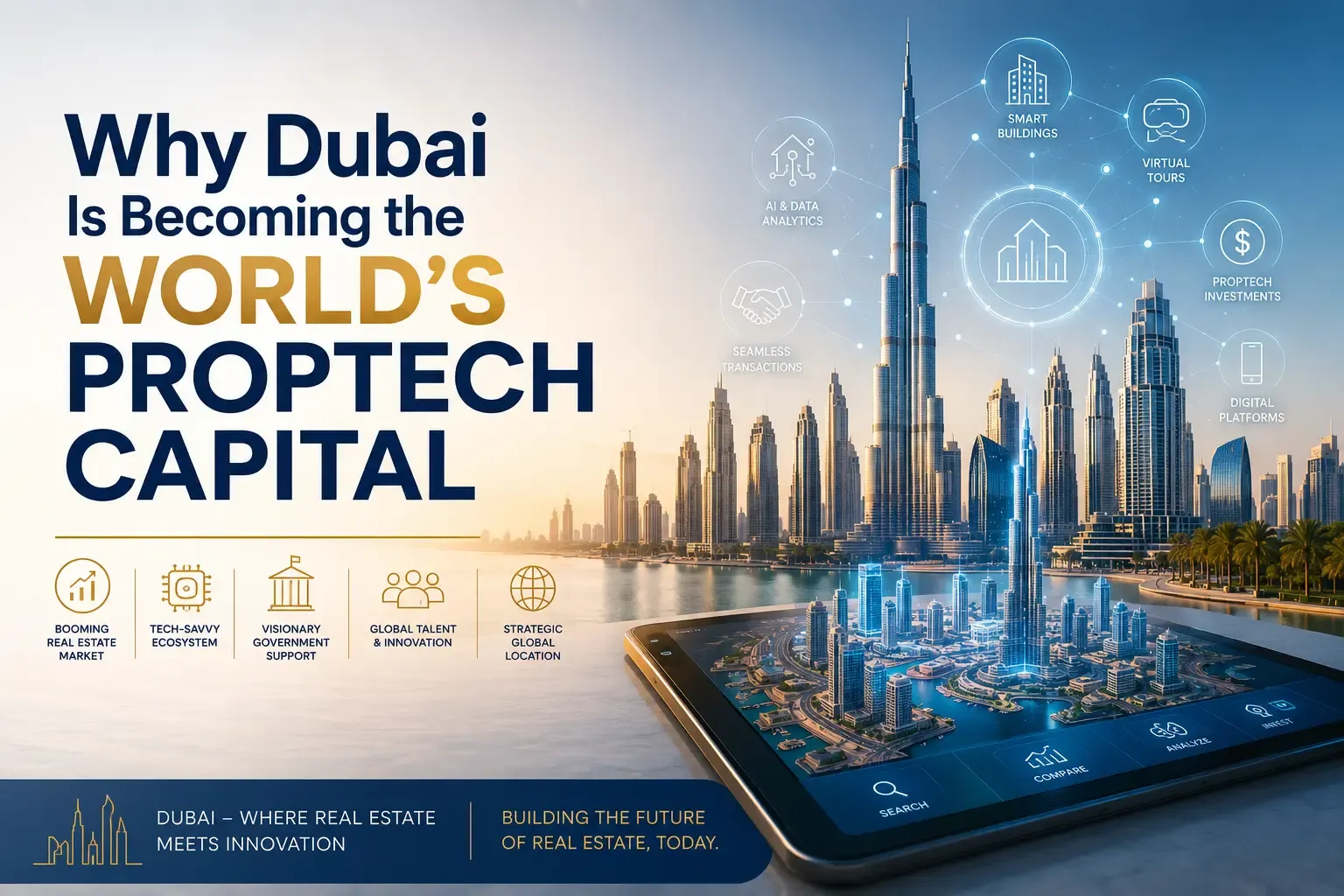
Dubai Land Department hosted PropTech Connect Middle East in February. Three thousand people, 1,500 companies, panels on AI and tokenisation, sponsors everywhere. Most of the coverage stayed at that level. Useful, but it is not the part I would lead with if you are holding property in Dubai or trying to figure out where to buy. The question I keep coming back to is why a government real estate regulator is putting itself at the centre of a global technology conference at all. And what that says about the way the Dubai property market is going to work for the rest of this decade.
Here is the detail that mattered to me more than the speaker list. The first day of PropTech Connect was structured around capital flows, real estate tokenisation, and AI in portfolio management. The host was not a technology ministry or a startup body. It was DLD itself. The same authority that issues your title deed when you buy property in Dubai is the one running the conversation about how that title deed becomes digital, fractional, and tradable. Tokenisation is not being explored here by founders asking permission. It is being built by the regulator.
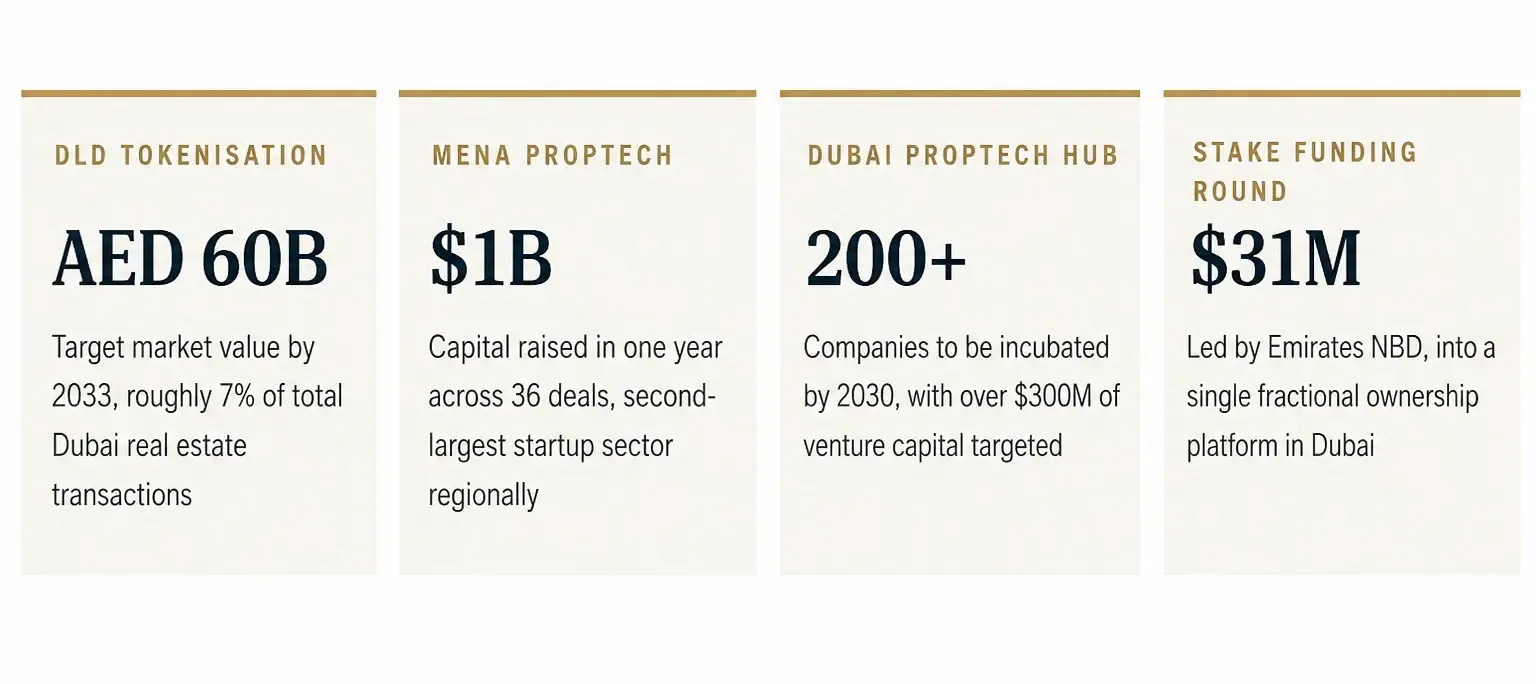
The number that stopped me was not a funding round. It was 60 billion. That is the size, in dirhams, that DLD expects the tokenised Dubai real estate market to reach by 2033, around 7 per cent of total transactions. The pilot phase of the Real Estate Tokenisation Project has already moved into its second stage. Digital tokens that represent fractions of a Dubai title deed can now trade on secondary markets. Prypco Mint was the first platform to issue them. Stake just closed a $31 million round led by Emirates NBD, with Property Finder also writing in. Two years ago a sentence like that would have read like a press release no one believed.
Pull back from the pilots and the picture gets bigger. PropTech was the second-largest startup sector in MENA last year, drawing close to a billion dollars across 36 deals. The Dubai PropTech Hub, sitting under DIFC and DLD, has set a target of incubating more than 200 companies and pulling in over $300 million of venture capital by 2030. Reach Middle East, the DLD-backed accelerator, is raising a $300 million fund and has already written cheques into seven regional startups. SandBoxReal Estate lets these companies test products under live regulatory cover before going to market. Most cities Dubai competes with do not have any of this. Some are still arguing about whether tokenised property is legal at all.
Every one of these initiatives shares a feature. They all sit on top of DLD transaction data, which is now released into the market in close to real time. That dataset is the most valuable input in the regional property economy. Most cities guard data like that. Dubai is feeding it forward to anyone serious about building tools on top of it, and for anyone selling, buying, or analysing Dubai real estate, that has consequences.
Every property held in Dubai is now sitting on a digital infrastructure layer that did not exist three years ago. That changes how the asset behaves, who can buy it, and how quickly it can move.
The first wave of PropTech in Dubai was about listings. Bayut, Property Finder, Dubizzle. Useful, but mostly a digital version of what already existed. The second wave was virtual tours, automated lead generation, CRM tooling. Still incremental. The wave landing now is different in kind. It changes who can buy, what they can buy, and how much capital they need to participate in the Dubai property market.
Tokenisation is the obvious example. A platform like Stake or Prypco lets an investor put as little as 500 dirhams into a Dubai property and earn a proportional share of the rent. That is not the buyer profile most of us in this business work with day to day, and it should not be. But the consequence further up the chain is what matters. A market that opens its base of buyers from a few hundred thousand HNW expats to several million regional and international retail investors becomes a deeper and more liquid market over time. Liquidity at the bottom of the stack tends to support pricing at the top. That should be relevant to anyone holding a luxury apartment in Dubai or a villa in a master community and worrying about exit.
The second shift is in analytics. A new generation of AI-native platforms is being built directly on top of DLD's open data. One Dubai-based startup just closed what was reported as the largest AI PropTech pre-seed in the GCC, focused on exactly this. The output is not the brochure-grade overview most clients are still being shown. It is transaction-level analysis. Which buildings in Dubai Hills are trading above original price. Where rental yields are compressing in JVC. Which off plan launches in The Valley or Emaar South are absorbing faster than the developer's official sell-through implies. The buyer who walks in next year having already run that analysis is not the buyer you and I were dealing with two years ago.
The third shift is in trust. Title deeds anchored to blockchain. Smart-contract escrow. Tenant and landlord platforms with built-in rental guarantees and dispute resolution. Picture a buyer in Mumbai or London who has heard the usual concerns about buying property they cannot see, in a jurisdiction they do not live in, through someone they have never met. Now hand them a tokenised, regulator-issued, blockchain-anchored title for an Emaar project in Dubai Creek Harbour or Emaar Beachfront. The objection does not disappear. The friction drops. The overseas buyer pool that has driven the last two years of off plan absorption has not finished arriving.
Capital and technology do not move into a market because a startup ecosystem exists. They move when the regulator is visibly committed to making that ecosystem work. The Dubai Real Estate Sector Strategy 2033, the Dubai Economic Agenda D33, the Virtual Asset Law sitting under VARA, the REES innovation framework, the SandBox Real Estate testing environment, the PropTech 2033 Whitepaper. None of this was built because PropTech Connect was coming. All of it was already committed. PropTech Connect was the visible surface of a deeper programme that the rest of the world is now studying.
That is the bit institutional and overseas capital actually responds to. The investment case for Dubai real estate has been well known for years. Yields, no income tax, dirham peg, residency through property, deep international school catchments, world-class infrastructure. None of that is new. What is new is the digital rail being built underneath the asset itself.
The tax case for Dubai has been the same for years. What has changed is that the property you buy now sits on a digital rail the rest of the world is still trying to design.
A lot of the buyers I work with are based outside the UAE. India, Pakistan, the UK, Europe, sometimes further. The usual concern, the one almost every first-time overseas buyer raises in some form, is risk. How do I know the property is real. How do I know my title is protected. How do I know the rent will actually reach me. How do I exit if I need to. These are not unreasonable questions. They are exactly the questions PropTech in Dubai is now answering.
Title deeds in Dubai are now issued through DLD's digital platform. The same title can be tokenised, traded, and verified on a blockchain layer that the regulator itself anchors. Rental income on tokenised property is paid automatically. Escrow is managed through smart contracts. Dispute resolution is built into the platform. None of this exists in most of the markets these buyers are comparing Dubai against. London, Mumbai, Lagos, Karachi, none of them offer the same regulatorbacked digital infrastructure. That is a real advantage, and it changes the calculus for an overseas buyer evaluating a Dubai property for sale against options at home.
There is a second, quieter effect worth flagging. Tokenisation lowers the minimum cheque size for owning Dubai real estate from a few hundred thousand dirhams to a few hundred dirhams. That brings in a new buyer who would never have qualified for a mortgage or a developer payment plan, but who can now own a fractional stake in an Emaar tower at Dubai Creek Harbour or a building at Emaar Beachfront. The market is expanding sideways, not just upwards. Anyone holding property and thinking about resale liquidity five years out should be paying attention to that.
Liquidity is being engineered into the market, not assumed. Tokenisation, secondary trading of fractional title deeds, and DLD-backed digital registration are turning Dubai real estate into a more tradable asset than it was even two years ago. That matters most at entry and exit. Off plan inventory in branded buildings inside well-mapped communities, like Emaar Beachfront, Dubai Creek Harbour, Dubai Hills, The Valley and Emaar South, is the cleanest beneficiary, because those addresses line up with both the institutional and the retail buyer profiles the new platforms are built around.
Data is now the second most valuable thing in the room. The buyer who shows up next year will increasingly have already run the building, the floor, the developer, and the rental history through an AI-powered analytics tool before the first call. Listings and brochures are not the conversation any more. The advisor whose own thinking holds up against that data wins the mandate. The one whose pitch falls apart against it does not get a second meeting. That is worth thinking about whether you are buying property in Dubai or selling it.
Read PropTech alongside capital migration, not separately. The 102 hedge funds at DIFC, the 9,800 millionaires landing in the UAE in a single year, Citadel's office, the Gold Line, and the regulator-led PropTech build are not five separate stories. They are one story. Dubai is being deliberately engineered as the default city for global capital. Reading any one of these in isolation, including this one, gives you half the picture. Reading them together is how I would suggest thinking about Dubai real estate news right now.
PropTech Connect on its own is one event. Read it next to the rest, though, the AED 60 billion tokenisation target, the $300 million PropTech Hub goal, the AI-native platforms now sitting on top of live DLD data, the pre-seed rounds closing at GCC-record sizes, the Stake and Prypco rounds, the central bank and the regulator pushing in the same direction at the same time, and the picture shifts. Dubai has gone from being an interesting alternative on the global PropTech map to being the place the rest of the world is studying. Real estate companies in Dubai working with serious institutional and overseas buyers will be measured this cycle not just on inventory, but on how well they understand the digital layer the inventory now sits on.
The right move is not to go and buy property in Dubai because tokenisation exists. The right move is to factor digital infrastructure, liquidity, data and regulator direction into a wider view of community, micro-location, building and timing. Investors who read these maps early tend to hold the better assets when the cycle matures. The ones who wait until the news is comfortable usually arrive after the move.
If you are sitting on Dubai property today, or evaluating an entry, this is the layer worth understanding. Not the conference, not the panels, not the launch news. The infrastructure being put under the asset. That is what will quietly separate the strong holdings from the weak ones over the next five to seven years, and it is the conversation I find myself having more often with serious investors, both end-users and overseas buyers, every month.
The headline this month was a technology conference. The longer story is what the regulator is quietly building underneath every property in this city, and what that means for the way Dubai real estate get
Dubai's 2026 property market is dispersing, not correcting. Understand the structural difference before making your next capital allocation decision.
Indian developers and institutional investors ready to enter Dubai's land market in 2026, Explore freehold plot zones, entry structures and legal frameworks.
Dubai real estate pipeline data through 2030, understand where supply is concentrated and what it means for your investment strategy.