Dubai Real Estate News: How to Read the Market Beyond the Headlines | Xperience Realty

Dubai Real Estate News: How to Read the Market Beyond the Headlines

Table of Contents

Key Takeaways

  • Dubai investors are exposed to more commentary than at any point in the market's history, but most retail analysis filters institutional research through narrative summaries that strip out the disaggregation that gives the original reports their value.

  • Knight Frank, Cushman & Wakefield, Cavendish Maxwell, JLL, and CBRE provide segment-level disaggregation that retail commentary rarely preserves.

  • Reliable forecasts specify falsification conditions; reactive commentary that pivots aggressively with news flow is reading the market rather than analysing it.

  • Live deal flow exposure is a critical filter for submarket-specific commentary; commentators without direct transaction exposure to a submarket produce less reliable submarket calls.

  • Goldman Sachs, Fitch, Moody's, and Citi each present forecasts as market-level numbers, but the actual experience of holders will be bimodal across tier 1 and tier 3 segments.

1. The Dubai information environment is full

There is more public commentary on Dubai real estate today than at any point in the market's history. Daily transaction reports from DLD. Quarterly research from Knight Frank, Cushman & Wakefield, CBRE, JLL, and Cavendish Maxwell. Weekly commentary from Bayut, Property Finder, and dozens of brokerages. Continuous social media output from individual brokers. Mainstream business press coverage in Gulf News, The National, Khaleej Times. Bank research from Goldman, Citi, Fitch, Moody's. Specialist newsletters and podcasts. The information environment is dense to the point of saturation.

This is not, on balance, making investors better informed. It is making them more confused, more sentiment-reactive, and more vulnerable to whichever narrative is loudest in any given week. The investors who are doing well in Dubai 2026 are not the ones consuming the most commentary. They are the ones who have built filters for distinguishing genuine structural analysis from narrative pattern matching.

2. What narrative analysis looks like

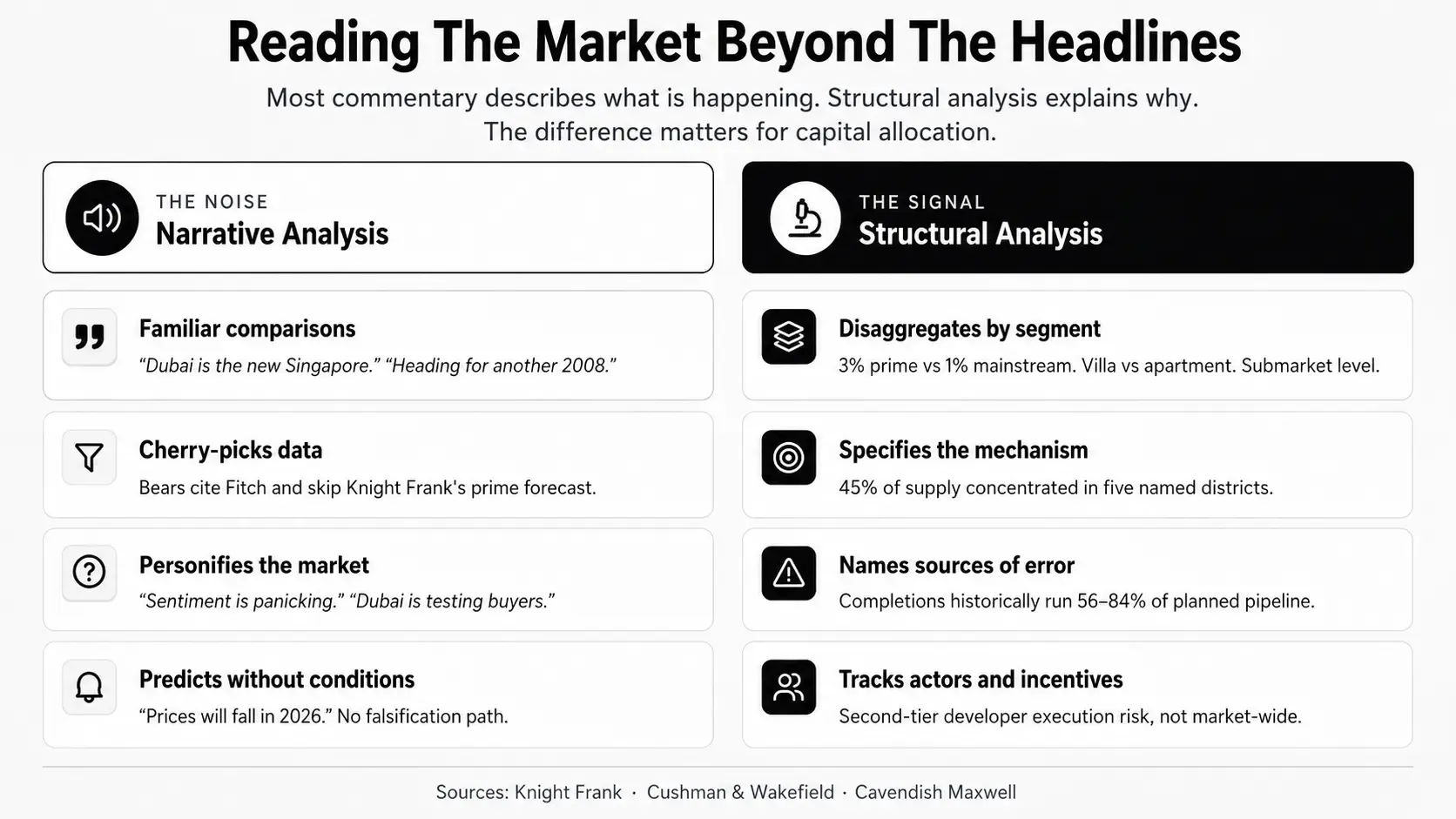
Narrative analysis describes what is happening in language that pattern matches to the audience's existing frame. It is not necessarily wrong. It is just incomplete in a specific way. Narrative analysis tends to use familiar comparisons that may or may not apply. "Dubai is heading for another 2008." "Dubai is the new Singapore." "Dubai is overheating like London in 2014." Each of these compresses a complex situation into a recognisable template, which is satisfying for the reader but tells you very little about what is actually different in the current market.

3. What structural analysis looks like

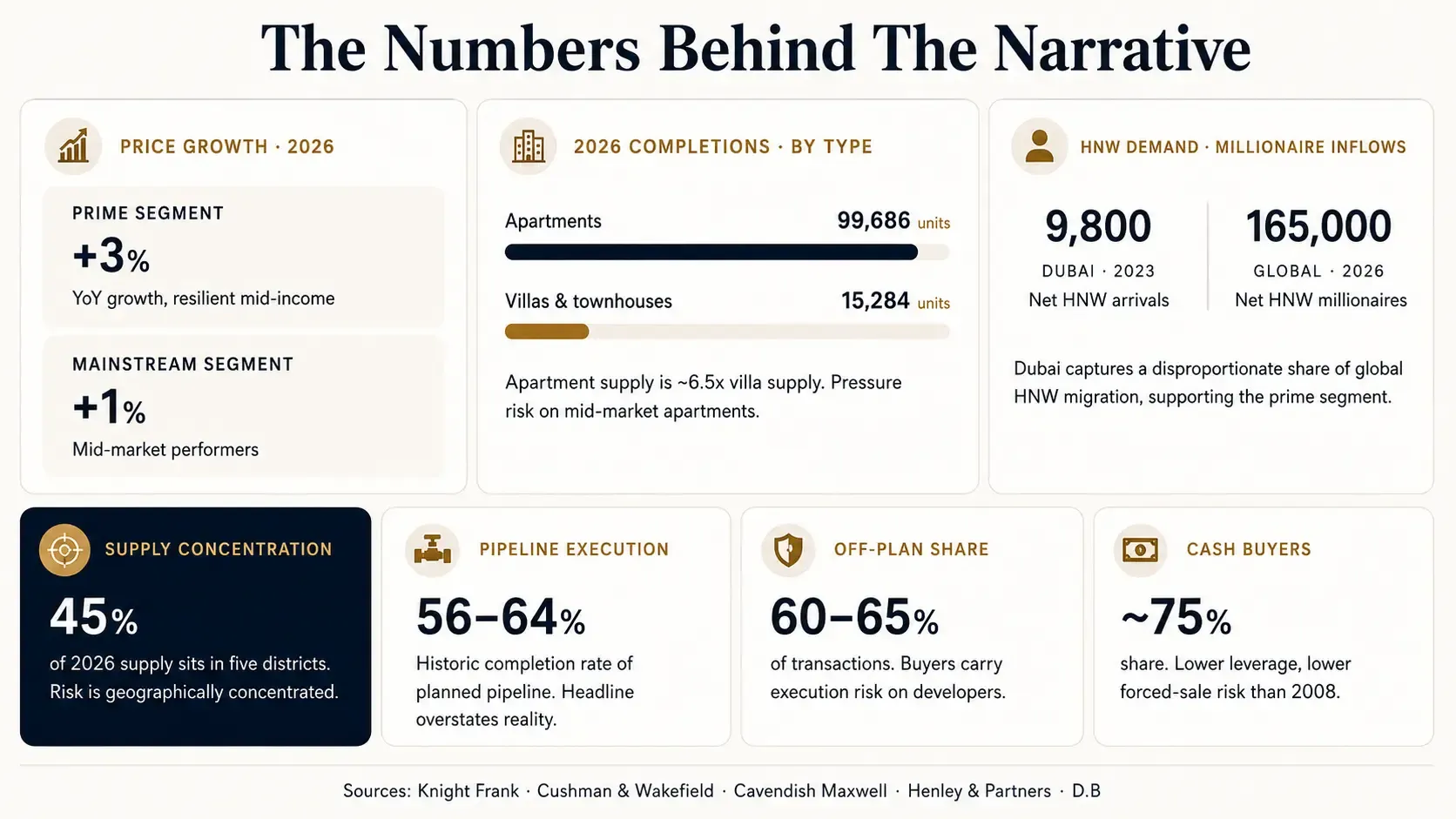
Structural analysis identifies the mechanisms generating outcomes, then traces those mechanisms forward into specific scenarios. It is less satisfying as journalism and considerably more useful for decision-making. Structural analysis disaggregates. Knight Frank's Q4 2025 review is a good example. Rather than treating Dubai as a unit, the review separates prime from mainstream, villa from apartment, specific submarkets from the citywide aggregate. The 3% prime versus 1% mainstream forecast tells you something useful about which segments will behave differently. The aggregate citywide number would tell you almost nothing.

4. The institutional research is mostly good

Institutional sources, Knight Frank, Cushman & Wakefield, Cavendish Maxwell, JLL, CBRE, the major banks, the Dubai Land Department itself, are largely doing structural analysis. They disaggregate, they specify mechanisms, they cite their assumptions, and they update on new data. They are not perfect. Each has its own framing biases, and aggregating multiple institutional views generally produces a better picture than relying on any single one. But the institutional research forms the analytical backbone for any serious Dubai allocation.

The mistake retail investors make is not that they ignore institutional research. It is that they consume it through narrative filters. A Knight Frank report saying "3% prime growth, 1% mainstream" gets compressed in social media commentary to "Dubai prices to rise." The disaggregation, which is the entire point of the analysis, gets stripped out in transmission. By the time the institutional view reaches the retail investor, it has been simplified into a narrative claim that contains very little of the original information. The same investor would be considerably better informed reading the Knight Frank report directly than reading three social media summaries of it. The institutional research is publicly available, free, and structurally rigorous. Most retail investors do not read it.

5. The narrative sources, calibrated

Public narrative sources, social media commentary, broker thought leadership, mainstream business press, are not useless. They surface anecdotes that institutional research does not capture, including granular submarket dynamics, specific developer behaviours, real-time deal flow patterns, and rapidly changing seller motivation profiles. They can be valuable for context. But they need to be consumed with calibration. A few specific filters that work in practice. Pay attention to who has skin in the game. A broker actively transacting in the market is closer to live information than a commentator who is not. A developer's representative talking about their own pipeline is more reliable than the same person commenting on competitors. A lawyer working on actual SPAs is closer to the regulatory reality than a generalist.

Track who has been right and wrong over multiple cycles. The most useful filter for narrative sources is their track record across the 2018-2020 softening, the 2020 COVID window, the 2022-2024 expansion, and the 2026 conflict period. Sources that called these correctly in real time are signal. Sources that consistently over-call corrections or expansion are noise.

Watch for narrative inversion. When the same source pivots aggressively from bullish to bearish or back, often within months, in response to news flow, that source is reactive rather than analytical. They are reading the market, not analysing it. Reactive sources can be entertaining and they can occasionally be right, but they are not building a coherent structural picture you can act on.

Discount predictions that lack falsification conditions. A bullish source that predicts "prices will rise" without specifying what would have to be true for that prediction to be wrong is producing a non-falsifiable claim, which is closer to marketing than analysis. The same applies to bearish sources predicting collapse without conditions.


6. The structural picture for Dubai 2026, briefly

Pulling the institutional research together produces a structural picture that is meaningfully different from the dominant narrative versions. The market is dispersing, not correcting

7. How to read commentary going forward

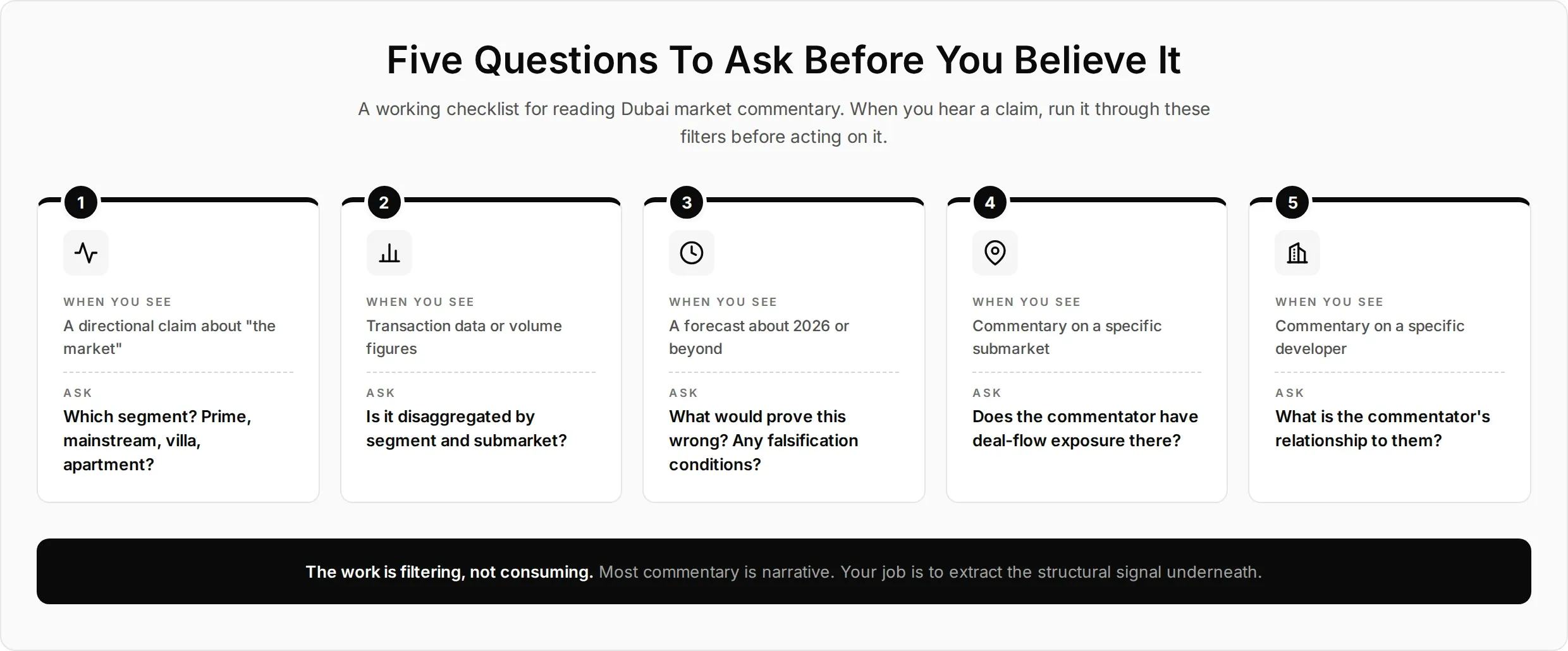
A few practical filters for the next 12-24 months of Dubai market commentary.

8. The work is filtering, not consuming

The Dubai information environment will continue to densify. The narrative noise will grow louder. The structural research will continue to be the better signal. The investors who do well over the next decade will not be the ones who consume the most information. They will be the ones who build filters that separate structural analysis from narrative pattern-matching, and who calibrate their decisions to the structural picture rather than the narrative noise.

This requires reading the institutional research directly. It requires discounting reactive commentary that pivots with news flow. It requires building broker relationships that surface live information. It requires the discipline to update on new structural data without over-updating on narrative shifts. Most investors will not do this work. Most will continue to consume narrative sources, react emotionally to news flow, and produce portfolio decisions that reflect whichever story was loudest in the week they decided. The investors who do build the filters will compound capital meaningfully better than those who do not. The information environment will not get easier. The framework for navigating it does not need to. It needs to be applied consistently, across cycles, against the natural pull of whichever narrative is loudest at any given moment.

About the Series

The Dubai Allocation is a 20 part research release published by Xperience Realty in May 2026, treating Dubai real estate as a capital allocation decision rather than a transactional one. The release functions as a 2026 mid-year house view, written for principals, family offices, and internationally mobile capital evaluating Dubai through the rest of 2026 and beyond. The full research package is available at xrealty.ae.

About the Author

Senior Consultant in Private Wealth and Real Estate Advisory at Xperience Realty, Dubai. I work with family offices, HNW principals, and internationally mobile capital on luxury and institutional-grade allocations. Before this, I spent four years across PwC Economics Advisory, Accenture (US residential mortgage modelling through the post-2008 recovery), Unilever, and TATA Steel. MBA from IIM Kozhikode. KHDA-certified Luxury Brand Manager. For a private discussion of how the framework applies to a specific portfolio or mandate, direct enquiries are welcome.

Frequently Asked Questions

The institutional research backbone includes Knight Frank's Dubai Residential Market Review (quarterly), Cushman & Wakefield Core's market outlooks, Cavendish Maxwell's Property Monitor reports, Dubai Land Department transaction data, and Bayut/Property Finder rental indices. Bank research from Goldman Sachs, Fitch, and Moody's adds a credit lens.

Institutional forecasts that disaggregate by segment, specify mechanisms, and name falsification conditions are reasonably reliable. Forecasts that aggregate Dubai as a single market or fail to specify the conditions under which they would be wrong are less useful for capital allocation.

Most apparent disagreement reflects different framing rather than different conclusions. Bear cases like Fitch's 15 percent correction call and bull cases like Henley's HNW migration story are typically both correct: bear pressure is concentrated in specific submarkets while structural demand persists in others.

Filter by track record across multiple cycles, direct deal flow in your target submarket, willingness to specify falsification conditions on their views, and willingness to discuss exit considerations alongside entry. Brokers who only frame the upside are not building exit-aware allocations.

Social media commentary is useful for surfacing live deal flow patterns and granular submarket dynamics that institutional reports miss, but it is poorly calibrated for structural analysis. Use it as a complement to institutional research, not a substitute for it.

Contact Us