Luxury vs Mid-Market Dubai 2026: Which Delivers Better Returns | Xperience Realty

Luxury vs Mid-Market Dubai 2026: Which Delivers Better Returns?

Table of Contents

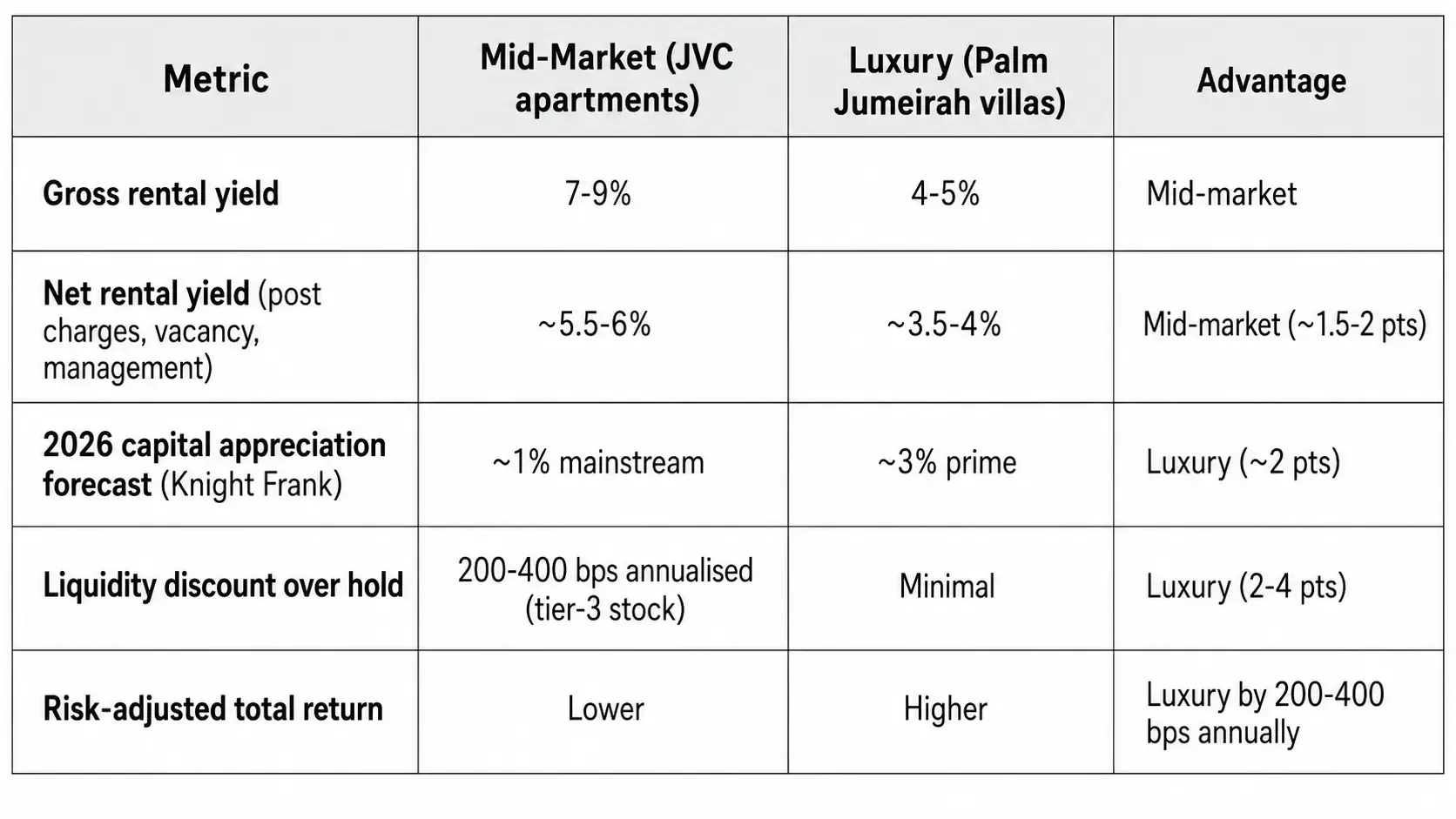
  • JVC apartments deliver 7 to 9 percent gross yields against Palm Jumeirah villas at 4 to 5 percent, but net yields after service charges, vacancy, and management compress the gap to 1.5 to 2 percentage points.

  • Total return equals net yield plus capital appreciation plus liquidity discount, and Knight Frank's 2026 forecast of 3 percent prime versus 1 percent mainstream is structurally meaningful.

  • Liquidity discount runs 200 to 400 basis points annualized over a 5 to 10 year hold for tier-3 apartment stock with thin secondary markets.

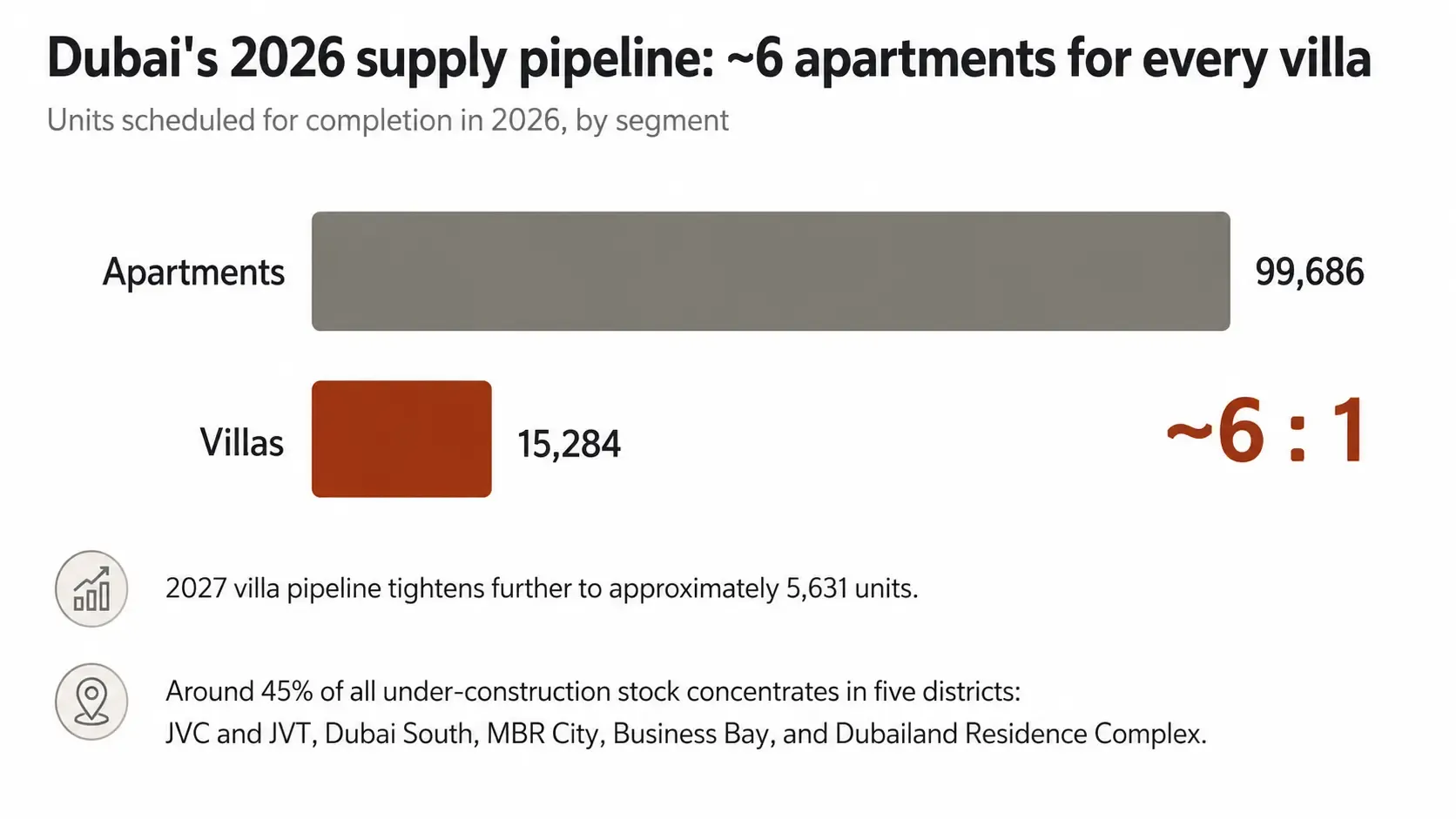
  • The 2026 to 2027 supply wave is concentrated in mid market, with 99,686 apartments scheduled for 2026 against just 15,284 villas, supporting structural villa price stability.

  • Risk adjusted total return favours luxury Dubai by 200 to 400 basis points annually over a typical hold, compounding into portfolio-defining differences over a decade.

At a Glance: Mid Market vs Luxury Dubai in 2026

Webp.webp

1. The wrong comparison, repeated forever

  • Walk into any Dubai broker conversation, and the comparison comes up within five minutes. JVC apartments deliver 7-9% gross yields. Palm Jumeirah villas deliver 4-5%. The conventional retail conclusion is that mid market is the better deal, because the income looks materially higher. This conclusion has cost more retail Dubai investors than almost any other single mistake, and the reason it is wrong takes more than a sentence to explain.

  • Headline yield is gross. It is calculated before service charges, vacancy allowance, management fees, capital expenditure, and the embedded costs of holding a position in a thinner secondary market. Net yield in Dubai mid market typically runs 1.5 to 2 percentage points below gross. An 8% gross JVC yield translates to roughly 5.5-6% net. A 5% gross Palm Jumeirah yield translates to approximately 3.5-4% net. The 3-point gross gap compresses to a 2-point net gap, which still favours mid-market on income, but by considerably less than the brochure suggests.

  • The bigger issue is that yield is a lagging indicator and capital appreciation is a leading one. The mid-market yield is real today. The question is what it will be 24 months from now once the supply wave has actually arrived. The luxury yield is real today, but the appreciation curve over a 5-10 year hold is the larger part of the return. Risk-adjusted total return is the only metric that resolves the comparison honestly, and it tells a very different story than the yield headline.

2. Total return, properly specified

  • Total return on a Dubai property has three components, not two. Net yield, capital appreciation, and a liquidity discount applied to assets where exit is structurally impaired. The third component is the one retail analysis consistently ignores, and it is the variable that flips the comparison.

  • Run the numbers. Net yield favours mid market by roughly 1-1.5 percentage points. Capital appreciation favours luxury. Knight Frank’s 2026 forecast is 3% prime against 1% mainstream, and within mainstream the supply-pressured submarkets (JVC, Dubai South peripheral, parts of Arjan, Dubailand, less differentiated Business Bay) are likely to deliver flat to modestly negative numbers. Cushman & Wakefield’s view is mid single digit appreciation in well-located prime communities. Even taking conservative versions of both forecasts, luxury wins on appreciation by 2-4 points annually.

  • Liquidity discount is the harder variable to quantify but it shows up in actual exits. Tier-1 villa and prime waterfront stock transacts at fair value most of the time, with multiple comparable sales available for any given valuation. Tier-3 apartment stock with thin secondary markets routinely transacts at meaningful haircuts when the seller actually needs to exit, especially during sentiment-driven windows. The discount can run 200-400 basis points annualised over a 5-10 year hold.

  • Sum the components. Mid market’s net yield advantage of 1-1.5 points is offset by luxury’s 4-8 point combined advantage on appreciation and liquidity over a typical hold period. Risk adjusted total return favours luxury structurally, often by 200-400 basis points annually.

Compounded over a decade, the gap is portfolio defining.

3. Why liquidity discount is real, not theoretical

  • Liquidity discount is an abstract concept until you have to exit. The post 2008 US residential cycle, where I built default models at Accenture for four years, taught me to weight this variable heavily. The same nominal yield on two assets produces dramatically different realised returns when one of them cannot be exited at fair value when circumstances change.

  • Dubai’s secondary market depth varies enormously across submarkets. Palm Jumeirah villa transactions occur regularly enough that any given valuation has multiple comparable sales available, and the global buyer pool means inventory clears at fair value. Dubai Hills Estate four bedroom villas have visible quarterly transaction history. Emaar Beachfront secondary is developing depth as more units hand over and the market matures.

  • Studio inventory in JVC peripheral towers is structurally different. The primary market itself competes with secondary sellers, because the same developers are still launching at similar price points in the same submarket. Cavendish Maxwell’s Q3 2025 Property Monitor data on off-plan resale activity tells you what happens when many buyers want to exit at the same time. Older International City product, peripheral Discovery Gardens, and second tier Dubai South towers face similar liquidity thinness. The discount on these assets is not theoretical. It shows up in the bid ask spread on every transaction, and it widens during volatility windows.

4. The supply asymmetry

The 2026-27 supply wave is the single most important variable for the luxury versus mid market comparison, because it is overwhelmingly concentrated in the segment most retail capital has been chasing.

Web.webp

  • Dubai’s 2026 supply pipeline: ~6 apartments for every villa. 99,686 apartments scheduled against 15,284 villas. 2027 villa pipeline tightens further to ~5,631 units. Around 45% of under construction stock concentrates in JVC and JVT, Dubai South, MBR City, Business Bay, and Dubailand Residence Complex.

  • Luxury supply is structurally constrained. There is only so much Palm Jumeirah land. Only so many Dubai Hills villa plots. Only so many Emaar Beachfront waterfront positions. New luxury supply arrives slowly, at progressively higher embedded cost bases. Mid market supply elasticity is high, especially in the five districts above. The same buyer pool that historically supported mid market yields is now competing with continuous new launches at similar or lower price points.

  • The result is that luxury yields are likely to hold or strengthen as supply remains tight, while mid market yields face 100-200 basis points of compression over the next 24 months in the most exposed clusters. The starting yield gap will narrow further as the cycle plays out, eroding the headline mid market advantage on the way.

5. Buyer pool depth and cycle resilience

The deeper structural question is which segment’s buyer pool is more durable through volatility.

The luxury buyer pool

Luxury Dubai is bought primarily for use, residency, capital preservation, and global mobility. By cash buyers from dozens of jurisdictions whose decision logic is largely uncorrelated with Dubai rental yield arithmetic. Goldman Sachs reported villa prices up 16% year on year through the March 2026 conflict window, even as transaction volumes in the segment fell sharply because most owners simply held. The buyer pool does not reverse on quarterly sentiment, because the purchase decision was not anchored to short term yield in the first place.

The mid-market buyer pool

Mid market Dubai has a structurally different buyer pool. Indian and Pakistani retail investors compressing pre LRS decisions. First time Dubai buyers attracted by accessible price points. Mortgage financed acquirers, with mortgage activity having roughly doubled over the past four years per Knight Frank. This buyer pool is more sentiment responsive, more leveraged, and more vulnerable to liquidity events. When sentiment turns, this pool withdraws first.

The historical pattern through past cycles

Through the 2008-09 cycle, the 2013-14 cycle, the 2020 COVID window, and the 2022 geopolitical shock, the same pattern repeated. Luxury submarkets recovered first because the buyer pool was structurally deeper and less sentiment-elastic. Mid-market submarkets recovered later and more unevenly. This is not coincidence. It is structural, and it is the variable most retail buyers do not weight properly when they look at the headline yield comparison.

6. Replacement cost cuts both ways

Three supply side costs are rising in parallel across Dubai development. Construction materials and labour. Land acquisition in prime submarkets, where the residual land value curve has been aggressively upward since 2022. Developer financing, which remains materially above pre 2022 levels despite UAE rate cuts in late 2025.

Luxury: replacement cost as a structural price floor

In the luxury segment, replacement cost provides a structural floor. Prime Emaar Beachfront launched in 2020-21 at around AED 2,200 per sq ft. Knight Frank’s Q3 2025 prime average sat at AED 3,767 per sq ft. Replacement cost on comparable beachfront, by the time you account for current land cost, current construction cost, and developer margin, is structurally above AED 2,900 per sq ft before margin. Even if demand softens, prices are supported by costs that are independent of sentiment. New launches cannot meaningfully undercut current pricing without operating below break-even.

Mid market: a weaker cost floor

In mid market, the replacement cost dynamic is weaker. Land costs in peripheral submarkets are lower and more elastic. Construction at scale produces unit-cost advantages that allow new launches to enter at competitive price points even when sentiment cools. The replacement cost floor exists, but it sits closer to current pricing, providing less downside protection. This asymmetry compounds the supply pressure asymmetry, making mid market structurally more vulnerable to multi year softness while luxury holds.


7. Two illustrative profiles, AED 6m each

Consider two buyer profiles working through Dubai allocations across 2024-25 with approximately AED 6m each, both wanting Dubai exposure. The decision logic produces materially different outcomes.

Profile 1: yield-prioritised JVC allocation

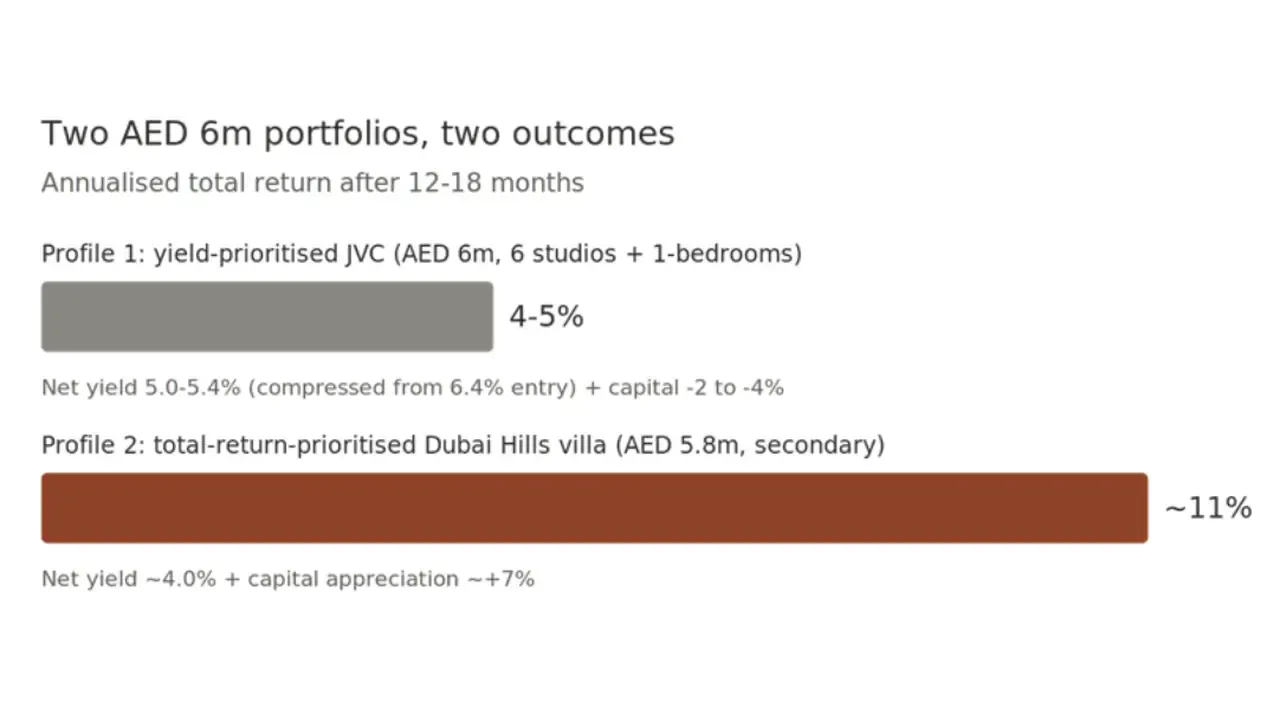
The first profile prioritises yield. AED 6m across six JVC studios and one bedrooms from a mid tier developer, blended gross yield around 8.7%, net around 6.4%. Twelve to eighteen months in, gross rental achievement tracks 12-14% below the broker’s projection because new inventory in the cluster has competed for tenants. Two of the buildings are running higher service charges than originally underwritten. Net yield has compressed to around 5.0-5.4%. Capital values have moved 2-4% lower against entry, depending on which unit you measure. Total return so far is positive in absolute terms but tracking well below what the same capital could have produced in a different allocation.

Profile 2: total return prioritised Dubai Hills villa

The second profile prioritises total return. AED 5.8m into one Dubai Hills Estate four bedroom villa, secondary market, negotiated around 4% below January 2025 asking. Gross yield around 5.2%, net around 4.0%. Twelve to eighteen months in, rental tracks on projection. Capital appreciation is around 7% against entry, broadly in line with what Knight Frank reported for the segment. Total return on the second portfolio tracks around 11% annualised, against the first portfolio’s 4-5% annualised across the JVC positions.

Webp.webp

Two AED 6m portfolios, two outcomes. Profile 1 (JVC, yield-prioritised, AED 6m) delivered 4-5% annualised total return after 12-18 months. Profile 2 (Dubai Hills villa, total-return-prioritised, AED 5.8m) delivered ~11% annualised through 4% net yield plus 7% capital appreciation.

The capital that chased headline yield delivered a worse total return than the capital that accepted lower headline yield in a structurally superior position.

This is not anecdotal. It is what the framework predicts and what observable Dubai deal flow consistently demonstrates.

8. Closing

  • The retail story has been that mid market Dubai is the better deal because the headline yields are higher. The institutional story, which is what observable deal flow demonstrates, is that luxury Dubai is delivering structurally superior risk adjusted total returns through this cycle, and the gap is widening. Knight Frank’s 3% prime versus 1% mainstream forecast for 2026 understates the within segment dispersion. Inside mainstream, supply pressured submarkets are likely to deliver flat or negative numbers. Inside prime, the most supply-constrained product is likely to outperform the segment average meaningfully.

  • This is not an argument that mid market has no role. Yield tilted positions in carefully selected submarkets, mature JLT, established Arjan, parts of Dubai Silicon Oasis with credible infrastructure adjacency, can deliver respectable risk adjusted returns when the asset and submarket are matched correctly. But the default retail logic of buy mid market because the yields are higher is producing systematically worse outcomes than the institutional logic of buy luxury because the total return is structurally-superior.

If you are evaluating Dubai allocations on yield alone, you are optimising the wrong metric. The right metric is risk adjusted total return over the intended hold period, and that metric in 2026 favours luxury more strongly than at any point in the last decade.

About the Series

The Dubai Allocation is a 20 part research release published by Xperience Realty in May 2026, treating Dubai real estate as a capital allocation decision rather than a transactional one. The release functions as a 2026 mid-year house view, written for principals, family offices, and internationally mobile capital evaluating Dubai through the rest of 2026 and beyond. The full research package is available at xrealty.ae.

About the Author

Senior Consultant in Private Wealth and Real Estate Advisory at Xperience Realty, Dubai. I work with family offices, HNW principals, and internationally mobile capital on luxury and institutional-grade allocations. Before this, I spent four years across PwC Economics Advisory, Accenture (US residential mortgage modelling through the post-2008 recovery), Unilever, and TATA Steel. MBA from IIM Kozhikode. KHDA-certified Luxury Brand Manager. For a private discussion of how the framework applies to a specific portfolio or mandate, direct enquiries are welcome.

Frequently Asked Questions

For risk adjusted total return over a 5 to 10 year hold, Dubai luxury structurally outperforms mid market in the 2026 cycle by 200 to 400 basis points annually, despite mid market’s apparent yield advantage. Luxury benefits from supply scarcity, deeper liquidity, and replacement-cost support that mid market lacks.

Dubai luxury property typically delivers 4 to 5 percent gross rental yields, translating to approximately 3.5 to 4 percent net after service charges, vacancy, and management. Mid-market apartments deliver 7 to 9 percent gross, or 5.5 to 6 percent net.

Selective mid market positions in mature submarkets (mature JLT, established Arjan, Dubai Silicon Oasis with metro adjacency) can deliver respectable risk-adjusted returns, but the default retail logic of buying mid market for high yields is producing systematically worse outcomes than tier 1 luxury allocation in the current cycle.

Liquidity discount is the haircut applied to realised exit pricing for assets where the secondary market is thin or where new primary inventory competes with secondary sellers. Tier 1 prime stock carries minimal liquidity discount; tier-3 mid market apartment stock carries 200 to 400 basis points annualised over typical hold periods.

Three structural reasons: villa supply for 2026 is only 15,284 units against 99,686 apartments creating scarcity, the luxury buyer pool is dominated by cash buyers who do not reverse on quarterly sentiment, and replacement cost on luxury product provides a structural pricing floor that mid-market lacks.

Net yield in Dubai mid market typically runs 1.5 to 2 percentage points below gross, after service charges, vacancy allowance, management fees, capital expenditure, and the embedded costs of holding a position in a thinner secondary market. An 8% gross JVC yield translates to roughly 5.5-6% net, while a 5% gross Palm Jumeirah yield translates to approximately 3.5-4% net.

Knight Frank’s pipeline data shows 99,686 apartments scheduled for 2026 against just 15,284 villas, roughly a 6:1 ratio. The 2027 villa pipeline is even tighter at around 5,631 units, which structurally supports villa price stability through the cycle.

Cushman & Wakefield indicates around 45% of all under construction stock concentrates in just five districts: JVC and JVT, Dubai South, MBR City, Business Bay, and Dubailand Residence Complex. Within mainstream, supply-pressured submarkets including JVC, Dubai South peripheral, parts of Arjan, Dubailand, and less differentiated Business Bay are likely to deliver flat to modestly negative appreciation in 2026.

Yield tilted positions in carefully selected submarkets mature JLT, established Arjan, parts of Dubai Silicon Oasis with credible infrastructure adjacency can deliver respectable risk adjusted returns when the asset and submarket are matched correctly. The key is selection, not the default retail logic of buying mid-market simply because the headline yields are higher.

Goldman Sachs reported villa prices up 16% year on year through the March 2026 conflict window, even as transaction volumes in the segment fell sharply because most owners simply held. The luxury buyer pool does not reverse on quarterly sentiment, because the purchase decision was not anchored to short term yield in the first place.

Contact Us