
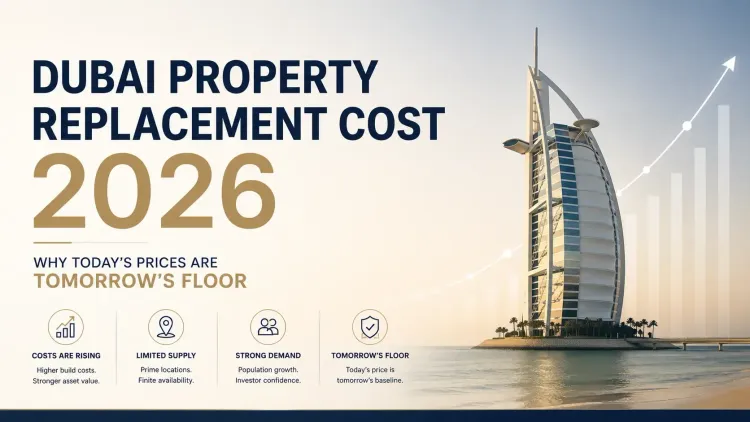
Dubai Property Replacement Cost 2026: Why Today's Prices Are Tomorrow's Floor
Dubai property market 2026 analysis: construction costs, replacement cost floor, prime vs mid-market price trends, and downside protection for investors.
JP Morgan has deployed more than $20 billion into the Gulf since the Iran war began, with hundreds of billions more expected for postwar rebuilding. The capital is targeting data centres, energy infrastructure, pipelines, logistics, and AI -the building blocks of the next decade. For Dubai property investors, this is institutional money voting on the region's long-term growth. More capital in the Gulf means more high-earning residents, more demand for quality homes - and Dubai sits as the safest, most stable base where that capital wants to settle.
On 11 June 2026, The National reported that JP Morgan has put more than $20 billion into the Gulf since the start of the Iran war. The bank expects the postwar rebuild to be much bigger. Doug Petno is the co-chief executive of JP Morgan's Commercial and Investment Bank. He said the bank has deployed significantly more capital and widened its risk limits across the region. On the cost of rebuilding, he was clear. The number will be substantial. He put it in the hundreds of billions of dollars. This is the largest bank in the United States telling the world that the Gulf is where it is putting its money.
A bank does not move $20 billion on a feeling. It moves it on numbers. When JP Morgan raises its risk limits for the Gulf, it is saying the risk is worth taking. When it opens a regional headquarters in Riyadh and plans to grow its team in the UAE, it is planting roots. When its co CEO talks about hundreds of billions of dollars in future investment, he is describing a pipeline of opportunity that runs for years.
This is institutional money. It is slow, careful and well informed. It does not chase a quick win. It follows long term value. And right now it is following that value into the Gulf.
The UAE, and Dubai in particular, sits in a strong position in this story.
Dubai was not the centre of the damage. It is the safe and stable base where capital, companies and families want to be. When hundreds of billions of dollars start flowing into the wider region, a large share of the people, businesses and headquarters that follow that money will want to live and operate from Dubai.
More capital in the Gulf means more high earning residents. More residents means more demand for quality homes. This is the engine that has driven Dubai real estate for years, and a wave of regional reconstruction adds fuel to it.
This is the same picture we have seen in the numbers. Dubai crossed AED 252 billion in Q1 2026 property transactions. Government money is now anchoring the biggest developers. Global banks are scaling up their presence. The pieces all point the same way.
JP Morgan has deployed more than $20 billion into the Gulf since the start of the Iran war in February 2026, with hundreds of billions of dollars more expected for postwar rebuilding, according to Doug Petno, co-CEO of the bank's Commercial and Investment Bank.
The capital is going into data centres, oil and gas installations, product pipelines, logistics, and AI infrastructure - the building blocks of the next ten years of growth in the Gulf.
More capital in the region means more jobs, more business, more residents, and more demand for quality homes. As the safe and stable base in the Gulf, Dubai is positioned to capture a large share of the people, businesses, and headquarters that follow this capital.
Yes, but the market is maturing. The age of buying anything and watching it rise is over. Strong assets in the right communities will do well, while weaker ones may not. Investors should be patient, selective, and focused on the long term.
If you already own in Dubai, the news supports holding for the long term. If you are buying, choose strong locations and trusted developers - off-plan property backed by established names is one of the smartest ways to enter with a structured payment plan. If you hold multiple properties, review your portfolio: selectivity matters more than chasing every launch.
JP Morgan set up its regional headquarters in Riyadh last year and plans to expand its presence in the UAE, doubling its team in the next three to five years.
Dubai property market 2026 analysis: construction costs, replacement cost floor, prime vs mid-market price trends, and downside protection for investors.
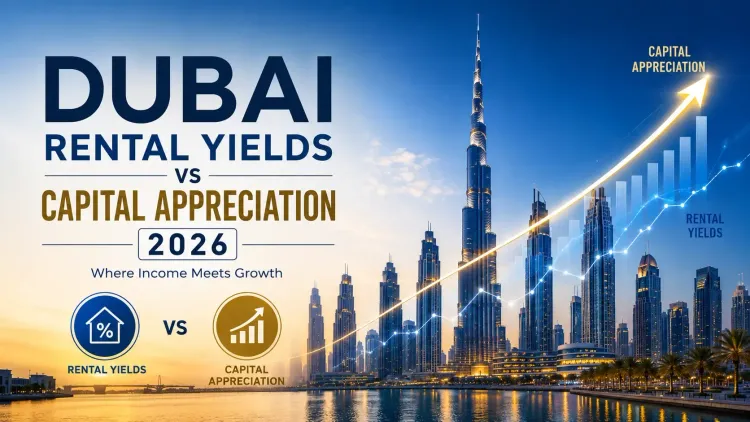
Compare Dubai rental yields and capital appreciation in 2026. Learn how yield, growth and liquidity shape total returns across communities.

Palm Jebel Ali vs Palm Jumeirah 2026: which is the better buy? Villa pricing from AED 22M, frond ROI, and the trade Dubai's UHNWI buyers are making now.