
How Indian Developers and Institutional Investors Can Enter Dubai's Land Market in 2026
Indian developers and institutional investors ready to enter Dubai's land market in 2026, Explore freehold plot zones, entry structures and legal frameworks.
Dubai real estate has always attracted attention. Sometimes for rapid growth. Sometimes for sharp corrections. And sometimes for the speed at which the city reinvents itself. But 2025 was different from most years that came before it. It was not a year defined by excitement or fear. It was a year defined by confirmation.
For many observers, 2025 answered a long-standing question: Is Dubai still a cycle driven market, or has it become a structured global real estate city? The answer became clear as the year unfolded. Going into 2025, expectations were mixed. Global interest rates were still high. Wars and political tensions continued across different regions. Major economies such as Europe and parts of Asia were slowing. Several research firms predicted that Dubai might enter a phase of balance or even mild correction after strong growth in previous years. These predictions were not unreasonable. Mature markets do not grow at the same speed forever. But what many forecasts missed was how deeply Dubai had changed beneath the surface.
One of the most important signs of strength in 2025 was what did not happen. There was no panic selling. There was no sudden drop in transaction volume. There was no collapse in buyer confidence. Instead, activity continued at scale. Residential sales remained active. Rental contracts increased. Commercial leasing grew faster than expected. Developers launched projects carefully, often limiting supply instead of flooding the market. Buyers took time to make decisions, but they did not exit the market. This behavior tells you something important. In fragile markets, buyers disappear the moment uncertainty rises. In strong markets, buyers slow down, assess carefully and continue. Dubai in 2025 showed the second behavior.
Another defining feature of 2025 was the quality of buyers entering the market. Earlier cycles in Dubai were heavily influenced by speculative capital. Investors bought early, flipped quickly, and exited when sentiment changed. In 2025, the buyer profile looked very different. A large portion of demand came from families relocating for work, education, and lifestyle. Professionals from Europe, India, Asia, and North America moved to Dubai with long-term plans. Entrepreneurs set up regional headquarters. Senior executives relocated with their families instead of commuting. These buyers were not focused on short-term price movement. They were focused on livability, community quality, access to schools, healthcare, and long-term security. When demand is driven by people building lives, not just portfolios, markets behave differently. Prices become more stable. Rentals stay strong. Corrections, when they happen, are shallow rather than sharp.
By the end of 2025, Dubai recorded more than 178,000 property sales, with transaction values exceeding AED 559 billion. When rentals, land deals, mortgages, and commercial leases are included, total real estate activity approached AED 1 trillion. This number matters for one simple reason: scale creates stability. Markets with low volume are easily disturbed. A small number of sellers or buyers can move prices sharply. Large markets absorb shocks more easily because activity is spread across many participants. When close to one trillion dirhams move through a property market in one year, it shows that the market is deep. It shows liquidity. It shows confidence. It shows trust in the legal system, the regulatory environment, and the future of the city. Very few cities globally see this level of annual real estate activity. Dubai joined that group in 2025.
Prices did increase in 2025, but the way they increased is what matters most. Growth was steady, not explosive. Some communities outperformed others. Well-located family communities, waterfront locations, and established villa areas saw stronger price movement. Areas with excessive supply moved more slowly. This uneven performance is healthy. In immature markets, everything rises together and falls together. In mature markets, price performance becomes selective. Location, design quality, developer reputation, and community planning matter more than timing. Dubai in 2025 behaved more like a mature market than an emerging one.
If sales show confidence, rentals show reality. People can delay buying, but they cannot delay living somewhere. In 2025, Dubai recorded more than 850,000 rental contracts, the highest in its history. Rental values crossed AED 71 billion. Apartments, townhouses, and villas all saw strong occupancy, with villas and family-sized homes facing the tightest supply.
This rental pressure was not driven by short-term tourism alone. It was driven by population growth, corporate relocation, and long-term residents entering the city. Strong rental markets support sales markets. When rents rise and supply stays limited, many residents eventually choose to buy. This creates a natural flow from rental demand to ownership demand.
Another important shift in 2025 was developer behavior. Instead of launching aggressively, many developers showed restraint. Construction costs had increased. Labor capacity was tight. Timelines were longer. Rather than overcommitting, developers phased launches and adjusted payment plans. This helped avoid oversupply and protected pricing across communities. Markets stay healthy when both buyers and developers act rationally. 2025 showed that discipline clearly.
While Dubai remained strong, many global cities struggled. Higher taxes, rising living costs, energy issues, and political uncertainty affected buyer sentiment in Europe. In North America, affordability challenges limited market activity. Against this backdrop, Dubai offered something rare: stability, safety, and clarity. The currency remained pegged to the US dollar. Ownership rules stayed consistent. Long-term visas encouraged settlement. Infrastructure investment continued without interruption. As global uncertainty increased, Dubai benefited not because it was perfect, but because it was predictable.
Markets do not become global overnight. They prove themselves over time. 2025 was not the beginning of Dubai’s growth story, and it will not be the end. But it was a year that confirmed a shift already underway. Dubai moved from being viewed as a fast-moving opportunity market to being recognized as a long-term capital market. That shift changes everything. It changes who buys. It changes how people hold assets. It changes how prices behave over time. For investors, end users, and families, this matters far more than short-term price movements.
As 2025 closed, the question was no longer “Will Dubai survive the cycle?” The question became “How does Dubai manage its growth responsibly from here?” That is a very different conversation. It is the conversation global cities have.
From where I stand, 2025 was one of the clearest years I have seen in Dubai real estate. It was calm, structured, and driven by real demand. Buyers who focused on quality, location, and long-term value felt confident throughout the year. For me, 2025 was not about chasing growth. It was about understanding how strong the foundation has become.
Yes. Dubai real estate in 2025 showed strong fundamentals with stable property prices, rising rental demand and high transaction volumes, making it attractive for long-term investors.
The Dubai real estate market 2025 was driven by population growth ,long term visas, disciplined supply from developers, strong rental demand and continued foreign investor confidence.
Yes, Dubai Property Prices in 2025 increased steadily rather than sharply. Prime locations, family communities and waterfront areas outperformed, while oversupplied zones remained stable.
The Dubai rental market in 2025 reached record levels, supported by population growth, corporate relocations and limited supply, especially for villas and family-sized homes.
By 2025, Dubai real estate evolved into a mature global property market with selective price growth, stable regulation and reduced speculative actively compared to earlier cycles.
Indian developers and institutional investors ready to enter Dubai's land market in 2026, Explore freehold plot zones, entry structures and legal frameworks.
Dubai real estate pipeline data through 2030, understand where supply is concentrated and what it means for your investment strategy.
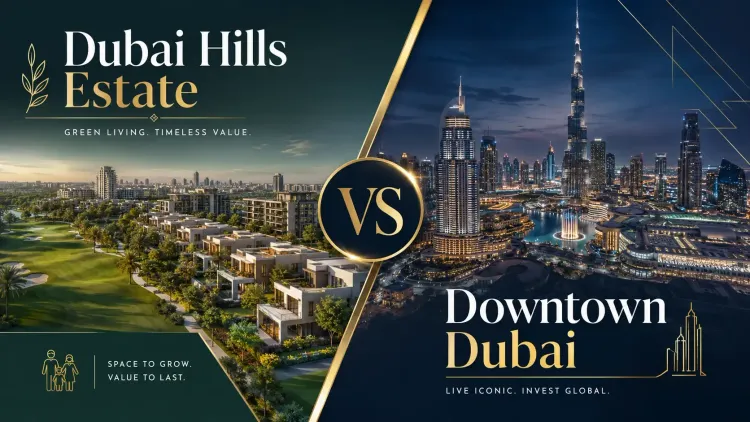
Downtown Dubai vs Dubai Hills Estate in 2026, the capital appreciation data, buyer pool shifts and why one community now wins for first time buyers.