Table of Contents
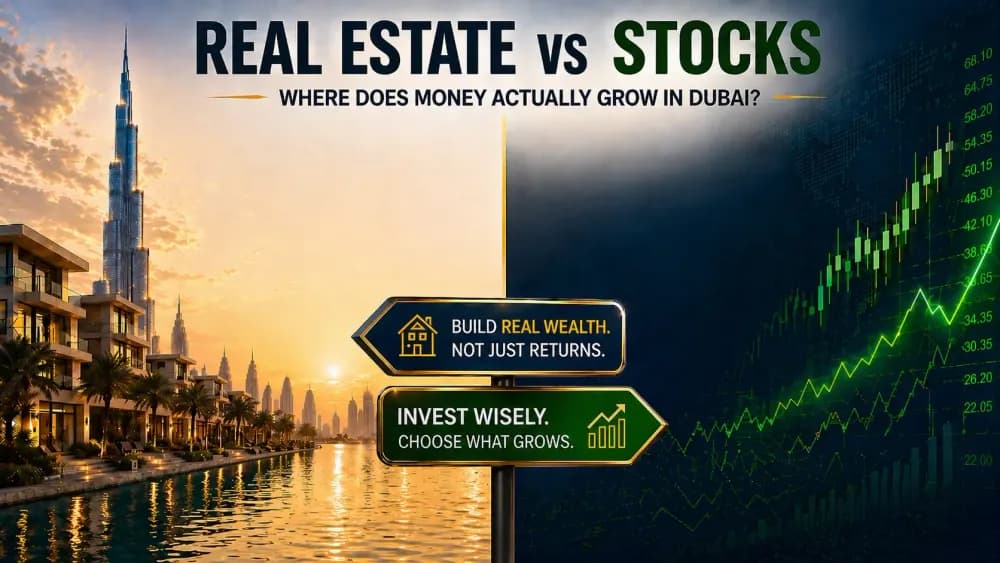
Every serious investor hits this question eventually. Property or the stock market? It gets debated endlessly, and in Dubai, the conversation has some very specific answers that most people never actually get because they're asking generic advisors rather than someone who works in this market every day.
I work with investors across Dubai's primary and secondary markets. The consistent pattern I see is people comparing these two asset classes using the wrong lens focusing on headline returns and missing the structural differences that determine where wealth actually compounds. Here's my honest take.
Real Estate vs Stocks: What Are You Really Investing In?
With stocks, you own a fractional stake in a company. Returns come from price appreciation and dividends. Stocks are liquid - you can sell in seconds on any trading day. That liquidity is also the problem. It makes it easy to react emotionally and emotional decision-making destroys more stock market wealth than any crash ever has.
With real estate, you own a physical asset that pays you rent. You can't panic-sell it on a bad Tuesday morning, which is a bigger psychological advantage than most investors give it credit for. There's also leverage: put AED 500,000 down on a AED 2 million property and your returns are calculated on the full AED 2 million. Stocks on margin carry margin call risk that can force an exit at exactly the wrong moment. A mortgage doesn't work that way.
Both are legitimate. The question is which fits your situation
Dubai Rental Yields vs Stock Dividends: The Income Gap Investors Ignore
Most investors focus on price appreciation and ignore recurring income. That's where they lose the plot.
Blue-chip dividend stocks globally yield 2–4%. The S&P 500's average dividend yield runs around 1.3–1.5%. Fine for a diversified portfolio, not a compelling income story.
Dubai rental yields are in a different bracket. Across the city, gross yields average 6–8%, with pockets like JVC and Business Bay pushing 7–9% on apartments. Even villa communities where the capital growth has been sharpest still yield 5–6.5%.
Simply put, a AED 2 million Dubai apartment at 7% gross rental yield earns AED 140,000 in income before expenses, annually. Alternately, the same AED 2 million in equities at 1.5% dividend yield earns AED 30,000. And that gap gets larger once you remember there's no income tax in Dubai. None.
Stock Market vs Dubai Property: Which Delivered Better Returns Recently?
The S&P 500 delivered 25% total returns in 2024, then around 16% in 2025 which is brilliant by any historical measure. Long-run average sits at 10–11% annually.
Dubai residential property averaged 14% capital appreciation in 2024, on top of those 6–8% rental yields blended returns of 20–22% for well-positioned investors. Villa prices went up by 35.3% year-on-year by Q1 2026. Over 5 years from 2020 to 2025, residential prices were up by roughly 60%.
What’s noteworthy is the fact that the DFM Real Estate Index gained 63% in 2024, then fell sharply in early 2026 when geopolitical news hit. Physical property barely moved. Developer equities and actual bricks don't move together, and most investors never factor that in. DLD transaction volumes reflect real buyer demand. The DFM index reflects sentiment about developer company health. Different animals.
Cushman & Wakefield project another 8–12% growth through 2026, driven by the city's persistent demand-supply gap - over 240,000 new residents arriving each year into an inventory that isn't keeping pace in established communities.
What Makes Dubai One of the Best Real Estate Investment Markets in 2026
There's no capital gains tax. You sell at a profit, you keep it. In most markets, that's a 15–30% exit cost. Here, zero.
The rental income you receive is the rental income you keep. In the UK it's taxed at marginal income tax rates. In Australia, up to 45% for high earners. In Dubai, the number on your bank statement is the number you earned.
A property purchase of AED 2 million or above qualifies for a 10-year UAE Golden Visa. No equity portfolio does that.
Foreign ownership is unrestricted in designated freehold areas - no local partnership required. That's unusual compared to most high-growth markets globally.
And the DLD publishes every transaction publicly, in real time. You can see exactly what a property actually sold for, not just what it was listed at. That level of transactional transparency is genuinely rare in global real estate.
Real Estate vs Stocks: Which Investment Is Right for You?
Stocks make more sense if your goal is to remain liquid, you're working with under AED 500,000, or if you want passive exposure without any asset management involved.
Real estate makes more sense if you have AED 500,000 or more to deploy, want income alongside capital growth, want to use leverage properly, care about tax efficiency, or are thinking about long-term UAE residency.
The investors I see doing best hold both. Equities for liquidity and global diversification, Dubai property for yield, leverage, tax efficiency, and long-term appreciation. They're complementary, not competing.
What I'd push back on is the idea that stocks are simpler. Every investment reward understanding and timing. Dubai property in 2026 is in a structural growth cycle backed by real fundamentals - population, infrastructure, constrained supply in the right areas. The question isn't whether to be invested. It's where to position yourself within the cycle.
If you want to discuss whether the numbers work for your specific situation, lets connect.
Neeha Ali is a Real Estate Advisor at Xperience Realty, specialising in Dubai's primary and secondary markets.
Thinking about your next Dubai property?
Talk to an XRealty specialist — market guidance, shortlists, and honest advice, no obligation.
Related Articles
 Buyer and Seller Guide
Off Plan, Ready, or Half-Built: The Question Most Dubai Buyers Get Wrong
Off plan, ready or half built? Compare Dubai property options, payment plans, risks, returns and timelines to find the right real estate investment.
 NRI Investment
Dubai vs. Singapore Real Estate 2026: Which is the Better Property Bet?
Dubai or Singapore property in 2026? Compare investment returns, rental yields, taxes, market growth and buyer opportunities before deciding where to invest.
 Market Pulse
How the UAE Turns Global Talent into Long-Term Property Demand
Explore how the UAE attracts global talent and converts population growth, career opportunities and long term residency into sustained demand for real estate.