Table of Contents
Dubai’s skyline is famous for transforming sand into soaring towers but now, the city’s developers are transforming how those towers are built. A growing number of major UAE property companies are setting up in-house contracting divisions, marking a strategic shift away from relying solely on third-party contractors.
The goal? Faster timelines, tighter cost control, higher quality standards and increased profit margins all while keeping more of the development process under one roof.
A New Era of Self-Reliance in Construction
Leading the charge is Emaar Properties, the developer behind the Burj Khalifa, which has launched Rukn Mirage under its subsidiary Mirage. This move aligns Emaar with other high-profile names such as Samana Developers, Ellington, and Azizi, all of which have created in-house contracting arms over the past two years.
Arada, co-founded by Saudi Prince Khaled bin Alwaleed bin Talal Al Saud, is also investing heavily in this strategy. In 2024, the company acquired part of an Australian contracting firm, aiming to integrate its operations into the UAE by 2027.
UAE Developers and their contracting arms
| Parent Company | Contracting arm | Contracting arm launched |
|---|---|---|
| Emaar Properties | Rukin Mirage | 2025 |
| Arada | Roberts Co. (New South Wales arm ) | 2027 (estd) |
| Samana Developers | In-house construction arm | 2024 |
| Aizi Developments | Gardinia Contracting | 2023 |
| Ellington Properties | Dutco Ellington joint venture | 2023 |
| Sobha Group | Sobha Constructions | 2016 |
Why Now? The Market Pressures Driving the Shift
Dubai’s real estate market is in a powerful growth phase:
- Property prices have surged by 70% in the four years to December 2024.
- The Dubai government aims to double the population to 7.8 million by 2040.
- Property launches jumped 83% in 2024, but completions fell 23%, creating delivery gaps.
These figures have increased pressure on developers to ensure timely completions. At the same time, competition for skilled third-party contractors has intensified.
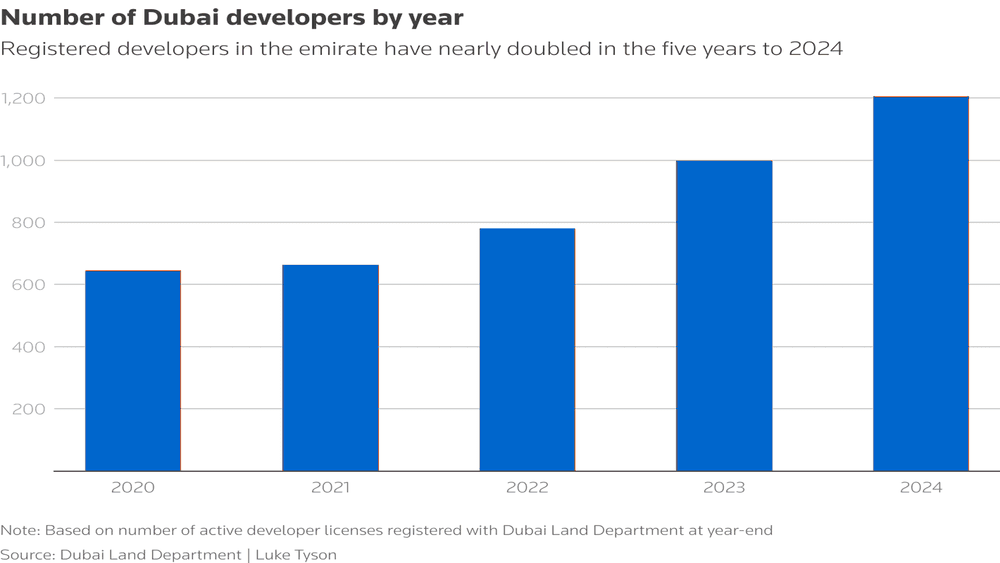
Developers have been struggling to attract bids from outside contractors, amid stiff competition.
Samana Developers, for instance originally planned to allocate just 20% of projects to its new in-house contracting team when it launched in September. Today, 80–90% of its pipeline is handled internally.
Emaar’s Hybrid Approach
Emaar, meanwhile, is taking a hybrid approach. While some projects — such as a recently announced residential development — will be executed by their in-house construction arm Rukn Mirage, they will continue to outsource others, founder and Managing Director Mohamed Alabbar said.
This flexibility allows developers to balance the benefits of in house control with the scalability of third party support.
Financial Incentives and Cash Flow Management
In Dubai, billions of dirhams from property buyers are held in escrow until after final inspections, with developers granted a one-year delivery grace period before buyers can seek refunds. Completing projects on time unlocks vital cash flow for shareholder returns, debt repayments and future expansion.
Delays can be costly in March 2024, a Dubai court ordered a developer to repay AED 12.4 million plus interest over an undelivered floating villa.
Risks of Going In-House
While owning the full pipeline offers control, it also increases operational complexity. Developers must now handle:
- Land acquisition
- Sales and marketing
- Procurement and site logistics
- Health and safety compliance
- Subcontractor management Industry experts warn that this could overstretch resources. In a market downturn, developers could face idle construction teams, unused machinery and costly fixed assets.
Impact on the Wider Construction Industry
As developers bring more work in-house, independent contractors may pivot towards sectors such as government infrastructure, manufacturing, and oil & gas to maintain volumes.
This reshaping of the construction ecosystem reflects a broader trend towards self-reliance in the UAE’s strategic industries, aligning with national growth plans.
Final Takeaway
By controlling the entire process — from land acquisition to final handover — developers hope to deliver faster, more efficiently, and with greater profitability. However, balancing these ambitions with market realities will be critical in sustaining growth in Dubai’s dynamic real estate market.
Thinking about your next Dubai property?
Talk to an XRealty specialist — market guidance, shortlists, and honest advice, no obligation.
Frequently Asked Questions
To speed up delivery, control costs, improve quality, and boost profits without relying solely on third parties.
Emaar (Rukn Mirage), Samana, Ellington, Azizi, and Arada are among those managing most projects internally.
Rising property prices, population growth targets, a delivery gap, and competition for skilled contractors.
Higher operational complexity, fixed costs during slowdowns, and resource management challenges.
Related Articles
 Lifestyle and Community
Yas Island Abu Dhabi: The Complete Guide to Lifestyle, Property and Investment (2026)
Explore Yas Island, Abu Dhabi: top communities like Water's Edge, Mayan, Noya and Yas Acres, plus rents, schools, attractions and Golden Visa tips.
 Invest In Dubai
Where to Buy in Dubai in 2026: Five Areas for Different Buyer Priorities
A practical guide to five Dubai locations for end users, long term growth buyers and income focused investors.
 Market News
One Visa, Six Gulf Countries: What the GCC Grand Tours Visa Could Mean for Dubai Property
Explore how the planned GCC Grand Tours Visa could influence Dubai tourism, holiday homes and property demand—and what remains unconfirmed.