Dubai Holding Becomes Emaar's Largest Shareholder

Table of Contents
ICD has handed its entire Emaar stake to Dubai Holding. This is not a routine intra government share transfer. It is the clearest commitment the city has ever made to the long term value of its real estate, and it changes what owning an Emaar address actually means.
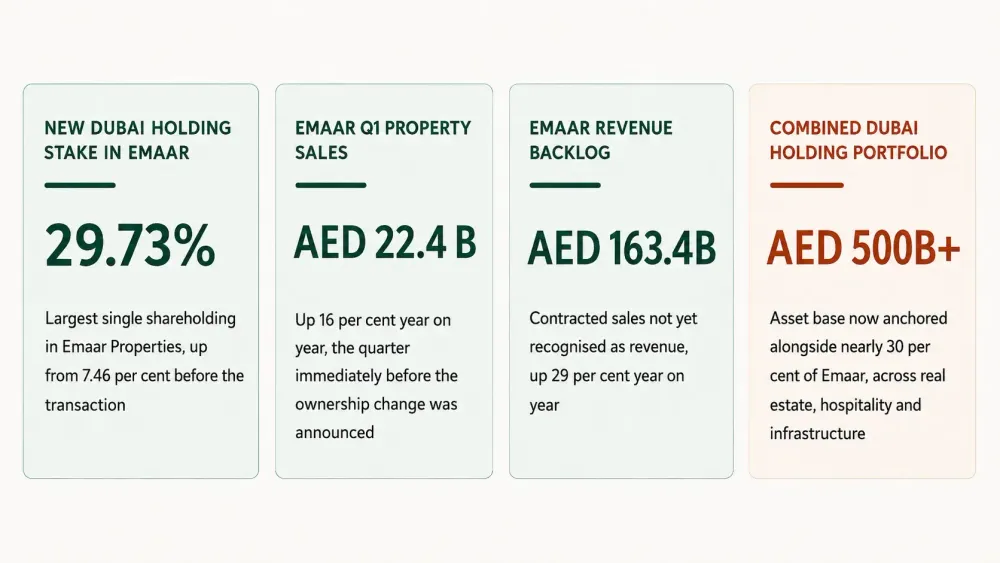
On the 12th of May, ICD transferred its 22.27% stake in Emaar Properties to Emirates Power Investment, a wholly owned subsidiary of Dubai Holding. ICD now holds zero. Combined with what Dubai Holding already owned, the group now sits on 29.73 per cent of Emaar, making it the single largest shareholder in the company that built Burj Khalifa, Downtown, Dubai Marina, Arabian Ranches, Dubai Hills, Dubai Creek Harbour and Emaar Beachfront. Most readers will note the percentage and move on. The detail that mattered to me more than the percentage was the route the stake took. It did not go to a passive sovereign fund or a financial holding company. It went directly into Dubai Holding's real-estate- and-infrastructure operating arm. That is a deliberate choice, and it tells you exactly how this stake is going to be used.
What Dubai has actually set in motion
Start with what this is not. It is not a merger. Emaar remains listed on the Dubai Financial Market. Mohamed Alabbar's operating role does not change. The Emaar brand stays exactly where it was. What has changed is who sits at the top of the shareholder register, and that change is the most important governance move the city's real estate sector has seen in over a decade.
The relationship behind it has been building for years. Dubai Hills Estate was originally a joint venture between Emaar and Meraas, which sits inside Dubai Holding. Dubai Creek Harbour was a joint venture between Emaar and Dubai Holding, until Emaar bought out the Dubai Holding stake in 2022 in a deal partly paid in Emaar shares. That was the transaction that first put Dubai Holding on Emaar's cap table. This week's transfer takes it from second largest shareholder to first, and signals that the relationship is now structural rather than transactional.
Pull back from the percentage and the picture gets bigger. Dubai Holding's wider portfolio sits at over AED 500 billion in assets. Nakheel, Meraas, Jumeirah, the Madinat Jumeirah holdings, the Bvlgari Resort, the Coca Cola Arena, the Dubai Properties land bank. Stack that against nearly 30 per cent of Emaar and you have the largest concentration of master developer real estate, hospitality and land bank in the city sitting under a single coordinating shareholder. That is not a balance-sheet observation. That is the city telling the market exactly where it is putting its weight for the next decade.
Two of Dubai's three biggest real estate platforms are now answering to the same anchor shareholder. The investment case for the city has just been reinforced at the structural level, not the marketing level.
Why this strengthens Emaar inventory
Most of the early commentary on this deal will focus on the share price, the governance and the financial implications for Emaar shareholders. Useful, but it is not the part I would lead with if you are buying or holding an Emaar address. The wave that matters more to your decision is what happens to the development pipeline, and the answer is straightforward. It gets stronger.
-
The first reinforcement is land. Emaar already runs the largest privately listed land bank in the city, around 600 million square feet of mixed-use development potential. Dubai Holding sits on its own substantial land bank through Nakheel, Meraas and Dubai Properties. Until this week those land banks were managed independently. With Dubai Holding now the largest shareholder in Emaar, the two are inside the same strategic conversation. Future master plans, district phasing, infrastructure sequencing and product mix can now be coordinated in a way that was structurally impossible when ICD held the Emaar stake passively from above. Emaar's existing master communities sit on the cleanest side of that change.
-
The second reinforcement is capital discipline. Emaar in Q1 reported AED 22.4 billion of property sales, AED 12.4 billion of revenue and a 35 per cent jump in profit to around AED 5 billion. Property sales up 16 per cent year on year, revenue backlog up 29 per cent. The buyer behind those numbers is not the buyer of two years ago, and the anchor shareholder behind those numbers is no longer the buyer of two years ago either. A larger, longer-tenor, government aligned anchor shareholder means longer cycle thinking on launches, more measured supply discipline, and tighter integration with city level infrastructure. That is how master community pricing holds up over time and it is the structural reason holding through this cycle has become easier to justify, not harder.
-
The third reinforcement is trust. Branded, listed, well capitalised developers have always commanded a premium. Emaar already had that premium. With Dubai Holding as anchor, the line between Emaar inventory and the city's strategic real estate platform tightens. A buyer in Mumbai, London or Riyadh evaluating an Emaar address is now buying into a developer whose largest shareholder is the same institution holding 14.8 per cent of Emirates NBD, full ownership of Jumeirah, and stakes across the city's hospitality and entertainment infrastructure. That is a different category of comfort and it is the kind of comfort that converts watchful overseas buyers into active ones.
The strategic layer underneath
This transaction did not appear in isolation. Dubai Holding's joint venture with Aldar, signed in 2023 and expanded in 2026. The 14.8 per cent stake in Emirates NBD taken in 2023. The Palantir joint venture announced in November. The PropTech and tokenisation programme being run out of DLD. The Real Estate Sector Strategy 2033. The D33 Economic Agenda. Each was treated as a separate story when it landed. Together they form one of the most coherent strategic builds any major city has executed this decade, and Dubai Holding is the central node of it. This week's transaction confirms that the listed developer market is now part of the same architecture.
That is the bit institutional and overseas capital responds to most strongly. The investment case for Dubai real estate has been clear for years. Yields, no income tax, dirham peg, residency through property, deep international schools, world class infrastructure. All of that is still in place. What has just been added is the coordination layer above the listed developers themselves, and it has been added at exactly the moment Emaar is posting record numbers.
The Emaar product has not changed. What has changed is the room it gets discussed in, and who else is at the table when the next master plan gets drawn. That is unambiguously positive for anyone already holding.
What this means for the overseas buyer
-
A lot of the buyers I work with are based outside the UAE. India, Pakistan, the UK, Europe, sometimes further. The questions that came in within hours of this announcement were predictable. Is Emaar still Emaar. Does Alabbar still run it. Should I buy into Emaar inventory now, or wait. Are off plan payment plans going to change. None of these are unreasonable questions. They are exactly the questions an ownership change of this size raises.
-
The operating reality is unchanged. Same developer, same brand, same escrow rules, same DLD registration, same product. What has changed is the broader logic of the platform, and it has changed in the buyer's favour. Emaar is now structurally aligned with the largest non-listed real estate operator in the city. Over the coming cycle, that means better integration with surrounding infrastructure, more disciplined launches, tighter coordination with the city's wider planning agenda, and a developer whose long-term horizon is now structurally protected. That does not show up in the next launch. It shows up over five to seven years, and it shows up in the resale market before it shows up anywhere else.
-
There is a second effect worth flagging, and it is the one that should matter most to overseas buyers. The dominant shareholder of one of the most internationally watched developers in the region is now a Dubai government-aligned holding company with explicit long term horizons. For overseas buyers who have spent years asking whether Dubai's growth story has the institutional backing to keep going, this transaction is the clearest answer the city has produced. The answer is yes, and the answer is in writing, on the Dubai Financial Market, in the form of a 29.73 per cent shareholding.
How this should change your buying logic
-
Emaar inventory just got stronger. Treat it accordingly. With a 29.73 per cent anchor shareholder thinking in decades rather than quarters, the strategic patience behind Emaar's master communities is structurally reinforced. Holding through cycles has just become materially easier to justify, and entry into the platform has just become materially safer. This is the kind of governance shift that quietly tightens spreads and supports prices on the resale side over the medium term.
-
The premium for branded master community inventory is going to widen. Pricing transparency is already tightening through DLD's open data programme. Layer in a more coordinated land bank, more measured launch discipline, and a clearer link between developer and city planning, and the gap between branded master community inventory and fragmented off-plan supply widens rather than closes. Buyers waiting on the sidelines for the gap to narrow are waiting on the wrong move.
-
Read this alongside everything else moving in parallel. The Dubai Holding stake in Emirates NBD. The Aldar joint venture. The Palantir partnership. The DLD tokenisation programme. The 9,800 millionaires who landed in the UAE last year. Q1 city wide transaction volume of AED 252 billion. These are not separate stories. Dubai is being engineered as the default city for serious capital, and the listed developer market is now part of that architecture. This week's transfer is the loudest signal yet that the consolidation is real, and it is the kind of signal serious investors do not get to act on twice.
The bigger signal
This single transaction is one event. Read it next to the rest and the picture is unambiguous. Emaar at AED 22.4 billion of quarterly sales and AED 163.4 billion of backlog. Dubai Holding at over AED 500 billion of assets and now anchor shareholder of the city's biggest developer. The Aldar joint venture. The Emirates NBD stake. The Palantir relationship. The DLD tokenisation pipeline. Q1 city wide transactions up 31 per cent year on year. Dubai is no longer being compared to the markets it used to be compared with. The cap tables of its strategic assets are being aligned with the same care normally reserved for sovereign wealth allocation, and the listed developer market has just joined them.
The right move is not to rush into Emaar inventory because the shareholder register has changed. The right move is to recognise that the city has just sent its strongest institutional signal yet about where this market is going, and to position accordingly. Investors who read these maps early hold the better assets when the cycle matures. The ones who wait until the news is comfortable always arrive after the move.
If you are sitting on Emaar property today, the position has just been strengthened. If you are evaluating an entry, the window is open and the institutional case for moving has just become harder to argue against. The conversations I am having with serious investors, both end users and overseas buyers, have shifted noticeably in the days since the announcement. The hesitation is gone. The question is no longer whether to participate in this market. It is which part of it to anchor in.
The headline this month was a share transfer. The longer story is that Dubai just put 29.73 per cent of its biggest developer inside the same strategic vehicle running the rest of its real estate, hospitality and infrastructure footprint. That is the strongest commitment this city has ever made to the long-term value of property, and it is the signal serious capital has been waiting for.