
Is Dubai Real Estate in a Bubble? The 2026 Dispersion Cycle Explained

Table of Contents
Why the bubble question misses what is actually happening in Dubai 2026, and how to tell the difference between assets that will hold their price and assets that were never really earning it.
Key Takeaways
-
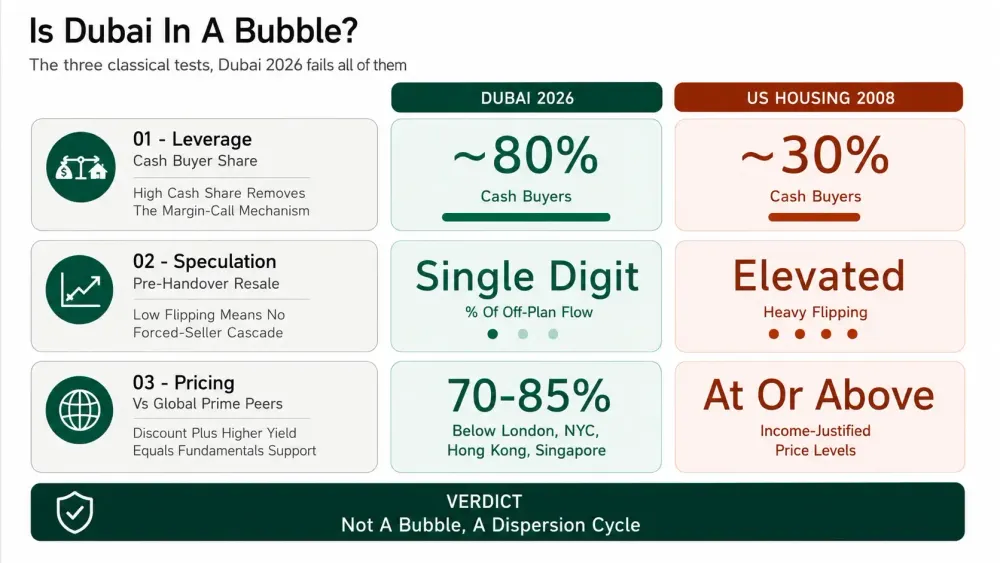
Dubai is not in a bubble in 2026 by the three classical bubble indicators: leverage concentration is low, speculative positioning has collapsed, and pricing remains 70 to 85 percent below comparable global prime markets.
-
The market has entered a dispersion cycle where Knight Frank projects approximately 3 percent prime growth versus 1 percent mainstream for 2026.
-
Cash buyers represent close to 80 percent of Dubai transactions, against approximately 30 percent in 2008, removing the margin-call mechanism that drives genuine bubble collapses.
-
Q3 2025 data showed villa prices up 12 percent year on year while specific mid tier rental segments saw decreases up to 13 percent, illustrating the bimodal market structure.
-
Asset selection, segment positioning, and developer credibility now matter more than market timing as the dispersion cycle widens.
1. The bubble question is badly framed
Every cycle produces the same question, and it has arrived again in Dubai. Is Dubai in a bubble? It sounds rigorous. It is actually a category error.
Markets do not fail uniformly. They fail selectively. The 2008 US housing collapse was not, in the end, a story about housing prices. It was a story about subprime originated mortgage backed securities concentrated in specific geographies, with specific loan-to-value profiles, held by specific counterparties. I spent four years at Accenture modelling the US residential mortgage book through the post-2008 recovery period. The defining feature of that cycle was that asset level selection explained most of the variance in outcomes. Borrowers in Texas with 30 year fixed rate conventional loans came through fine. Borrowers in Nevada with option ARMs on 2006 vintage originations did not. The same market produced completely different results depending on what you owned.
Dubai 2026 is the same analytical situation. "Is the market in a bubble" implies the market is a monolithic thing. It is not. The better framing: which assets are being priced as if they aren't in a bubble, when they structurally should be? And which assets are being priced as if they are, when structurally they are not?
2. This is a dispersion cycle, not a bubble
From 2021 to 2024, Dubai was a beta driven market. Prices moved together. Asset selection mattered less than timing. Knight Frank's tracking shows roughly 78% cumulative price appreciation across this third freehold cycle, relatively uniform across apartment and villa segments through the early phase.
That phase has ended. The market has now entered a dispersion cycle, where returns diverge sharply based on asset quality. Knight Frank's Faisal Durrani has projected approximately 3% growth in prime against approximately 1% in mainstream for 2026, a 3x spread within the same city. Knight Frank's Shehzad Jamal used explicit language in the Q4 2025 review about a two speed market emerging where prime locations outperform even as price growth normalizes in the mid market.
The Q3 2025 data already shows this mechanically. Knight Frank reported villa prices up 12% year on year, apartments up less. La Mer recorded the steepest individual price increase, with quarterly gains of 33.8% and yearly gains of 54.7%. Inside mid-tier, Bayut's 2025 data showed rental decreases of up to 13% in specific bed type configurations in mid tier villa communities like Al Furjan, JVC, and Arabian Ranches 3. In a beta market the question was when. In a dispersion cycle, the question is what. The market has stopped rewarding participation and started rewarding precision.
3. Why the bubble narrative is partially right
The bubble narrative responds to three visible signals. Rapid price appreciation, the 78% cumulative rise from 2020 to 2025 is genuine. Off-plan dominance, with Knight Frank and Cushman & Wakefield both putting off-plan share around 60-65% of 2025 transaction value. And retail participation, first-time investors are visible, mortgage-financed purchases have roughly doubled in four years per Knight Frank.
Where the bubble narrative goes wrong, and where my mortgage background makes me confident, is the diagnostic. What defines a bubble analytically is not price appreciation. It is three specific conditions: high leverage concentration, short-term speculative positioning dominating the buyer base, and pricing that cannot be justified by reasonable models of cash flows or scarcity. Dubai 2026 fails on all three.
4. Supply elasticity and demand rigidity
The core insight most Dubai commentary skips is that the market is not a single supply demand curve. It is multiple curves operating in parallel, with very different elasticities.
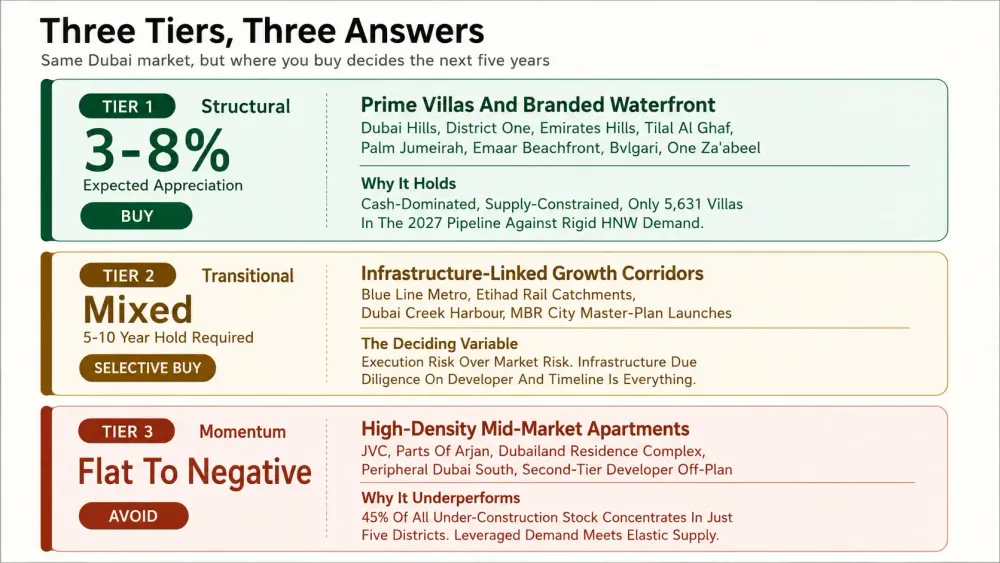
Prime villa stock in Dubai Hills Estate, Emirates Hills, District One, and Tilal Al Ghaf has low supply elasticity. Only 15,284 villas scheduled for 2026 against 99,686 apartments, with the 2027 villa pipeline tighter at 5,631. Combined with high demand rigidity, cash buyers, family end-users, HNW migration flows that do not reverse on quarterly sentiment. Low supply plus rigid demand equals structural price support.
Mid market apartment stock in JVC, Dubai South, Al Furjan, and parts of Business Bay has the opposite profile. Cushman & Wakefield indicates around 45% of all under-construction stock concentrates in just five districts: JVC and JVT, Dubai South, MBR City, Business Bay, and Dubailand Residence Complex. Demand rigidity is low because the buyer base is more leveraged and yield sensitive.
This asymmetry is why the same external shock through March 2026 produced villa prices up 16% year-on year while apartment prices were down 3% per Goldman's data. The two segments have fundamentally different economic structures, and they are being priced accordingly. Asking whether Dubai is in a bubble is like asking whether equities are in a bubble. The right question is which equities, at which prices.
5. The tier framework
For practical portfolio construction I use a three-tier map.
6. Off-plan risk, read correctly
Off-plan's 60-65% market share triggers the bubble reflex. It should not. Off-plan in Dubai is not a speculative structure; it is a financing structure. Developers function as distributed credit providers offering 5-20% down, 3-7 year payment plans, and no reliance on bank underwriting. This removes the credit gate that blocks international buyers in most other global markets.
But off-plan amplifies whatever risk is already embedded in the underlying asset. Four variables determine whether off-plan in Dubai is a sound allocation or a trap. Developer credibility, the difference between an Emaar, Nakheel, Sobha, or Aldar payment plan and a second-tier plan is the difference between holding a pseudo-corporate bond and an option on execution by a counterparty whose ability to deliver is uncertain. Location quality, a payment plan does not protect against a bad location, it amplifies the exposure. Supply concentration in the surrounding cluster, JVC off-plan at current pipeline levels is structurally different from Dubai Creek Harbour off-plan. Exit liquidity profile, some off-plan trades actively in the secondary market before handover, some does not.
The rigorous way to underwrite off-plan today is the way a credit analyst underwrites a corporate bond: balance sheet, track record, structural protection, exit. Not the way a retail buyer underwrites a property: do I like the floor plan.
7. The bear case, engaged honestly
Three institutional bear cases deserve direct engagement. Fitch (May 2025): up to 15% correction in 2H 2025 through 2026, driven by approximately 210,000 units of supply. Moody's (March 2026): moderate correction beginning late 2026 driven by projected supply increase, but Moody's notes Dubai's actual completion rate runs well below planned supply, which would bring real 2026 handovers significantly below the registered pipeline. Citi (March 2026): tail-risk scenario requiring population growth to collapse from 4% to 1%.
Each has merit. None supports the bubble thesis. Fitch is explicit that this is normalisation after a strong cycle, not a systemic event. Moody's completion benchmark is more conservative than Fitch's implicit assumption and is the more accurate historical prior. Knight Frank's Q4 2025 review confirmed 2025 deliveries hit 64% of planned (39,700 of around 62,000 units), still leaving most announced pipeline figures overstated. Citi's tail-risk requires a reversal with no observable precedent in the data.
Where I part company is on the uniformity of the impact. Fitch, Moody's, and Citi all present forecasts as market-level numbers. The actual experience of holders will be bimodal. Tier 1 holders will experience mild to positive performance. Tier 3 holders will experience material compression. The market average will hide this.
8. The market will not correct, it will separate
Dubai 2026 is not heading toward a broad correction. It is heading toward a separation between assets that justify their price and assets that do not. In the last cycle, participation was rewarded. In this cycle, precision is rewarded. The spread between a good decision and a mediocre one has widened, and the spread between a good decision and a bad one is now large enough to define portfolio-level outcomes for the next five to ten years.
If you are asking whether Dubai is in a bubble, you are thinking at the market level. The better question is which assets are priced as if they are not in one, and which are priced as if they never will be. Both dislocations exist. The buyers who can see the difference will do well. The buyers who cannot will find themselves averaging into the wrong side of the distribution. That is what a dispersion cycle does. And that is the cycle we are in.
Frequently Asked Questions
No. Dubai 2026 fails all three classical bubble indicators: cash buyers represent close to 80 percent of transactions removing leverage-driven fragility, speculative pre-handover assignment activity is at single-digit percentages of off-plan flow, and prime pricing remains 70 to 85 percent below comparable global markets.
A market-wide crash is unlikely. Specific mid-market apartment clusters in JVC, peripheral Dubai South, and Dubailand may see 5 to 10 percent corrections per Fitch and Cushman & Wakefield analysis. Tier-1 prime villa stock and branded residences are projected to continue appreciating.
A dispersion cycle is a market phase where returns diverge sharply across segments based on structural quality. Beta cycles reward broad market participation; dispersion cycles reward precise asset selection. Dubai entered its dispersion phase in 2025 as the supply pipeline became more concentrated.
Cushman & Wakefield identified five districts where 45 percent of under-construction stock is concentrated: JVC and JVT, Dubai South, MBR City, Business Bay, and Dubailand Residence Complex. Mid-market apartment product in these clusters faces the most direct supply pressure.
Knight Frank's data points to three structurally undersupplied segments: prime villa stock in established communities (Dubai Hills Estate, District One, Tilal Al Ghaf), prime waterfront (Palm Jumeirah, Emaar Beachfront), and branded residences (Bvlgari, One Za'abeel, Dorchester).
Read More

Bvlgari, One Za'abeel, Dorchester - Why Dubai Is Becoming the Global Capital of Branded Living

JP Morgan's $20 Billion Gulf Bet: What It Means for Dubai Property Investors
Dubai Property Replacement Cost 2026: Why Today's Prices Are Tomorrow's Floor